Modi’s DD Speech Sparks Legal Storm: Congress Leader Moves Supreme Court Over MCC Violation
(By Syed Ali Taher Abedi)
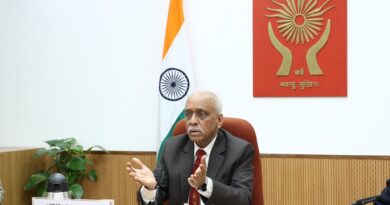
New Delhi: 22, April,2026-In a significant legal challenge to the use of state-run media during elections, Congress leader and former Member of Parliament TN Prathapan has approached the Supreme Court, contesting the televised address delivered by Prime Minister Narendra Modi on public broadcaster Door Darshan on April 18, 2026.
“The broadcast constituted a misuse of state machinery and official media for electoral gain, targeted at specific opposition political parties by name, and was delivered without any sanction, authority, or justification under the Constitution or any law. The Petitioner contends that such inaction on the part of the ECI is arbitrary, unconstitutional, and constitutes an abdication of its solemn constitutional mandate”
The 30-minute speech, aired shortly after pivotal political developments surrounding the “Nari Shakti Vandan” initiative, saw the Prime Minister directly naming and criticizing opposition parties including the Indian National Congress, Trinamool Congress (TMC), Dravida Munnetra Kazhagam (DMK), and Samajwadi Party.
“The address delivered by the Prime Minister was overtly partisan in both tone and substance. In the course of the broadcast, he expressly named and criticised opposition parties, including the Indian National Congress, the Trinamool Congress (TMC), the Dravida Munnetra Kazhagam (DMK), and the Samajwadi Party, attributing to them opposition to the Nari Shakti Vandan amendment and calling upon the electorate to hold them accountable at the ballot box. The address was delivered in the midst of an ongoing election cycle and was clearly designed to influence electoral outcomes by promoting the prospects of the ruling party while prejudicing those of its political opponents.”
He accused them of obstructing measures for women’s empowerment and urged voters to hold them accountable at the ballot box.
Prathapan’s petition contends that the broadcast constitutes a blatant misuse of government-controlled television channels to target opposition parties during an active election period, in direct violation of the Model Code of Conduct (MCC). Door Darshan and Sansad TV, fully funded by public exchequer and operating under ministerial oversight, were leveraged to air what the plea describes as partisan political rhetoric, amounting to a “corrupt practice” under Section 123(7) of the Representation of the People Act, 1951. This provision prohibits the misuse of official machinery for electoral gain.
“The cumulative effect of these facts renders the broadcast a clear and egregious instance of the misuse of official machinery and state-funded media for partisan electoral purposes, in direct violation of Section VII (4) of the Model Code of Conduct. Furthermore, the use of official governmental resources and institutional apparatus by the Prime Minister who is also the principal campaigner of the ruling party for the advancement of the electoral interests of the ruling party and to the detriment of opposition parties, squarely attracts the prohibition contained in Section 123 (7) of the Representation of the People Act, 1951, and constitutes a “corrupt practice” within the meaning thereof.”
The plea underscores that the address occurred while the MCC was in force for the ongoing Kerala Assembly elections, barring the use of public resources for partisan advantage.
“Furthermore, the use of official governmental resources and institutional apparatus by the Prime Minister—who is also the principal campaigner of the ruling party—for the advancement of the electoral interests of the ruling party and to the detriment of opposition parties, squarely attracts the prohibition contained in Section 123 (7) of the Representation of the People Act, 1951, and constitutes a “corrupt practice” within the meaning thereof.”
Despite Prathapan’s formal representation to the Election Commission of India (ECI) highlighting the infraction, no action was taken a lapse the petition argues undermines the Commission’s constitutional mandate under Article 324 to ensure free and fair polls.
Backdrop: Defeat of Women’s Reservation-Linked Bills in Lok Sabha
The controversy traces back to the Lok Sabha’s rejection of the Constitution (131st Amendment) Bill, which sought to expand the House from 543 to 850 seats, alongside two ancillary legislations the Delimitation Bill, 2026, and the Union Territories Laws (Amendment) Bill, 2026.
“Elections are time-bound processes. The harm caused by the misuse of official media for partisan electioneering cannot be undone after the polls. Voters who watched the Prime Minister’s address on Door Darshan and Sansad TV have already been exposed to its partisan content. Every day of inaction by the ECI compounds this prejudice.
The package aimed to pave the way for one-third reservation for women in Parliament and state assemblies, effective post-delimitation.
The Delimitation Bill proposed constituting a commission to redraw constituencies, allocate seats, and determine reservations based on the 2011 Census.
The UT Amendment Bill addressed consequential changes for Delhi, Puducherry, Jammu & Kashmir, and other territories.
Opposition parties, while endorsing women’s quota in principle, opposed bundling it with delimitation.
They alleged the linkage was a stratagem to bolster the ruling BJP’s northern stronghold by increasing Lok Sabha seats for Hindi-heartland states, using outdated 2011 data to create new constituencies rather than redistributing existing ones.
This, they argued, could skew representation without necessitating a full electoral map overhaul, potentially entrenching the BJP’s dominance.
Lacking the requisite two-thirds majority, the bills fell through.
In his Door Darshan address, Prime Minister Modi termed the defeat “foeticide” against women’s political empowerment, directly indicting the opposition and concluding with a poll-time call to voters.
Petition Seeks ECI Action, Levels ‘Uneven Playing Field’ Charge
Prathapan’s plea asserts the speech tilted the electoral field, granting the ruling dispensation undue advantage via state media while opposition candidates remained shackled by MCC curbs on official resources.
Currently contesting from Manaloor in the Kerala Assembly polls, he has sought Supreme Court directions to the ECI to investigate, act against the violation, and enforce MCC and RPA provisions.
The petition, filed through advocate Suvidha MS, raises broader questions on the boundaries of executive speech, public broadcaster impartiality, and ECI vigilance in a multi-phase national electoral cycle.