Beyond Borders: CJI Surya Kant Warns Only Collaboration Can Stop Organized Cyber Syndicates
(Judicial Quest News Network)
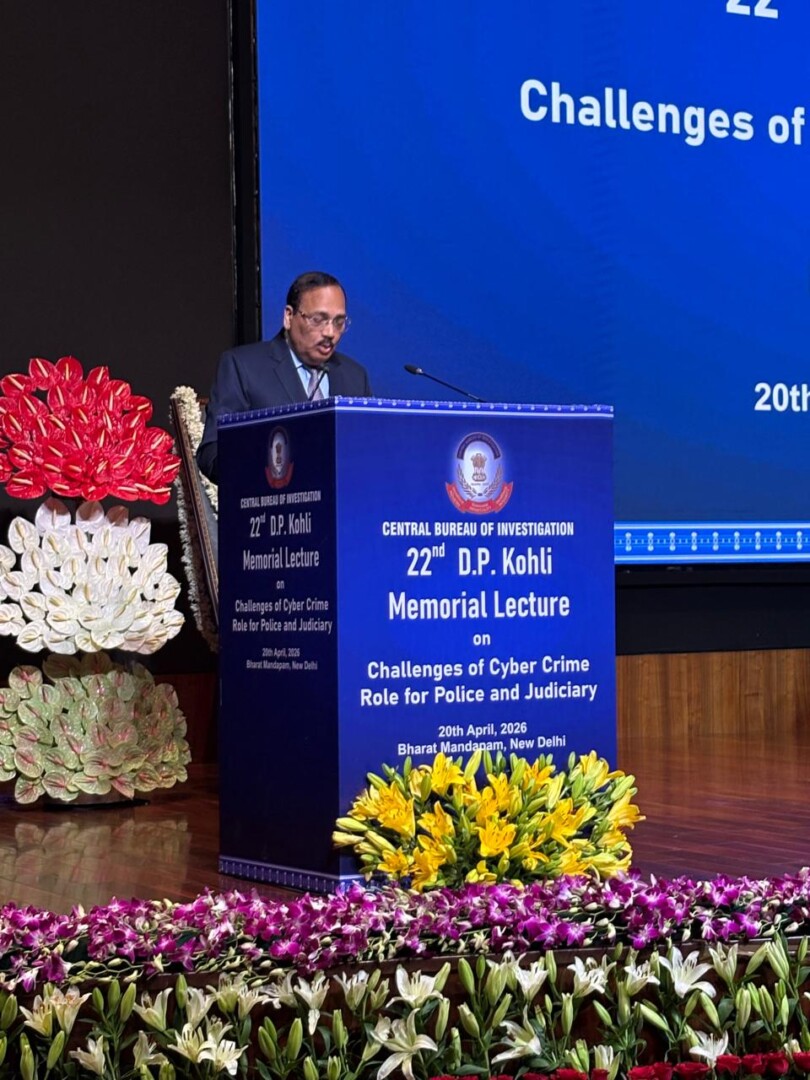
Speaking at the 22nd D.P. Kohli Memorial Lecture organised by the Central Bureau of Investigation, Chief Justice of India Surya Kant delivered a stark assessment of the rapidly evolving threat of cybercrime, emphasising the urgent need for a victim-centric, technology-driven, and collaborative response framework.
“It is therefore imperative that we begin to understand cybercrime not merely as an economic offence, but as a crime against human dignity. It disrupts the sense of agency that individuals have over their own decisions. It converts everyday digital interactions, namely, banking, communication, and even social engagement, into sites of vulnerability. And in an increasingly digital society, this vulnerability is not marginal, but universal.”
Highlighting the human cost of digital fraud, the Chief Justice noted that victims are often retired individuals and senior citizens who lose their life savings accumulated over decades of honest work.
He stressed that cybercrime is not merely a financial offence but one that deeply impacts dignity and agency.
“Between these structural features lies an even more ghastly reality. I am told that a significant number of individuals operating within these networks are not willing participants but trafficked victims themselves who are confined within these cyber scam compounds. Subjected to coercion, surveillance, and often physical intimidation, they are compelled to perpetrate fraud against others, becoming both instruments and victims of an exploitative criminal enterprise.”
“Cyber fraud reveals a deeply unsettling reality,” he observed, pointing out that such crimes are typically preceded by extensive data harvesting. Perpetrators meticulously gather personal information, behavioural patterns, and financial habits before profiling their targets.
“Engage with evolving standards of admissibility, ensuring reliability without imposing impractical burdens. They must also be equipped to address cross-border evidence requests, questions of admissibility of foreign digital material, and the timelines governing international cooperation”
Many victims, he added, remain silent due to embarrassment, hesitation, or social stigma.
“However, this information is not always accessed or shared immediately. When the victim approaches law enforcement, the investigation begins with a conventional approach and more often than not, its fate would depend on inputs from several institutions, each following its own procedures.”
Addressing emerging trends, CJI Kant drew attention to the growing menace of so-called “digital arrests,” where individuals are psychologically coerced into compliance through fabricated claims of legal authority.
These tactics, he said, reflect the sophistication and organised nature of modern cybercrime networks.
He further noted that cybercrime today operates through structured, transnational ecosystems, often linked to scam compounds spread across parts of Southeast Asia.
Alarmingly, many individuals working within these networks are themselves victims of human trafficking, forced into executing fraudulent schemes.
Describing the complexity of enforcement, the Chief Justice explained that a single fraudulent transaction may involve a victim in one country, servers in another, routing through multiple jurisdictions, and operators located elsewhere.
This fragmented structure makes such crimes extremely difficult to trace.
In this context, he called for a fundamental shift in law enforcement strategy from reactive investigation to anticipation, preparedness, and adaptability.
He emphasised the need for capacity building, inter-agency collaboration, and technology-led governance.
CJI Kant also underlined the limitations of traditional jurisdictional frameworks in addressing cyber offences. “The application of existing laws creates profound challenges,” he said, noting that both enforcement agencies and the judiciary face conceptual and procedural hurdles.
Key legal questions arise in such cases which legal framework applies, which agency has jurisdiction, and how digital evidence can be lawfully accessed and preserved.
The Chief Justice pointed out that the admissibility of digital evidence depends heavily on metadata, chain of custody, and technical validation, requiring courts to adapt to evolving standards—especially in cases involving foreign digital material and international cooperation timelines.
He also highlighted systemic inefficiencies in responding to cyber fraud. Often, by the time a victim approaches authorities, the stolen funds have already been fragmented and routed through multiple accounts.
Meanwhile, banks process fraudulent transactions as routine, telecom networks hold crucial communication data, and digital platforms may detect suspicious patterns yet this information is rarely shared in real time.
“Our response remains multi-staged and delayed, while the crime itself is executed with speed and coordination,” he remarked.
The Chief Justice urged courts, particularly those dealing with cyber fraud networks, to adopt a broader perspective when assessing cases such as bail applications.
Instead of focusing solely on individual complaints, they must consider the larger architecture of organised criminal activity.
Calling for a systematic and anticipatory approach, he stressed that tackling cybercrime is a shared responsibility across institutions.
Coordination between law enforcement, financial institutions, telecom providers, and digital platforms is essential.
Commending recent technological initiatives, CJI Kant highlighted the launch of “Abhay,” an AI-based chatbot designed to help individuals verify the authenticity of notices issued by the CBI.
Describing it as a pivotal step toward building public trust and preventing impersonation scams, he emphasised the need for its widespread adoption.
To maximise its impact, he suggested integrating such tools into everyday digital ecosystems potentially as pre-installed applications on mobile devices to ensure accessibility and enhance public utility.