
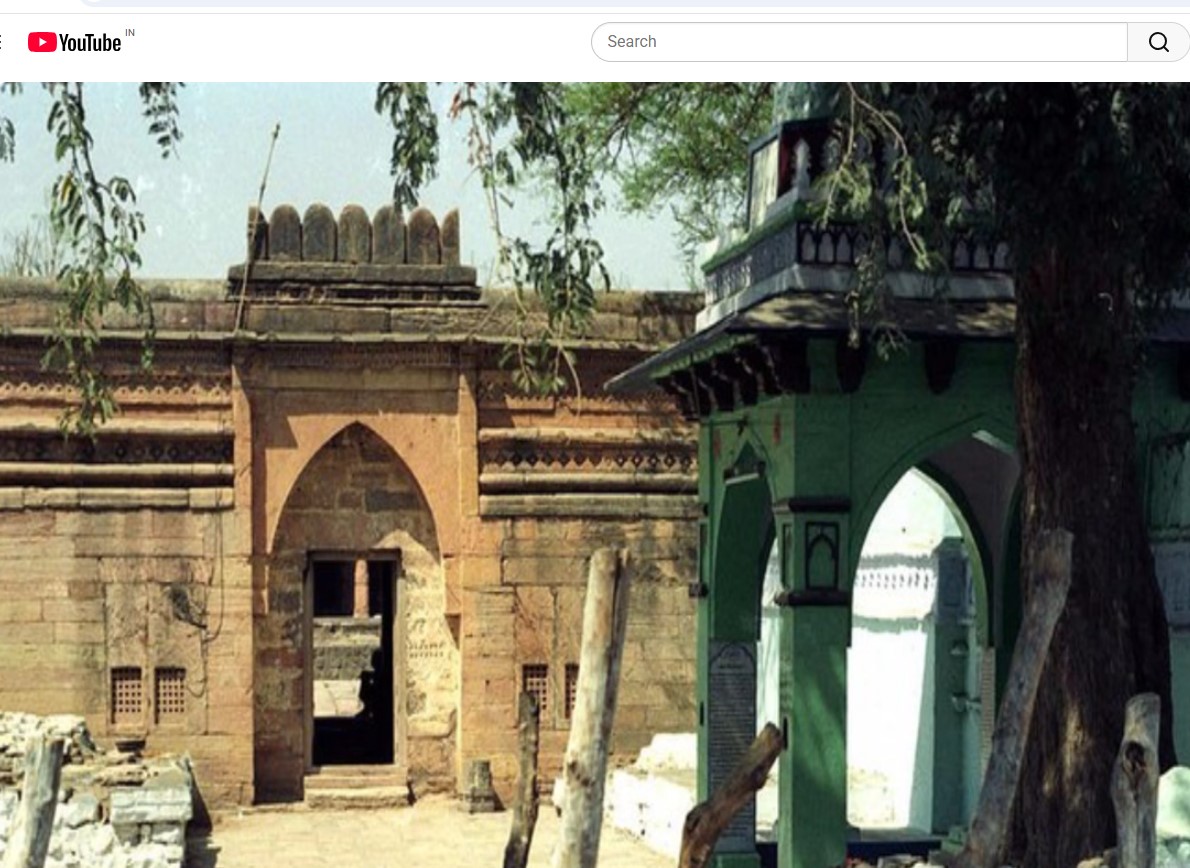
Madhya Pradesh HC Rules Bhojshala-Kamal Maula Mosque Complex Site Is a Temple
(Judicial Quest News Network)
15 May 2026 — In a judgment of profound constitutional and archaeological significance, and one that expressly draws upon the legal reasoning affirmed by the Supreme Court in the Ayodhya case, the Madhya Pradesh High Court has resolved one of central India’s most contentious and long-standing religious disputes.
Delivered by the Indore Bench on Friday, 15 May, the verdict addresses a question that has remained contested for decades through archaeology, history, litigation, and lived religious practice: what is the true religious character of the structure standing at Bhojshala in Dhar district?
“We have noted the continuity of the Hindu worship at the site, though regulated overtime… we record finding that historical literature of the place establishes as a centre of Sanskrit learning associated with Raja Bhoj….. it indicates the existence of Temple dedicated to Goddess Saraswati at Dhar…. Therefore, the religious character of the area is held to be Bhojshala with Temple of Goddess Vagdevi Sarasvati.”
The Court’s answer is categorical. It is a temple.
Bench and ruling
A division bench comprising Justice Vijay Kumar Shukla and Justice Alok Awasthi delivered the landmark ruling in Hindu Front for Justice v. Union of India, Ministry of Culture, holding that the Bhojshala–Kamal Maula Mosque complex in Dhar district is, in its essential religious character, a Hindu temple.
The Court also quashed the order that had permitted Muslims to offer prayers at the site. In a direction certain to invite sustained legal and political scrutiny, the Court further observed that Muslims may apply for alternative land for the construction of a mosque.
The ruling brings to a close, at least at this stage, a prolonged litigation history rooted not merely in competing religious claims, but in the layered and contested archaeology of a structure that has at different points in Indian history been associated with Sanskrit learning, colonial documentation, and sharply divided communal worship.
Core finding of the Court
The heart of the judgment lies in the principle that has increasingly guided Indian courts in disputes of this nature after Ayodhya the decisive issue is not simply who has worshipped at the site in recent decades, but what the original and enduring religious character of the structure is.
The Court held that the disputed area of the Bhojshala complex and the Kamal Maula Mosque together constitute a protected monument, and that the religious character of the disputed portion is that of a Bhojshala with a temple dedicated to the goddess.
It recorded findings that historical literature establishes the site as a centre of Sanskrit learning, while archaeological references support the existence of a temple dedicated to Goddess Saraswati at the location.
Significantly, the Bench found that Hindu worship at the site had never been fully extinguished across the long span of its history, a conclusion that carries substantial jurisprudential weight in light of the Supreme Court’s reasoning in the Ayodhya judgment.
Archaeological record
A substantial part of the judgment rests on the findings of the Archaeological Survey of India, which conducted a comprehensive survey of the complex pursuant to an earlier High Court order. What the survey revealed, according to the Court, was a structure whose present form conceals a far older architectural history.
The ASI reported that the existing structure was built using parts of earlier temples. It identified decorated pillars and pilasters that, from an art-historical and architectural perspective, had clearly formed part of earlier temple structures and were later reused in the mosque’s colonnades over a high basalt platform.
One pillar, decorated with niches on all four sides, contained mutilated images of deities. Another pillar base also showed a deity image in a niche. Images on two pilasters had been deliberately chopped off and rendered unrecognisable.
This is the language of forensic architecture: a structure whose original identity was not erased by time alone, but altered through physical reuse, modification, and concealment. The ASI’s findings shifted the matter from competing historical claims to documented material evidence.
Petitions before court
The judgment was delivered on a batch of petitions seeking restoration of Hindu worship at the Bhojshala complex and restraint on Muslim prayer within the premises.
These petitions challenged an ASI notification dated 7 April 2003, which had allowed Muslims to offer namaz at the site while restricting Hindu worship in the same premises. One public interest petition, filed by the Hindu Front for Justice, asserted that it was espousing the cause of the Hindu community for enforcement of the right to religion under Article 25 and the right to conserve cultural heritage under Article 29 of the Constitution.
The petitioners also sought reinstallation of the idol of Goddess Saraswati, known as Vagdevi, claiming that it had been established by King Bhoj in 1034 AD and later taken to London by the British after desecration. They further alleged that Muslims were permitted to pray there on the basis of an unlawful claim that Muslim rulers had constructed the Kamal Maula Mosque at the site.
Constitutional reasoning
The Court’s legal reasoning is grounded in a framework that has become central to adjudication of disputed religious sites in India: the interaction between archaeological evidence, constitutional guarantees, and the State’s duties under the Ancient Monuments and Archaeological Sites and Remains Act.
The Court said it considered the archaeological and historical facts, the ASI notifications, and the survey report, and reached its conclusion by applying the precedent set in the Ayodhya case along with the constitutional protections under Articles 25 and 26.
It also observed that every government has a constitutional obligation to preserve and protect ancient monuments and structures of historical and archaeological importance, including temples, along with the sanctum sanctorum and deities of spiritual significance contained within them.
The Bench further noted the State’s duty to provide basic amenities to pilgrims, maintain law and order, and preserve the purity and pristine character of the deity, observing again that Hindu worship at the site had never been extinguished.
Judicial inspection
One notable procedural feature of the case was a personal site inspection by Justice Vijay Kumar Shukla on 24 March, undertaken before the judgment was delivered.
That visit gave the proceedings a distinctly investigative dimension, unusual in constitutional and civil litigation, but fitting for a dispute in which the physical structure itself functioned as primary evidence.
The inspection appears to have informed the Court’s understanding of the layout, architecture, and religious character of the complex. In a case of this kind, the monument is not merely the subject of the dispute; it is also one of the strongest witnesses.
Orders and consequences
Beyond declaring the site’s religious character, the judgment carries substantial administrative consequences. The Court directed the Government of India and the Archaeological Survey of India to decide on the administration and management of the affairs of the temple, while the ASI will continue to have overall administration and management of the property.
“In order to secure the religious rights of the Muslim community and ensure complete justice between the parties, in case respondents 8 (Maulana Kamal Uddin welfare Society) submits an application for allotment of suitable land within Dhar District for construction of a Mosque or place for prayer, the state may consider said application in accordance with the law for allotment of suitable and permanent part of land in Dhar District to the Muslim Community which may be represented either through respondent no8, intervenors or duly constituted waqf body for construction, administration of mosque and associative religious facilities. Accordingly, WP 1049 of 2022 and WP 10484 of 2022 are allowed and disposed off
As for the Muslim community, the Court held that it may apply for alternative land for the construction of a mosque. Though framed as a possible path forward, that direction is likely to trigger further legal contestation.
Supreme Court backdrop
The dispute has not moved in a straight line through the courts. In May 2024, the Supreme Court declined to stay the ASI survey but directed that its outcome could not be acted upon until further orders.
In January 2026, the Court ordered status quo at the site pending adjudication.
The High Court’s ruling now alters the legal landscape underlying that status quo. The matter is widely expected to return to the Supreme Court, where issues concerning religious character, the Places of Worship (Special Provisions) Act, 1991, and the broader constitutional dimensions of the dispute will likely be examined again.
“Every government has the constitutional obligation to ensure preservation and protection of not only ancient monuments and its Structures including temples and archaeological importance, but also of sanctum sanctorum as well as the deities of spiritual importance
Wider significance
The Bhojshala verdict will be closely watched not only for what it decides about one contested complex in Dhar, but also for what it signals about the evolving jurisprudence of disputed religious sites in post-Ayodhya India.
The Court’s explicit reliance on the Ayodhya precedent, its evidentiary approach, and its constitutional framing place this judgment within a larger national legal conversation.
The stones of Bhojshala, as the Court has effectively held, speak through both archaeology and adjudication. Whether that conclusion survives appellate scrutiny will now be determined at the highest judicial level.

