A Judicial Wake Up Call: CJI Places Arbitration Reform at the Heart of the Indo UK FTA
(By Syed Ali Taher Abedi)
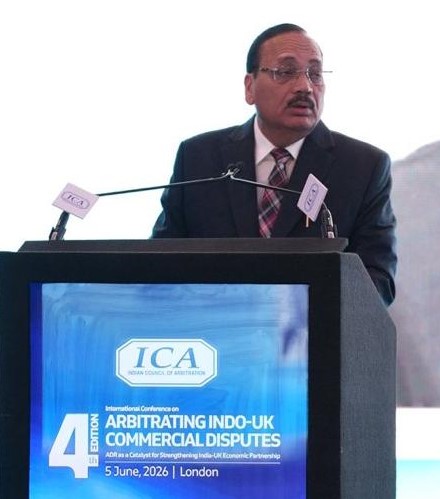
London, June 5: Delivering a powerful and introspective keynote address at the 4th International Conference on Arbitrating Indo-UK Commercial Disputes in London, Chief Justice of India Justice Surya Kant issued a candid critique of the contemporary international arbitration regime, warning that a mechanism originally conceived as an alternative to cumbersome court litigation is increasingly replicating the very defects it was designed to overcome.
The conference, organised by the Indian Council of Arbitration, assumed particular significance in the wake of the recently concluded India–United Kingdom Free Trade Agreement (FTA), a landmark economic accord expected to substantially deepen bilateral commercial engagement. Against this backdrop, Justice Surya Kant underscored the urgent need for a dispute resolution framework capable of supporting the growing volume of cross-border commercial transactions.
Rather than celebrating arbitration’s expanding global footprint, however, the Chief Justice offered a sobering institutional assessment of its present condition.
The Remedy Has Come to Resemble the Disease
In one of the most striking observations of his address, Justice Surya Kant remarked that arbitration, once conceived as a cure for the inefficiencies of traditional litigation, now risks inheriting the same ailments.
“Arbitration was built to be the answer to the pathologies of formal litigation, and it is now seemingly acquiring each of those very failings. In other words, the remedy has come to resemble the disease it was designed to cure,” the Chief Justice observed.
The remark resonated strongly with practitioners and academics present at the conference, as it encapsulated a growing concern within international dispute resolution circles that arbitration has drifted away from its foundational promises of speed, efficiency, economy, and procedural flexibility.
Escalating Costs and Delays Under Judicial Scrutiny
The Chief Justice identified several structural challenges that have increasingly undermined confidence in the arbitral process, including escalating costs, prolonged timelines, excessive procedural complexity, and the concentration of appointments among a small circle of repeat arbitrators.
He noted that international arbitration has witnessed a significant rise in expenses through mounting arbitrator fees, institutional charges, expert witness costs, and extensive procedural stages, making the process inaccessible for many commercial entities.
Equally concerning, according to the Chief Justice, is the re-emergence of delay one of the principal shortcomings arbitrations was originally intended to eliminate. Complex jurisdictional objections, extensive document production exercises, multiple rounds of pleadings, and lengthy hearings have, in many cases, resulted in proceedings that rival traditional litigation in duration.
Concerns Over a Closed Circle of Repeat Appointments
Justice Surya Kant also drew attention to what many regard as one of the most sensitive issues confronting international arbitration the concentration of appointments among a limited group of practitioners.
Observing that high-value commercial disputes frequently involve the same pool of arbitrators, counsel, and experts, the Chief Justice cautioned that such patterns may create a perception that access to the arbitral system remains restricted for emerging practitioners.
His remarks have been widely interpreted as a call for greater diversity, transparency, and institutional democratisation within the global arbitration community.
Arbitration Becoming an Industry Rather Than a Service
Perhaps the most far-reaching aspect of the address was the Chief Justice’s critique of what he described as the commercialisation of arbitration.
Justice Surya Kant observed that arbitration is increasingly being treated “as a product to be promoted rather than a mechanism to be refined,” leading to a shift in focus away from the interests of disputing parties and towards the commercial ecosystem that has developed around arbitral practice.
The observation strikes at the heart of an ongoing debate within international arbitration regarding whether institutional growth, marketing, rankings, and commercial incentives have overshadowed the fundamental objective of delivering efficient and impartial dispute resolution.
Warning Against Procedural Over-Engineering
The Chief Justice further expressed concern over the growing complexity of arbitration clauses themselves, noting that disputes often become entangled in preliminary litigation concerning the validity of arbitration agreements, governing law, arbitral seat, and jurisdictional questions before parties can even address the substantive merits of their claims.
He cautioned that arbitration has increasingly absorbed the procedural habits of conventional litigation, including extensive pleadings, multiple procedural rounds, and prolonged hearings, thereby eroding the efficiency that originally distinguished the process.
Reaffirming the True Meaning of Party Autonomy
In a jurisprudentially significant segment of his address, Justice Surya Kant examined the doctrine of party autonomy, widely regarded as the cornerstone of international commercial arbitration.
Questioning overly expansive interpretations of the principle, the Chief Justice clarified that party autonomy should not be understood as an unrestricted right to select adjudicators likely to favour a particular party’s position.
Instead, he emphasised that party autonomy is fundamentally intended to secure a dispute resolution process that is independent, impartial, and fair.
The observation is expected to contribute meaningfully to ongoing international discussions concerning arbitrator selection, procedural fairness, and the ethical limits of strategic forum design.
Justice Surya Kant’s address ultimately emerged as more than a critique of procedural inefficiencies. It was a broader call for introspection within the international arbitration community at a time when global commerce increasingly depends upon credible and effective private dispute resolution mechanisms.
As India and the United Kingdom embark upon a new phase of economic cooperation under the FTA framework, the Chief Justice’s remarks serve as a reminder that the legitimacy of arbitration will depend not on its expansion as an industry, but on its continued ability to deliver justice efficiently, fairly, and accessibly.
The London address is likely to be remembered as one of the most significant judicial interventions in the contemporary arbitration debate one that challenges the arbitral establishment to return to the principles that justified its existence in the first place.