
Justice V. Ramasubramanian Leads NHRC Deliberations on Protecting Citizens from Digital Arrest Frauds
(By Syed Ali Taher Abedi)
9, June,2026- The National Human Rights Commission (NHRC) today hosted a hybrid Open House on “Safeguarding human rights against digital arrest scams” at Manav Adhikar Bhavan, New Delhi. Chairperson Justice V. Ramasubramanian warned that cyber‑enabled frauds notably digital arrest scams pose a growing threat to individuals’ rights, dignity and security.
NHRC members Justice (Dr.) Bidyut Ranjan Sarangi and Vijaya Bharathi Sayani flagged procedural gaps and stressed that prevention demands not only technological and regulatory measures but also sound governance. Secretary General Bharat Lal cautioned that cybercriminals are increasingly exploiting leaked personal data to target the vulnerable, raising acute privacy concerns.
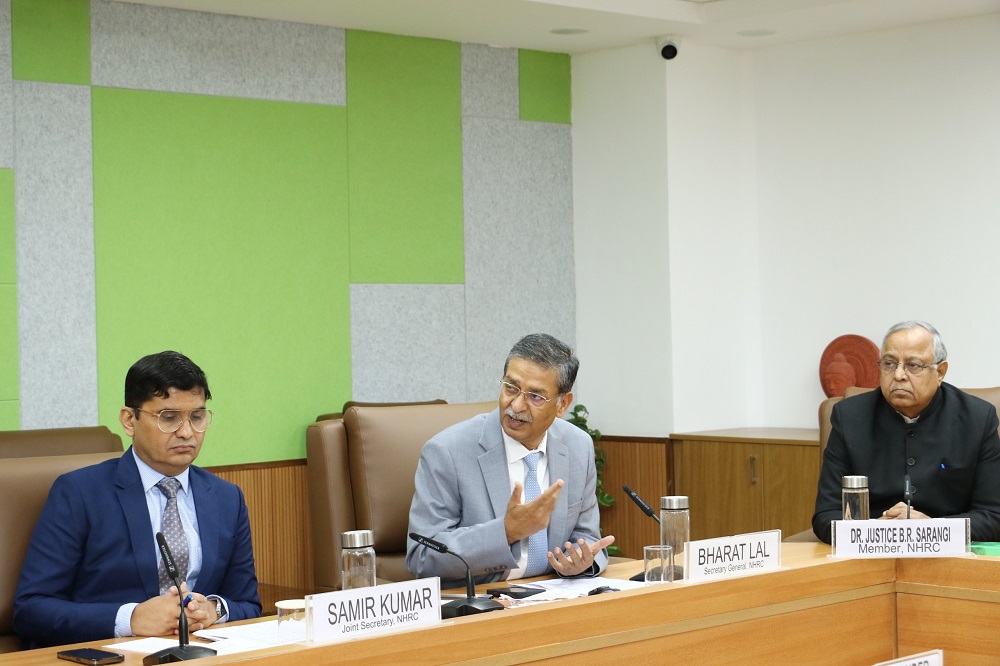
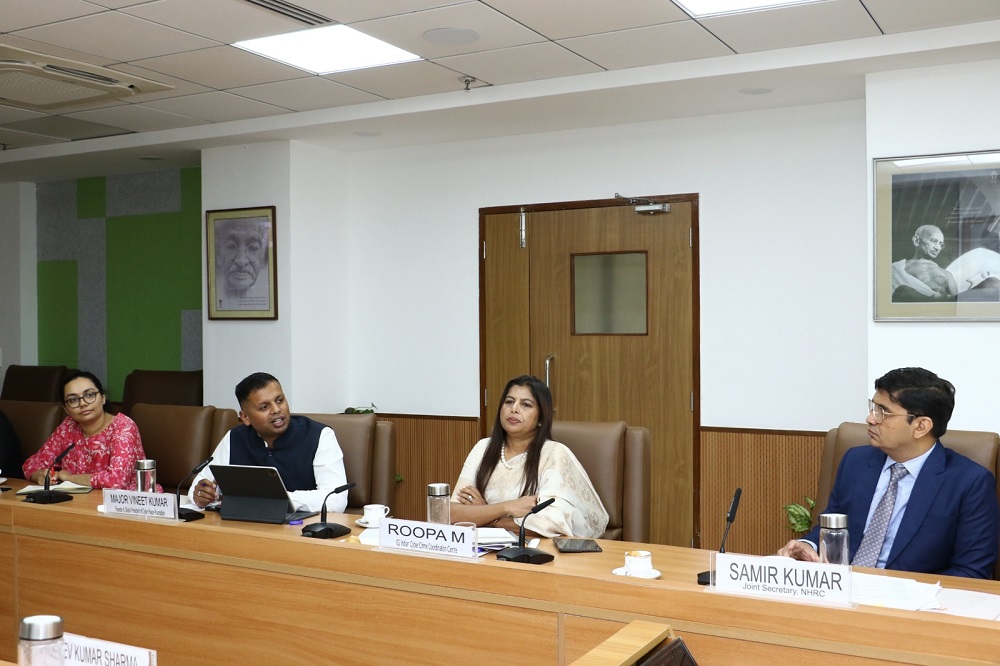
Participants included senior NHRC functionaries, officials from MeitY, DoT, TRAI, RBI, CBI, NPCI, representatives of telecom, banking and fintech sectors, and legal and domain experts, who discussed proposals such as recognising digital arrest scams as a distinct offence to improve investigation, prosecution and victim redressal.
Highlighting the staggering scale of the crisis, National Human Rights Commission (NHRC) Chairperson Justice V. Ramasubramanian revealed that Indians have lost a massive ₹52,976 crore to cyber frauds over the past six years, with “digital arrest” scams accounting for nearly 8% of those losses.
Citing data from the Indian Cyber Crime Coordination Centre (I4C), Justice Ramasubramanian warned that current legal recovery processes are often “more painful than losing the money itself.” He called for an immediate overhaul of the legal framework, a crackdown on lakhs of active mule accounts, and innovative safeguards including automated alerts on prolonged OTT calls to protect vulnerable citizens from being coerced by scammers exploiting their fear of law enforcement.
Justice (Dr.) Bidyut Ranjan Sarangi, Member of the Commission, observed that “gaps persist in the existing processes to confront the challenges posed by cyber deception.” He voiced confidence that such dialogues would yield “practical remedies at the earliest,” underscoring the urgency of institutional response.
Member Vijaya Bharathi Sayani, invoking the principle of Rajadharma, declared that shielding citizens from cybercrime and financial fraud is not merely a technological or regulatory imperative but a solemn duty of governance. “Preventive action,” she stressed, “is the responsibility of a State committed to justice and fairness.
Our collective goal must be to ensure that no citizen falls prey to such frauds.”
Earlier, Secretary General Bharat Lal, in his opening remarks, traced the rationale for convening the discussion. He cautioned that cybercrimes disproportionately afflict the elderly retired officials, professionals, industrialists, and bankers inflicting not only financial harm but also eroding dignity, self-respect, and psychological well-being.
Citing data placed before the Supreme Court, he revealed that over 3,000 such frauds targeting senior citizens were reported last year.
He further warned that cybercriminals are exploiting personal data from leaks and breaches to orchestrate scams, raising grave concerns about privacy and protection.
With evolving digital governance and financial systems enabling swift, untraceable transfers, he urged the strengthening of safeguards to protect vulnerable groups, particularly senior citizens, and to ensure effective remedies for victims.
The Commission’s proceedings thus carried the weight of judicial gravitas, framing cyber fraud not merely as a technological aberration but as a violation of fundamental rights demanding immediate redress.
Ajit Kumar, Joint Secretary, MeitY, outlined government efforts, noting an inter-departmental committee’s work and the development of a portal under Section 47 of the IT Act for adjudication and compensation. He expressed confidence that the DPDP framework would reinforce data protection.
Law enforcement representatives, including Ms. Roopa M. of I4C and Muktesh Chander of NHRC, highlighted existing mechanisms such as cybercrime.gov.in, helpline 1930, and platforms for fund recovery, while stressing regulation of SIM cards, bank accounts, and stronger victim-centric approaches.
Brijesh Singh, ADG Maharashtra, described cybercrime as “industrial-scale,” advocating automated interventions and a national cybercrime force.
Financial regulators and industry leaders from RBI, IBA, NPCI, and telecom operators underscored the role of AI-based detection, trusted-person authentication, and awareness campaigns. Shri R. Vanaraja of RBI suggested a single government communication channel, while Shri Rajiv Ranjan Prasad of IBA detailed banking initiatives such as mule account detection and the proposed Indian Digital Payment Intelligence Platform.
Telecom and investigative agencies, including DoT, CBI, and TRAI, called for stronger regulation of OTT platforms, real-time data sharing, and international cooperation to disrupt scam compounds abroad. Civil society voices, such as Major Vineet Kumar of the Cyber Peace Foundation, urged creation of a “human firewall” of trained responders, while Supreme Court advocates Ms. N. S. Nappinai and Dr. Pavan Duggal pressed for recognition of digital arrest scams as a distinct offence under the IT Act or Bharatiya Nyaya Sanhita, alongside restorative justice and statutory safeguards.
The discussion yielded key proposals:
- Recognition of digital arrest scams as a distinct offence under law.
- Criminalisation of mule accounts and misuse of government logos.
- Automated safeguards such as circuit breakers and trusted-person authentication.
- Simplified victim recovery and compensation frameworks.
- Accountability across digital ecosystem including banks, telecom operators, and intermediaries.
- International cooperation to dismantle transnational networks.
- Public awareness campaigns on intimidation and impersonation tactics.
The Commission will consolidate these recommendations and place them before the Union and State Governments, framing cyber fraud not merely as a technological challenge but as a violation of dignity, privacy, and liberty demanding urgent redress.