From Red Cloth Bundles to Hyperlinks: Chief Justice Surya Kant Declares India’s Digital Judicial Revolution a Constitutional Imperative
(Judicial Quest News Network)
17-5-2026-There was a time, not so long ago, when a litigant walking into a lawyer’s chamber would ask with anxious urgency “File kahan hai?” Where is the file? Today, that same litigant sends a text message: “Link bhej dijiye.” Send me the link. In those six words lies the story of one of the most profound institutional transformations in the history of Indian justice and the Chief Justice of India has now placed that transformation in its rightful constitutional frame.
The Address: A Vision Articulated from the Apex
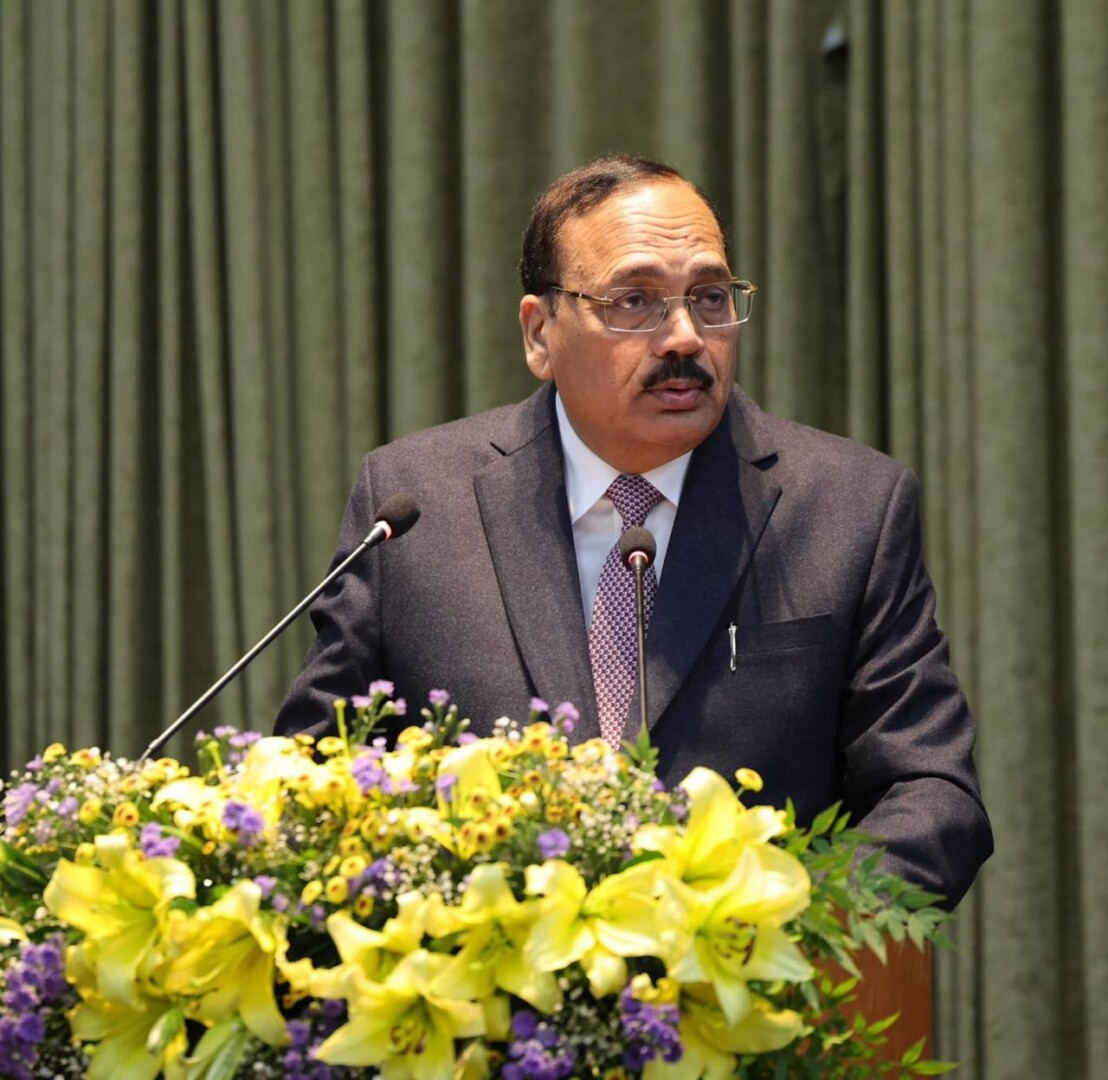
Chief Justice of India Surya Kant was addressing a conference on the theme of ‘Digital Transformation: Advancing Paperless Legal System’ when he offered this quietly revolutionary observation that behind the seemingly small shift in a litigant’s vocabulary lies an institutional metamorphosis of the entire justice-delivery architecture of the country.
The CJI did not speak as a distant administrator surveying change from above. He spoke as a practitioner who had lived through the old system, who understood its textures and its inefficiencies from personal experience, and who had watched with a mixture of relief and admiration as the Indian judiciary reinvented itself under the pressure of crisis and the demands of a billion people who could no longer afford to wait.
The Old World: Red Cloth, Paper Towers, and Trolleys of Justice
To appreciate how far India’s courts have travelled, it is necessary to first understand where they began.
The Chief Justice recalled that the justice-delivery system was once reflected by towering bundles of files tied in red cloth, advocates carrying trolleys filled with paper books, and courtrooms overflowing with physical records a physical theatre of law that was as much about the weight of paper as the weight of argument.
The imagery is evocative and instantly recognisable to anyone who has ever stepped inside an Indian court of law.
The red-cloth-bound file the basta was the central protagonist of every legal proceeding. It was measured in inches and kilograms.
It was the product of months of labour by clerks, typists, and juniors who assembled, paginated, indexed, and indexed again the documentary foundation upon which every case rested.
The Chief Justice, with characteristic candour, admitted that he himself had once been a victim of the prejudice that the heavier the brief, the greater the preparation that the physical bulk of a compilation was somehow a proxy for the intellectual rigour of the advocate who carried it. But over time, he came to understand that justice lies not in the number of books but in efficiency and accessibility.
It is a confession of institutional self-awareness that deserves to be heard across every bar room and court corridor in the country.
The Human Cost of Paper: The Farmer, the Widow, the Undertrial
The Chief Justice did not allow the discussion of digital transformation to remain at the level of institutional abstraction.
He brought it firmly and compassionately to the level of the individual the human being at the end of the justice delivery chain, for whom every adjournment is not a procedural inconvenience but a life disrupted.
He stated that adjournments in cases were often granted simply because a file could not reach the courtroom in time, or had been misplaced and that this meant a litigant who could be a farmer who had travelled overnight from a remote village, a woman waiting for her pension, a worker contesting wrongful termination, or an undertrial prisoner, would have to wait yet again for his or her case to be heard.
This is the human arithmetic of judicial delay an arithmetic that the paper-based system, for all its procedural dignity and historical legitimacy, was structurally incapable of solving.
A file that could not be found was not merely an administrative failure. It was a farmer sleeping on a railway platform for a second night. It was a widow returning home without her pension order.
It was an undertrial spending another week in custody because a bundle of paper did not find its way from the registry to the courtroom in time.
The digitalisation of court records is, in this light, not a technological upgrade. It is an act of justice.
Technology as a Constitutional Instrument
The Chief Justice elevated this argument to its highest register the constitutional in a passage that deserves to be read and re-read by every stakeholder in India’s justice system.
He stated that it is precisely in this context that technology acquires constitutional significance that digital systems are not merely instruments of convenience but mechanisms through which avoidable barriers to justice can be reduced.
When records become digitally accessible, filings become electronic, and information becomes instantly available, courts are able to devote greater attention to adjudication rather than the administrative movement of paper
The phrase “avoidable barriers to justice” is the operative constitutional concept.
The right to access justice is not merely a procedural entitlement it flows from the fundamental right to life and personal liberty under Article 21, interpreted expansively by the Supreme Court across decades of progressive jurisprudence.
When a systemic feature of the court’s functioning the paper-based file system creates barriers that are avoidable through the application of existing technology, the failure to deploy that technology is not merely an administrative inefficiency. It is a constitutional question.
The Chief Justice also observed that moving towards a digitised judiciary does not mean abandoning traditions, but liberating institutions that were once limited in their efficiency bridging the gap of justice that the old system, for all its solemn ceremony, had been unable to close.
The Pandemic: Crisis as Catalyst
In one of the most illuminating passages of his address, the Chief Justice turned to the event that forced upon the Indian judiciary a transformation that, under ordinary circumstances, might have taken decades to accomplish the COVID-19 pandemic.
The spoke of the irony that it was the pandemic that forced this transition, remarking that during that moment of profound national crisis, the Indian judiciary demonstrated extraordinary adaptability and that within a remarkably short period, courts across the country transitioned to virtual hearings, with judges hearing matters from their homes, lawyers arguing cases through screens, and judicial proceedings continuing despite extraordinary disruption.
The achievement, viewed in historical perspective, is nothing short of remarkable.
An institution that had functioned on the physical presence of parties, counsel, and judges for over a century an institution in which the ritual geography of the courtroom was itself a source of procedural legitimacy was compelled, within weeks, to reconstitute itself in entirely virtual space.
That it did so, and that the constitutional work of the courts continued without fundamental interruption, is a testament to the resilience of both the institution and the individuals who serve within it.
But the Chief Justice was also honest about the difficulties of that transition.
He acknowledged that the shift was nowhere near smooth that there were moments of connectivity failures and technology testing everyone’s patience, and that it was particularly difficult for advocates who had spent decades mastering the art of courtroom advocacy and suddenly found themselves navigating uncharted digital waters.
The Muted Microphone: A Lesson in Digital Humility
With the warmth and self-deprecating wit that have characterised many of his public addresses, the Chief Justice shared an anecdote from those early days of virtual hearings that captures, with perfect precision, the democratic levelling effect of technological disruption.
He recalled one senior lawyer passionately advancing submissions while unknowingly remaining on mute for several minutes and that by the time the issue was discovered, everyone in the virtual courtroom had learnt an important lesson in digital humility, because for perhaps the first time, seniority at the Bar offered no advantage against weak internet connectivity.
The observation is funny on its surface and profound beneath it. The courtroom, with its carefully calibrated hierarchies of seniority, precedence, and institutional rank, was suddenly subjected to a levelling force that recognised no designation.
The most eminent senior counsel and the most junior advocate stood equally before the vagaries of broadband infrastructure. In that shared vulnerability lay a democratic moment that the courtroom, in its traditional form, had never quite produced.
The Spread of Transformation: From the Apex to the Village
The Chief Justice was emphatic that the digital transformation of the judiciary is no longer confined to the Supreme Court that it has spread across the High Courts and into the subordinate judiciary, and that an ordinary citizen sitting in a remote village can now access the status of his or her case on a mobile phone.
This is the constitutional promise of digital justice made real. The Supreme Court of India, with its imposing architecture and its location in the capital of the Republic, has always been physically inaccessible to the vast majority of Indians.
But the information it generates the orders it passes, the dates it fixes, the judgments it delivers need no longer be confined to those with the resources to maintain agents and clerks in New Delhi.
A litigant in a tribal hamlet in Chhattisgarh, or a fisherfolk community in coastal Kerala, can now know the status of their appeal at the touch of a screen.
The Chief Justice pointed to Sikkim, which was recently declared the country’s first fully paperless judiciary, as a landmark institutional achievement that demonstrates the direction in which the entire system must travel.
A Paperless Court is a Green Court: The Environmental Dimension
In an observation that places judicial administration within the broader framework of national and global responsibility, the Chief Justice connected the paperless court to the imperative of environmental stewardship.
He remarked that a paperless courtroom is in many ways an expression of institutional responsibility towards future generations and that at a time when societies across the world are confronting environmental challenges, public institutions must lead by example in adopting sustainable practices, because the judiciary cannot remain isolated from broader national and global conversations surrounding responsible governance and ecological consciousness.
The tonnage of paper consumed by India’s courts every year in filings, compilations, certified copies, registers, and records is staggering.
A judiciary that transitions to paperless functioning is not merely improving its own efficiency. It is making a statement about the kind of institution it wishes to be in the century ahead.
A Tribute to the Bar: Resilience, Adaptation, and Expanded Possibility
The Chief Justice reserved particular commendation for the Bar acknowledging that senior members who once relied almost entirely upon physical compilations today navigate electronic records with impressive ease, and that young lawyers and first-generation practitioners have utilised digital platforms to enhance both accessibility and professional opportunity.
He concluded that the transition towards paperless functioning has not weakened the legal profession rather, it has expanded its possibilities.
This tribute matters. The Bar could have resisted the digital transition and in some quarters, the resistance was real.
Advocates trained over decades in the physical art of courtroom practice, who found their professional identity bound up in the weight of the brief and the texture of the courtroom encounter, had genuine reason to feel disoriented by the speed and totality of the change demanded of them.
That the Bar absorbed that disruption, adapted to it, and ultimately found in its new avenues of professional reach is a contribution to the justice system that the Chief Justice was right to acknowledge formally.
The Caution: Digital Transformation Must Not Become Digital Exclusion
In his concluding remarks, the Chief Justice sounded a note of institutional caution that is as important as any of the achievements he celebrated a warning that the very technology that promises to democratise justice must not be allowed to create new hierarchies of exclusion.
He cautioned that digital transformation must not lead to digital exclusion, where certain sections of persons continue to be shut out from access to justice, and stressed that human interaction, procedural assistance, and institutional sensitivity must continue to be embedded in the judicial functioning even as the system moves toward greater digitalisation.
The warning is well-founded. India’s digital divide between urban and rural, between the educated and the illiterate, between those with smartphone access and those without is deep and consequential.
A court system that moves entirely to online filing, digital records, and virtual hearings without building the human infrastructure to assist those who cannot navigate those systems independently, risks trading one form of inaccessibility for another.
The litigant who once could not reach the court because the file was missing must not now be unable to reach the court because he has no smartphone.
The digital revolution in India’s judiciary will only fulfil its constitutional promise if it is accompanied by a sustained and deliberate commitment to leaving no one no farmer, no widow, no undertrial, no first-generation litigant behind.
In Closing: Justice, Reimagined
The Chief Justice of India’s address on digital transformation is more than a progress report on a technological initiative. It is a constitutional meditation on what justice delivery means in twenty-first century India who it must reach, how it must function, and what institutional values must guide its evolution.
From the red-cloth basta to the hyperlink. From “file kahan hai” to “link bhej dijiye.” The words have changed. The obligation to every farmer, every widow, every undertrial, every citizen who places their faith in the promise of justice has not.