
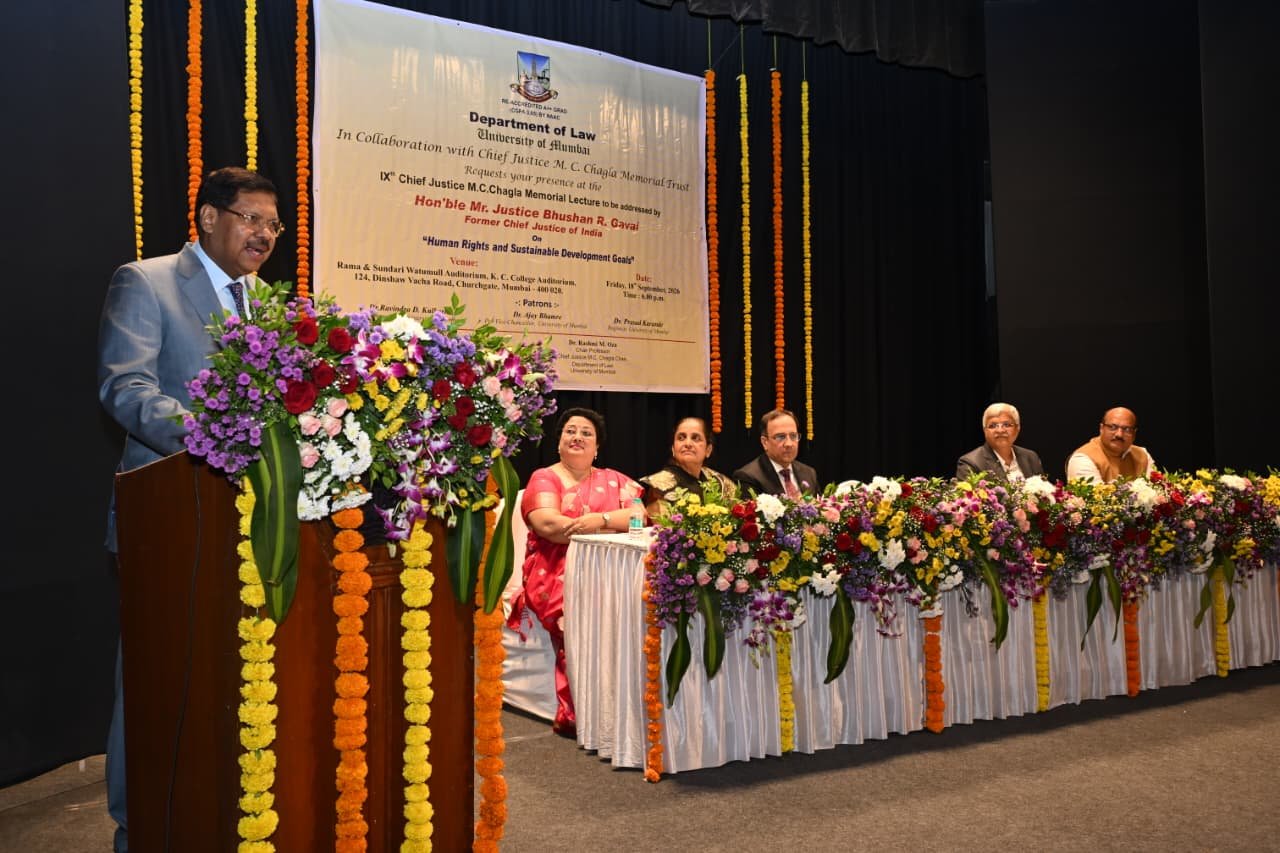
Development Must Not Come at Cost of Human Dignity, Justice BR Gavai Says
Former Chief Justice underscores the constitutional link between fundamental rights, sustainable development and environmental justice
(Judicial Quest News Network)
Former Chief Justice of India Justice BR Gavai has emphasised that development must be assessed not merely through the lens of economic growth, but also by its impact on human rights, dignity and the quality of life of ordinary citizens.
Delivering the ninth Chief Justice MC Chagla Memorial Lecture, Justice Gavai highlighted the close relationship between civil liberties, social welfare and the broader objectives of sustainable development.
He observed that political freedom, in the absence of access to food, education, healthcare and livelihood, could become little more than a formal guarantee without meaningful substance.
According to Justice Gavai, fundamental rights cannot be treated as abstract constitutional promises.
Their true value lies in ensuring that individuals are able to live with dignity and participate meaningfully in society.
“The relationship between freedom and social conditions was also central to the development of the modern international human rights framework. The experience of the Second World War had demonstrated the consequences that could follow when the dignity of the individual ceased to be regarded as a matter of common concern.”
He pointed out that a person may technically enjoy political liberty, but the real benefit of that liberty is severely weakened when the same person is denied the basic necessities of life.
In such circumstances, he said, rights must be understood not only as legal entitlements but also as instruments for securing social and economic justice.
Questioning the Conventional Meaning of Development
Justice Gavai cautioned against measuring human progress solely through economic indicators.
He urged policymakers and public institutions to ask deeper questions about the purpose and consequences of development.
“If development is necessary for the enjoyment of human rights, what kind of development should we pursue? Is every form of economic growth necessarily consistent with human well-being? What happens when the benefits of development are enjoyed by some while its social or environmental costs are borne by others?”
“Development must be examined by asking who it serves, what objective it pursues and who bears its cost,” he said, underscoring the need for a more inclusive and rights-based approach to policymaking.
The former Chief Justice stressed that economic expansion, if pursued without regard for vulnerable communities, workers and future generations, could undermine the very constitutional values it is expected to advance.
In his view, genuine development must enlarge human capabilities, protect individual dignity and ensure that the benefits of progress are distributed fairly across society.
Balancing Ecology with Livelihoods
Recalling his experience presiding over the Supreme Court’s Green Bench, Justice Gavai spoke about the difficult task of reconciling environmental protection with the requirements of sustainable development.
“This is also where development connects with environmental and climate justice. We must ask whose surroundings are polluted, whose livelihoods are placed at risk, and whose voices are heard when decisions are made. We must also consider whether those bearing the greatest burdens have the resources and institutional support necessary to protect themselves.”
He described judicial decision-making in environmental matters as a delicate exercise in balancing competing constitutional and public interests.
Courts, he noted, are frequently required to protect fragile ecosystems while also taking into account the livelihood concerns of communities that depend on natural resources.
Justice Gavai referred to the creation of eco-sensitive zones around wildlife reserves as an example of how environmental safeguards can be designed without completely disregarding local economic realities.
He also referred to the decision to replace human-pulled rickshaws in Matheran with battery-operated vehicles.
The measure, he explained, was intended not only to reduce environmental harm but also to protect workers from an occupation that adversely affected their dignity and physical well-being.
The example illustrates, he suggested, that environmental jurisprudence is not confined to the preservation of forests, rivers or wildlife.
It also concerns the protection of people whose lives and livelihoods are intertwined with the environment.
A Constitutional Duty Towards Future Generations
Justice Gavai further maintained that environmental protection must be viewed as an obligation owed not only to the present generation but also to those yet to come.
Natural resources, he observed, are held by the present generation in trust for future generations.
Public institutions therefore have a responsibility to ensure that decisions concerning land, water, forests and other ecological assets are made transparently and in the public interest.
He also stressed the importance of public participation in such decisions. Citizens, he said, must have the opportunity to contribute to choices that affect their lives and must be able to seek effective remedies when their rights are infringed.
The former Chief Justice’s remarks place human dignity at the centre of the development debate. His message was clear: economic growth cannot be treated as an end in itself. Development acquires constitutional legitimacy only when it advances human welfare, protects the environment and respects the dignity of every individual.


