CJI Surya Kant Unscripted: A Candid Student Dialogue on Retirement Eve
(By Syed Ali Taher Abedi)
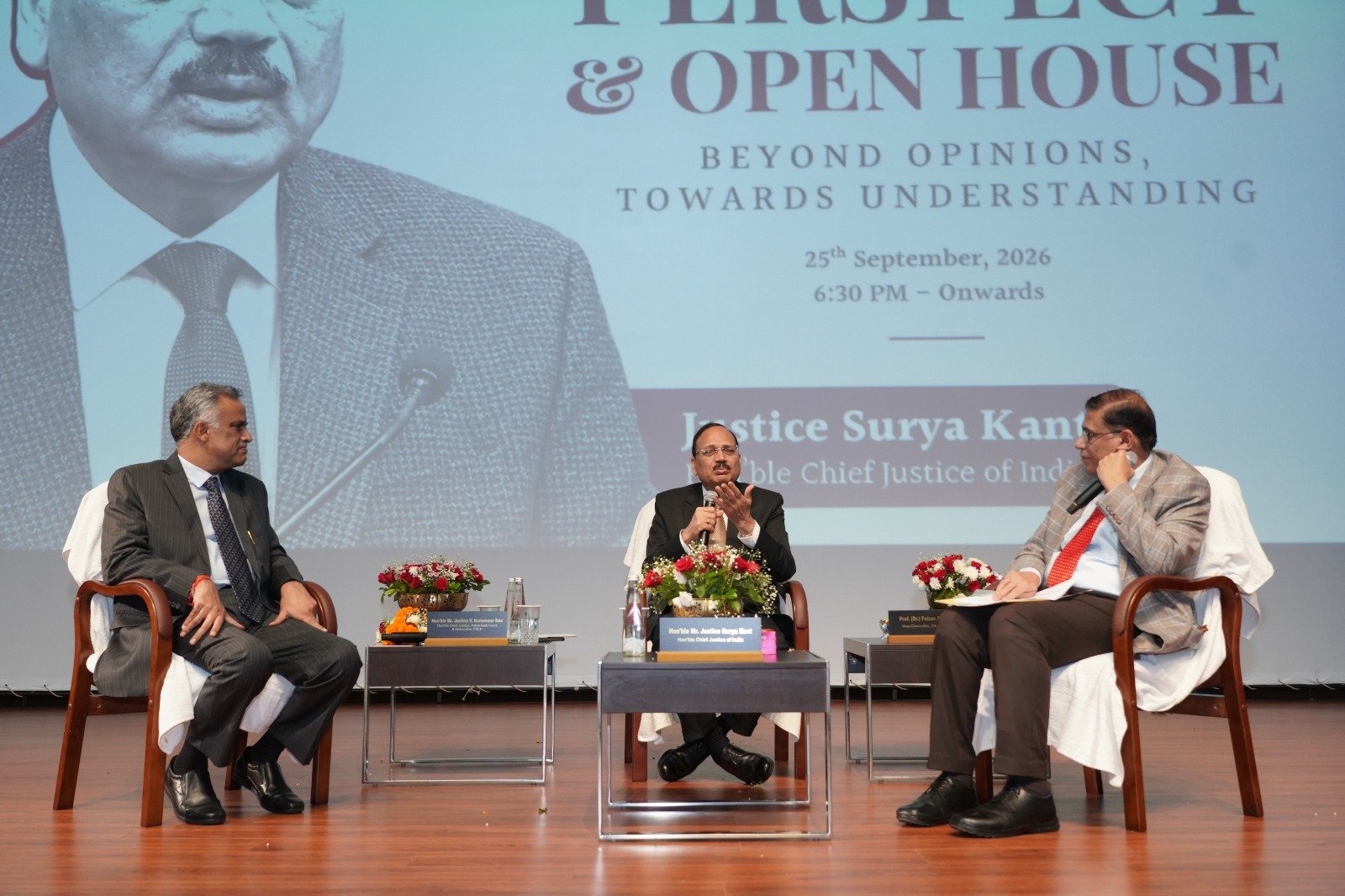
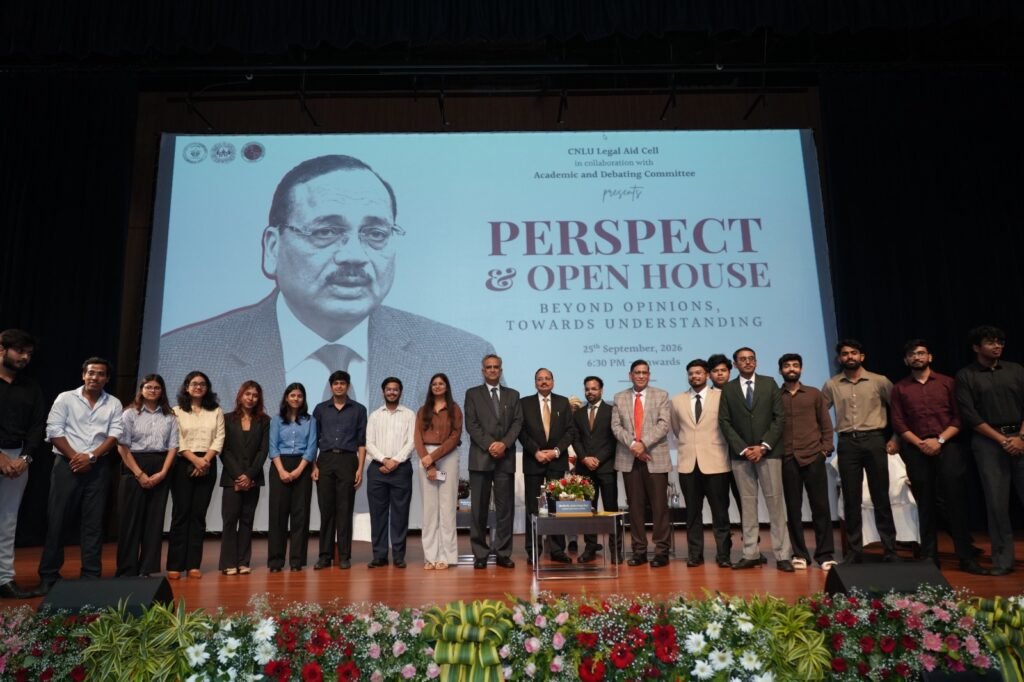
Patna, September 26, 2026-In what Chanakya National Law University has described as the first interaction of its kind in Indian legal history a sitting Chief Justice of India engaging in a live, unfiltered, unscripted question-and-answer session with law students Chief Justice Surya Kant on Saturday walked into the Ashoka Auditorium at CNLU Patna and did something that no Chief Justice before him had done quite so directly he sat before India’s next generation of lawyers and answered, without a prepared text, the hardest questions they had.
The session organised by CNLU’s Academic and Debating Committee and Legal Aid Cell, and attended by Patna High Court Chief Justice and CNLU Chancellor Justice V Kameswar Rao and Vice-Chancellor Professor Faizan Mustafa assumed a significance beyond the ordinary register of a distinguished visitor’s address, arriving as it did in the shadow of the Chief Justice’s publicly documented difficulties with two of India’s most prestigious law school campuses.
The students of NALSAR Hyderabad had recently petitioned their university to reconsider the Chief Justice’s convocation invitation, citing his courtroom response to an urgent mentioning about police violence against student protesters.
The students of NLSIU Bangalore had expressed similar reservations. Into that fraught institutional atmosphere, CNLU’s students extended a different kind of invitation not a ceremony to be presided over, but a conversation to be had. And the Chief Justice of India, in the final days of a tenure that has been defined by a willingness to engage rather than retreat, accepted.
On Police Action Against Protesters: The Judiciary’s Commitment to The Street
The question that has followed Chief Justice Surya Kant most persistently through the final chapter of his tenure the question of what the Supreme Court was prepared to do when students exercising their constitutional right to peaceful protest were met with police force was placed before him directly from the floor of the CNLU auditorium.
The Chief Justice’s response reaffirmed, on the public record and in the presence of the generation of lawyers who will carry these constitutional principles forward in their professional lives, the judiciary’s commitment to protecting students’ fundamental right to hold peaceful protests.
The reaffirmation carries weight that is not diminished by the fact that it was made in a law school auditorium rather than from the Supreme Court bench.
A Chief Justice who tells law students directly, openly, and without a script that the court stands committed to the protection of their right to peaceful assembly is making a constitutional statement that the next generation of lawyers can hold the institution to account for.
He is also, implicitly, addressing the question that the NALSAR students had raised with such institutional precision that a Chief Justice who is seen as dismissive of police action against student protesters cannot function as the embodiment of the constitutional values that a law school’s graduation ceremony is designed to celebrate.
On The Collegium: Why Dissents Are Recorded but Not Published
Among the most constitutionally textured questions of the session came from a student who pressed the Chief Justice on one of the most discussed and least resolved questions in the Collegium’s institutional history why are dissenting views expressed during deliberations recorded, but not disclosed to the public?
Chief Justice Surya Kant’s response is a window into the institutional reasoning that has kept Collegium dissents confidential despite persistent calls for greater transparency in the judicial appointments process.
He explained that the disclosure of negative observations even observations made in good faith and for legitimate institutional purposes could place the individual under consideration in an untenable position.
He referred specifically to the impact that the publication of such observations could have on the dignity of the person whose appointment or elevation is under deliberation.
The reasoning is not without constitutional force. A Collegium deliberation about a judicial candidate involves an assessment of that person’s professional character, judicial temperament, integrity, and fitness for office.
If negative assessments made in the course of that deliberation assessments that may reflect incomplete information, institutional caution, or a minority view that does not ultimately prevail were to be made public, the candidate concerned would carry the reputational burden of those assessments regardless of the final outcome of the deliberation.
A person about whom a Collegium member expressed reservations, but who was ultimately recommended and appointed, would carry the public knowledge of those reservations into their judicial career a burden that the Chief Justice evidently regards as incompatible with the dignity of the office and the fairness of the process.
Whether this reasoning fully satisfies those who argue that the Collegium’s accountability requires full transparency in its deliberations including its dissents is a question on which reasonable legal minds differ. But the Chief Justice’s articulation of the institutional concern is a significant and candid public statement about how the system justifies its own opacity on this specific question.
On First-Generation Lawyers: The Young Lawyers’ Fund
The Chief Justice’s engagement with the difficulties faced by first-generation lawyers’ advocates who enter the profession without the family connections, established chambers, or inherited client base that smooth the early careers of those born into legal dynasties was both empathetic and institutionally grounded.
He referred to the Supreme Court’s order in Sarika Tyagi v. Union of India the case in which the court endorsed the proposal for a Young Lawyers’ Professional Assistance Fund to provide financial support to junior advocates during their initial years of practice, reducing proportionately as the lawyer builds professional self-sufficiency.
The reference is a reminder that the Chief Justice’s concern for early-career lawyers is not merely rhetorical it has produced concrete institutional proposals that are moving through the judicial and administrative framework toward implementation.
The acknowledgement that first-generation lawyers face structural disadvantages that the profession must address through systematic institutional support rather than individual mentorship or the vagaries of fortunate professional encounters is a statement of institutional seriousness that the legal profession’s governing bodies and Bar associations would do well to take up with the urgency it deserves.
On Rising Law School Fees: A Concern Acknowledged from The Highest Chair
Students pressed the Chief Justice on the question of rising tuition fees at national law universities and the inadequacy of scholarships available to students from financially constrained backgrounds a concern whose urgency reflects the structural tension between the NLU system’s aspiration to be a genuinely meritocratic pathway into the legal elite, and the reality that the cost of a five-year programme at a national law university has placed it beyond the unaided reach of many academically qualified students from modest economic backgrounds.
The Chief Justice responded by indicating that the issue would be addressed a commitment whose specifics were not elaborated but whose acknowledgement from the Chief Justice of India, in a public forum, constitutes a form of institutional accountability that the NLU system’s administration and the Bar Council of India, which maintains oversight of legal education, will be expected to act upon.
On Legal Education Reform: Faizan Mustafa’s Proposal and The CJI’s Positive Response
One of the most substantively significant discussions of the session arose from a proposal advanced by CNLU Vice-Chancellor Professor Faizan Mustafa a legal academic of national standing whose views on legal education reform are among the most carefully considered in the country.
Professor Mustafa proposed restructuring the five-year integrated law programme so that the final year would involve mandatory court apprenticeship embedding practical litigation experience directly into the law degree rather than leaving it to the separate one-year practice requirement currently prescribed for judicial service examinations.
His proposal, as described by the university, would not reduce the overall duration of the law course but would seek to integrate courthouse experience into the educational programme itself.
The CJI responded positively and said the proposal could lead to greater integration of court experience with legal education an endorsement that, coming from the head of India’s judiciary, carries considerable weight as the proposal is taken forward through the relevant regulatory and legislative channels.
The proposal addresses one of the most frequently identified failings of legal education as currently structured the near-complete separation between the academic environment in which law is taught and the professional environment in which it is practised.
A graduating lawyer who has spent five years reading cases and writing memos but has never stood in a courtroom, examined a witness, or drafted a pleading under pressure arrives at the Bar with a theoretical command of the law that the practical demands of legal practice cannot immediately translate into professional competence. Professor Mustafa’s proposal is a structural response to that disconnect and the Chief Justice’s endorsement of the concept is an important institutional signal.
On Judicial Clerkships: Making The Judiciary Competitive With Corporate Law
Justice V Kameswar Rao, Chief Justice of the Patna High Court and Chancellor of CNLU, added a complementary perspective on the recruitment of legal talent to judicial institutions supporting the proposal to make High Court clerkships more competitive and financially attractive, and specifically suggesting that remuneration for judicial clerks at the Patna High Court should be competitive with the opportunities available in corporate law.
The observation acknowledges a structural challenge that has grown more acute as India’s corporate law sector has expanded dramatically the competition for the most academically accomplished law graduates between public institutions, including the judiciary, and private legal employers who can offer substantially higher remuneration.
A judicial clerkship that offers intellectual depth, constitutional exposure, and proximity to the judicial decision-making process is, for many graduates, an opportunity of incomparable professional value.
But its financial terms must be sufficient to make it a viable choice for graduates who carry the economic expectations and obligations of their families alongside their professional ambitions.
The Institutional Context: A Chief Justice Who Chose Conversation Over Confrontation
The CNLU open house on September 26 is, in its institutional meaning, more than a pleasant end-of-tenure event. It is a deliberate choice made by a Chief Justice who was aware of the institutional climate in which the visit took place, aware of the questions that would be asked, and aware that his answers would be scrutinised with the heightened attention that accompanies any public appearance in the final days of a significant judicial tenure.
Chief Justice Surya Kant could have chosen the safety of a prepared keynote address, a ceremonial valedictory, or the closed-room comfort of a meeting with faculty and administration. Instead, he chose to sit before students who had hard questions, in an open forum, without a script, and answer them.
That choice is itself a statement one that the legal fraternity, the law school community, and the students who will spend their careers being shaped by the constitutional values he has articulated across his tenure will be right to remember and to hold the institution to.