“BCI Not Personal Estate”: Co-Chair Reddy’s 15-Day Quit Ultimatum to Manan Mishra
(By Syed Ali Taher Abedi)
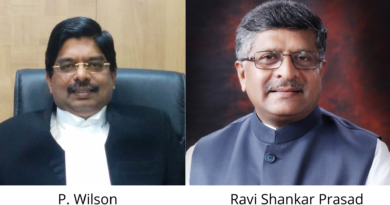
New Delhi, August 22, 2026-In the most significant internal rupture in the Bar Council of India’s recent institutional history, Senior Advocate and BCI Co-Chairman YR Sadasiva Reddy has written a blistering eight-ground letter to BCI Chairman Manan Kumar Mishra demanding his immediate resignation accusing him of transforming India’s premier statutory regulator of the legal profession into a vehicle for personal power, family patronage, financial irregularity, and institutional intimidation over a continuous fourteen-year chairmanship that Reddy declares has, in any real sense, ceased to be an elected office at all.
The letter, dated August 22, 2026, gives Mishra fifteen days to vacate the chair.
It simultaneously demands a special meeting of the Bar Council, an independent audit of BCI’s accounts and of the BCI Trust PEARL First, and a complete bar on any further payments being accepted from law colleges seeking BCI approval.
A petition has also been separately filed before the Supreme Court challenging Mishra’s uninterrupted decade-long tenure and seeking his removal.
The Opening Proposition: A Trust Betrayed
Reddy’s letter opens with a proposition of constitutional and institutional gravity that sets the tone for everything that follows.
“The Bar Council of India is not the personal estate of any individual… Every rupee it holds is held in trust.
Every power it exercises is a power conferred by Parliament for the benefit of the Bar, and not for the benefit of the person who happens to occupy the Chair,” Reddy writes.
The formulation is precise and legally significant. The BCI is a statutory body established under the Advocates Act, 1961 an institution whose authority derives not from the personal mandate of its chairman but from a parliamentary enactment whose entire purpose is the regulation of the legal profession in the public interest.
Its funds are public trust funds. Its powers are public trust powers. And its chairman is a trustee not an owner, not a proprietor, and not a sovereign.
When Reddy writes that the BCI is not the personal estate of any individual, he is not deploying rhetoric.
He is restating the foundational legal character of the institution Mishra chairs and implying, with eight documented grounds to support the implication, that that character has been systematically violated.
Ground One: The NALSAR Threat Punishing Students for Having an Opinion
The immediate precipitating cause of Reddy’s resignation demand is an episode that drew national attention and widespread condemnation across the legal fraternity the August 13 directive issued under Mishra’s authority threatening to bar NALSAR Hyderabad’s entire 2026 graduating batch from enrolment as advocates, in apparent retaliation for the batch’s representation requesting the university to reconsider the CJI’s participation as convocation chief guest.
Reddy notes that the August 13 direction barring the university’s graduating batch from enrolment was issued without the material being placed before the Bar Council of India, without the Council deliberating upon it, and without any resolution of this Council authorising it.
The directive and the subsequent withdrawal that came within hours under the pressure of universal professional condemnation is cited by Reddy not as an isolated administrative error but as evidence of a deeper institutional malady the use of the Chairman’s office as an instrument of personal authority unaccountable to the collegial body whose mandate it purports to exercise.
“The expression of regret, though belated, is not the point.
The point is that the office of Chairman was used to threaten an entire graduating batch of law students’ young men and women with no power and no voice with exclusion from the profession, as reprisal for having held an opinion,” Reddy’s letter states.
The constitutional implications of that act using the regulatory power of a statutory body to punish citizens for the exercise of their Article 19(1)(a) right to freedom of expression are as serious as any ground in the letter.
The BCI’s power of enrolment is not a discretionary administrative tool available for deployment against law students whose political views or institutional representations displease the Chairman.
It is a statutory power, conferred by Parliament for the singular purpose of ensuring that qualified persons are admitted to the legal profession.
Its threatened weaponisation against an entire graduating class is, Reddy implies, an abuse of statutory authority of the most basic and indefensible kind.
Ground Two: Irregular Appointments Recruitments Without Transparency
Reddy claims that several BCI staff members are closely tied to Mishra and appear to have been recruited without any advertisement or transparent appointment process.
The allegation of opaque and relationship-driven recruitment to a statutory body whose staff positions are funded from the dues and fees of India’s legal profession is a charge of institutional governance failure that demands independent verification.
A statutory regulator’s administrative appointments must be made through fair, transparent, and merit-based processes not through the Chairman’s personal networks.
That the BCI’s own staff may have been recruited outside any formal selection process is, if true, both an administrative irregularity and a betrayal of the Bar’s trust.
Ground Three: BCI Trust PEARL — ₹150 Crore to a Private Trust
Reddy alleges that in 2020 a new trust, “BCI Trust PEARL First,” was registered with trustees chosen by Chairman Manan Kumar Mishra, and that roughly ₹150 crore of BCI funds were transferred into it despite objections from several members.
He states he knows of no provision in the Advocates Act, 1961 permitting a statutory regulator’s corpus to be moved to a private trust created by its own chairman, and that no member has ever seen the Trust Deed.
If true, this is an unauthorised, unapproved transfer of public regulatory funds warranting an independent forensic audit. Reddy adds that former judges were later associated with the trust to lend it respectability it did not earn through proper establishment.
Ground Four: Law College Payments Approval as a Revenue Stream
Reddy says he has received complaints that law colleges seeking BCI approval or renewal were made to pay “contributions” of ₹25 lakh to ₹1 crore to the BCI Trust PEARL.
If accurate, this turns a regulatory approval process into a toll, corrupting the very purpose of ensuring academic and infrastructural standards.
He links this to the visible crisis in legal education: colleges that should never have been approved continue to operate, selling degrees that do not produce competent advocates an issue echoed by the Chief Justice of India this year.
Ground Five: Family Nepotism in BCI-Run Institutions
The letter points to key administrative posts in BCI-run educational institutions being held by Mishra’s family members.
This creates a transparent, indefensible conflict of interest, subordinating institutional independence to the chairman’s personal and familial interests and undermining confidence in the regulatory framework.
Ground Six: Factionalism in State Bar Councils
Reddy flags Mishra’s encouragement of factionalism within State Bar Councils through orders issued without full-Council deliberation. Using the chair’s authority to pick sides in internal bar politics perverts the BCI’s role from impartial regulator to manager of factional politics, distorting the institutional design of the Advocates Act.
Ground Seven: Fourteen Years of Uninterrupted Tenure An Office That Is No Longer Elected
Reddy argues that Mishra’s continuous chairmanship since 2012 is without precedent, with election arrangements managed to produce foregone outcomes.
An elected office with one occupant for 14 years has, in effect, ceased to be elected, subverting the democratic accountability Parliament intended for the BCI’s leadership.
Ground Eight: Lost Confidence Students, Advocates, and the Bar
Reddy cites advocates protesting outside BCI offices and National Law University Student Bar Councils refusing to share a platform with the chairman as evidence that the Bar’s confidence in the BCI has collapsed.
When a statutory regulator loses the moral authority that secures voluntary compliance, the only credible response is a fundamental change of leadership.
Closing Appeal: Conscience, Not Animosity
Reddy closes by stating he holds no personal animosity, having served alongside Mishra for a decade.
It is precisely this insider view, he says, that convinces him the institution will not recover while Mishra remains in the chair, and that the Bar deserves better.
What Comes Next: 15-Day Window and Supreme Court Petition
Mishra has 15 days from the letter (until September 6, 2026) to respond to the resignation demand. A separate Supreme Court petition challenging his tenure adds a judicial dimension if the Court issues notice, the leadership crisis will move from internal confrontation to judicial scrutiny.
The institution must now decide how to act on Reddy’s eight-ground indictment and 15-day ultimatum.