80 Students Selected from 1,147 Applicants as NHRC of India Launches March 2026 Online Internship
(By Syed Ali Taher Abedi)
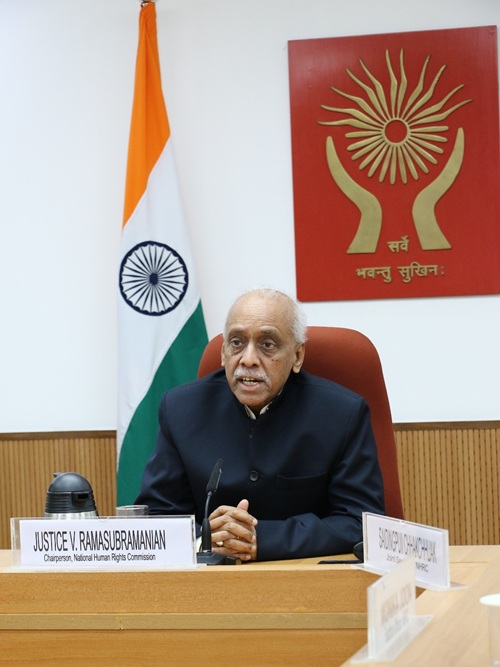
The National Human Rights Commission of India on Monday commenced its Online Short-Term Internship Programme (OSTI) for March 2026, with Chairperson Justice V. Ramasubramanian emphasizing that at a time of escalating global conflicts, a deeper understanding of human rights has become more critical than ever.
The programme was inaugurated in the presence of NHRC Secretary General Bharat Lal, who underscored that safeguarding the dignity of every individual is a collective responsibility of citizens.
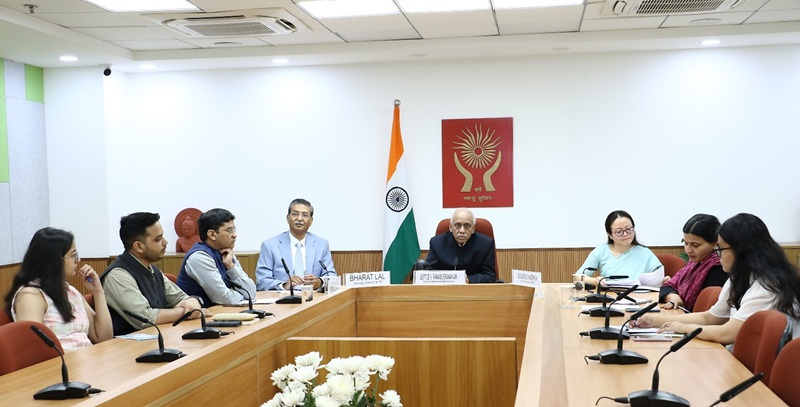
The two-week internship has brought together 80 university students selected from 1,147 applicants across 17 States and Union Territories, and will conclude on March 20, 2026.
Justice V. Ramasubramanian, a Chairperson of the National Human Rights Commission (NHRC), voiced his profound satisfaction regarding the surging participation of young women in the NHRC’s esteemed internship programme.
During his address, he underscored that elevating education and fostering greater awareness among women stands as a cornerstone for the prosperity of any society.
This empowerment, he elaborated, is vital for nurturing equity, ensuring fairness, upholding justice, and cultivating a deeper social consciousness that benefits all.
He further expressed optimism that the interns many of whom are women would harness the invaluable knowledge of human rights not merely as a tool for professional advancement, but as a transformative force to enrich their personal character and broaden their perspective on societal responsibilities.
Turning to the precarious state of global affairs, Justice Ramasubramanian drew attention to the latest Global Peace Index, a comprehensive report released by the Sydney based Institute for Economics and Peace, a leading international think tank.
He highlighted a stark and alarming statistic as of now, a staggering 78 countries worldwide are embroiled in armed conflicts beyond their own borders, ostensibly waged in the name of safeguarding peace and liberty.
Yet, in a poignant irony, he noted, those very voices that once championed peace have now pivoted to advocating war a reversal that underscores the fragility of international rhetoric.
The ramifications of these conflicts, he warned, extend far beyond battlefields, inflicting devastating blows on human civilisation and the global economy.
They have uprooted nearly 122 million individuals, forcing them into the harrowing existence of refugees or internally displaced persons.
Economically, the toll is equally catastrophic, with an estimated loss of approximately 20 trillion dollars rippling through worldwide markets, supply chains, and livelihoods.
It is precisely within this tumultuous context, Justice Ramasubramanian emphasised, that the profound meaning and enduring importance of human rights must be grasped and championed.
Human rights, he implied, offer a beacon of hope and a framework for resolution amid such chaos.
In his address that underscored the fundamental nexus between citizenship and constitutional morality, NHRC Secretary General Bharat Lal posited that the sovereignty of the nation resides within its people, imposing a collective mandate to safeguard individual dignity.
He asserted that the vision of a ‘Developed India’ must transcend abstract indices and manifest as a lived reality within the domestic, educational, and professional spheres.
Characterizing the Commission’s internship program as a crucible for future ‘Ambassadors of Human Rights,’ Mr. Lal exhorted the participants to cultivate an acute judicial temperament one capable of discerning and challenging systemic inequities and pervasive discrimination across the social spectrum.
Supplementing this vision, Joint Secretary. Saidingpuii Chhakchhuak delineated a rigorous and multi-faceted curriculum designed to bridge the gap between human rights theory and institutional practice.
The pedagogical framework encompasses high-level academic lectures, competitive research presentations, and immersive virtual inspections of custodial institutions, such as Tihar Shelter Home and local police units, to provide a granular understanding of the operational realities within the criminal justice system.
The proceedings were also attended by Joint Secretary Shri Samir Kumar, further emphasizing the Commission’s institutional commitment to human rights education.