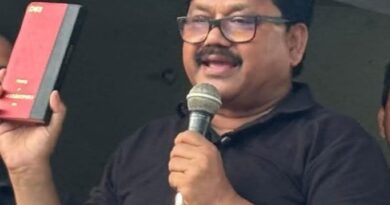
Youth Congress Challenges Protest Denial Before Delhi HC
(By Syed Ali Taher Abedi)
New Delhi, October 3, 2026-The Indian Youth Congress has carried its grievance against the Delhi Police’s refusal to permit a peaceful demonstration at Jantar Mantar directly to the Delhi High Court filing a writ petition that places before the constitutional court a question of enduring democratic importance whether the police’s power to regulate public assemblies extends to imposing a blanket prohibition on a lawful and peacefully intended demonstration, without any individualised assessment of the specific threat it poses to public order.
The petition, filed by IYC National President Uday Bhanu Chib and placed before the court through Advocate Roopesh Singh Bhadauria, is expected to be listed for hearing next week.
It challenges the Delhi Police’s order of October 1, 2026, rejecting the IYC’s application to hold a peaceful demonstration at Jantar Mantar against Chief Election Commissioner Gyanesh Kumar and raises constitutional arguments that go well beyond the immediate political controversy to engage the foundational principles governing the right of assembly in a constitutional democracy.
The Application and Its Rejection: A Timeline of Institutional Unresponsiveness
The facts of the case, as placed before the Delhi High Court, reveal a timeline whose procedural character is as constitutionally significant as its substantive outcome.
The IYC submitted its application to Delhi Police on September 25, 2026, seeking permission to hold a peaceful demonstration at Jantar Mantar India’s constitutionally recognised public protest site at the heart of the national capital involving approximately 100 to 150 participants.
The organisation expressly undertook in its application to comply with all lawful conditions relating to security, traffic management, discipline, and the maintenance of public order a voluntary assumption of responsibility that reflects the IYC’s acknowledgement of both the legitimacy of regulatory oversight and its own obligation to exercise the right of assembly in a manner consistent with public safety.
The application was submitted six days before the first proposed date of the demonstration.
Six days is, by any reasonable administrative standard, a sufficient period within which a considered and reasoned decision accepting, declining, or imposing conditions upon the application could and should have been communicated.
The Delhi Police’s track record of processing permission applications for demonstrations at Jantar Mantar is sufficiently established that the substantive and procedural framework for such decisions is not unfamiliar to the relevant administrative officers.
What the IYC received instead was silence. Repeated follow-ups communications addressed to the police seeking an update on the status of the application produced no response. And when the police’s decision finally arrived, it arrived on October 1 the very day on which the demonstration had been proposed to begin.
A rejection communicated on the first proposed date of the event is not, in any functionally meaningful sense, a timely administrative decision.
It is a decision timed to make the exercise of the right it denies practically impossible regardless of whether the organisation subsequently secured judicial relief to protect that right.
The Constitutional Arguments: Assembly, Expression, and the Limits of Police Regulation
The IYC’s petition before the Delhi High Court raises two foundational constitutional arguments whose implications extend well beyond the specific demonstration it sought permission to hold.
The first is grounded in Articles 19(1)(a) and 19(1)(b) of the Constitution of India the provisions that guarantee every citizen the freedom of speech and expression and the right to assemble peaceably and without arms.
These are not permissions granted by the state at its discretion. They are fundamental rights that every citizen possesses by virtue of the Constitution, whose exercise the state may regulate under Article 19(2) and Article 19(3) only through reasonable restrictions imposed in the interests of the sovereignty and integrity of India, public order, or the maintenance of friendly relations with foreign states.
The operative word in both provisions is “reasonable.” A restriction on the right of assembly that consists of a blanket prohibition issued without reasons, communicated on the first day of the proposed demonstration, and preceded by a period of administrative silence during which repeated requests for information went unanswered is not, the petition contends, a reasonable restriction.
It is an unreasoned administrative refusal whose practical effect is the extinguishment, rather than the regulation, of a fundamental constitutional right.
The second constitutional argument targets what the petition characterises as the mechanical application of guidelines governing protests and assemblies the deployment of a standardised administrative template in place of the individualised and proportionate assessment that the Constitution requires.
The constitutional jurisprudence of assembly rights, as developed by the Supreme Court of India across a series of landmark judgments, is clear on this point the police’s power to regulate public assemblies is not a power to prevent them.
It is a power to impose conditions on timing, location, numbers, and conduct that address specific and identified threats to public order.
A blanket refusal, unaccompanied by an assessment of the specific circumstances of the proposed demonstration, the specific risk it presents, and the specific absence of less restrictive alternative measures, is not the exercise of a regulatory power. It is the substitution of administrative convenience for constitutional obligation.
Jantar Mantar: A Constitutionally Designated Space for Democratic Dissent
The choice of Jantar Mantar as the proposed venue for the IYC’s demonstration is not incidental.
It is constitutionally and symbolically deliberate. Jantar Mantar has, across decades of democratic practice in the national capital, functioned as the designated public space for peaceful political demonstration the location to which citizens, political parties, civil society organisations, and social movements have historically directed their peaceful dissent, in the knowledge that the Constitution protects their right to do so.
Its designation as a protest venue reflects a constitutional accommodation the recognition that the right of assembly, to be meaningful, must include the right to assemble in spaces where the assembly can be seen and heard by those in authority and by the wider public.
A right of peaceful protest that can only be exercised in locations where no one is listening is a right that has been rendered substantially hollow.
The Delhi Police’s refusal to permit a demonstration of 100 to 150 people at a venue specifically designated and regularly used for public demonstrations without reasons, without individualised assessment, and without timely communication is an administrative decision whose constitutional defensibility the Delhi High Court is now invited to examine.
The Political Context: Who Is Gyanesh Kumar, and Why the IYC Sought to Demonstrate
The Chief Election Commissioner of India, Gyanesh Kumar, is the constitutional officer who heads the Election Commission of India the independent body vested under Article 324 of the Constitution with the superintendence, direction, and control of the preparation of electoral rolls and the conduct of elections to Parliament and State Legislatures.
The IYC’s desire to demonstrate against the Chief Election Commissioner reflects the political opposition’s publicly stated concerns about the independence, conduct, and decision-making of the Election Commission under its current leadership concerns that have been voiced in Parliament, in the courts, and in public discourse by multiple political parties and civil society actors across the spectrum of democratic opposition.
Whether those concerns are well-founded is a political and constitutional question whose adjudication belongs to the democratic process and, where specific legal issues are raised, to the courts.
What is not in question is that the right to publicly demonstrate against a constitutional officer to gather peaceably, to carry placards, to raise slogans, and to make visible a political grievance is a right that the Constitution guarantees to every citizen and every organisation, regardless of the political sensitivity of the subject matter or the institutional stature of the officer against whom the demonstration is directed.
A democracy that permits criticism of constitutional officers only in Parliament and in courts but suppresses it on the street has not merely regulated the right of assembly.
It has fundamentally misunderstood what that right is for.
The High Court’s Constitutional Role: Protecting the Street, Not Just the Courtroom
When the Delhi High Court takes up the IYC’s petition next week, it will be called upon to exercise the supervisory constitutional jurisdiction that distinguishes a constitutional court from an ordinary appellate tribunal the jurisdiction under Article 226 of the Constitution to issue directions, including writs of mandamus, against public authorities who have failed to discharge their constitutional and statutory obligations.
In this instance, the relevant obligation is the obligation to deal with an application for permission to hold a peaceful demonstration through an individualised, reasoned, and timely administrative process one that neither assumes the demonstration to be a threat without evidence, nor communicates its decision so late as to make the exercise of the underlying right practically impossible.
The petition also raises the question of whether Delhi Police’s guidelines governing demonstrations at Jantar Mantar, as applied in this case, are consistent with the constitutional framework governing the right of assembly a question that the High Court may address with consequences for future applications that extend well beyond the IYC’s immediate case.
The Broader Democratic Stakes: Regulation Versus Suppression
The case of the Indian Youth Congress’s blocked demonstration is, in its constitutional essence, a case about the difference between the regulation of public assembly and its suppression a difference that the Supreme Court of India has repeatedly held to be of the highest constitutional importance.
Regulation is constitutionally permissible. It involves the imposition of conditions on numbers, timing, location, and conduct that address identified and proportionate concerns about public order, traffic management, and security. Regulation acknowledges the right and manages its exercise.
Suppression is constitutionally impermissible. It involves the denial of the right without reasons, without individualised assessment, and without regard for the fundamental character of what is being refused. The Delhi Police’s October 1 order, arriving on the very day the demonstration was to begin, following a week of administrative silence in response to repeated follow-up requests, carries the character of suppression rather than regulation and it is that characterisation that the Delhi High Court is now being asked to examine and, if confirmed, to correct.
The right to peaceful assembly is not a licence issued by the state. It is a fundamental right guaranteed by the Constitution. The state may regulate its exercise. It may not extinguish it.