
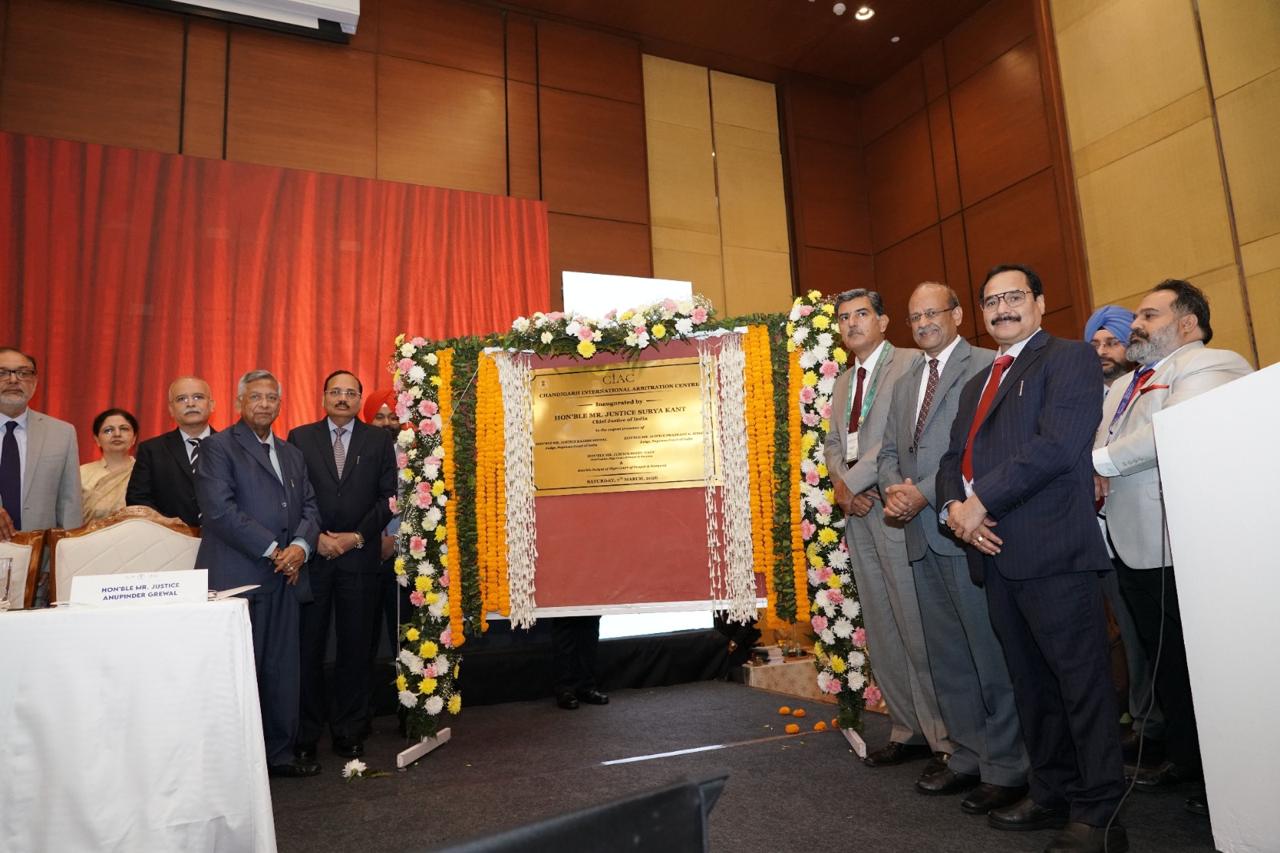
Chandigarh Steps onto Global ADR Map with CJI Surya Kant’s Vision
(By Syed Ali Taher Abedi)
Chandigarh, March 7: Chief Justice of India, (CJI) Justice Surya Kant, on Saturday formally inaugurated the Chandigarh International Arbitration Centre (CIAC), a milestone in India’s journey towards strengthening its institutional architecture for international dispute resolution.
The launch coincided with the inaugural edition of the India International Disputes Week (IIDW), drawing jurists, arbitration practitioners, policymakers, and industry leaders from across jurisdictions.
In his address, the Chief Justice underscored that the CIAC must aspire to be a model institution of global standing, embodying the highest standards of neutrality, efficiency, and procedural fairness.
He declared that the Centre must represent “neutrality beyond doubt, efficiency beyond promise, and procedural integrity beyond reproach.” These principles, he emphasised, are indispensable if the institution is to command the confidence of both domestic and international stakeholders who increasingly turn to arbitration for resolving complex commercial disputes.
Reflecting on India’s expanding economic footprint, Justice Kant observed that the nation’s growing participation in global trade and investment has inevitably led to a rise in cross-border disputes. While this expansion signals confidence in India’s markets and institutions, it also demands a robust and credible dispute resolution ecosystem.
The Chief Justice cautioned that the true measure of India’s arbitration landscape will not lie in the proliferation of statutes or centres alone.
By 2030, he noted, the framework will be judged by substantive benchmarks the consistency of neutrality, the predictability of enforcement, the swiftness of resolution, and the adaptability of institutions to evolving global practices.
He further stressed that the central question before India is not merely legislative capacity, but whether its institutions can inspire sustained confidence among international investors and legal communities worldwide.
On the role of courts, Justice Kant articulated that judicial institutions must serve as guardians of the arbitral framework, ensuring respect for agreements, timely enforcement of awards, and minimal intervention—limited only to circumstances necessary to preserve fairness and legality.
Such judicial restraint, he remarked, would reinforce the credibility of India’s arbitration regime and encourage greater reliance on institutional arbitration.
Commending the organisers of IIDW, the Chief Justice lauded the initiative for fostering dialogue among diverse stakeholders—judiciary, practitioners, policymakers, and industry representatives.
He observed that such platforms contribute to building a responsive and globally competitive dispute resolution environment, positioning India as a trusted hub for international arbitration.

