“A Profession, Not a Trade”: Justice BV Nagarathna’s Blunt Message to the Bar
(By Syed Ali Taher Abedi)
NEW DELHI, AUGUST 29, 2026: Supreme Court Justice B.V. Nagarathna delivered a sharp indictment of the Bar Council system’s institutional health on Saturday, calling upon bar councils to earn not assume the respect of their members and warning that a profession unable to command respect from within cannot expect to command it from outside.
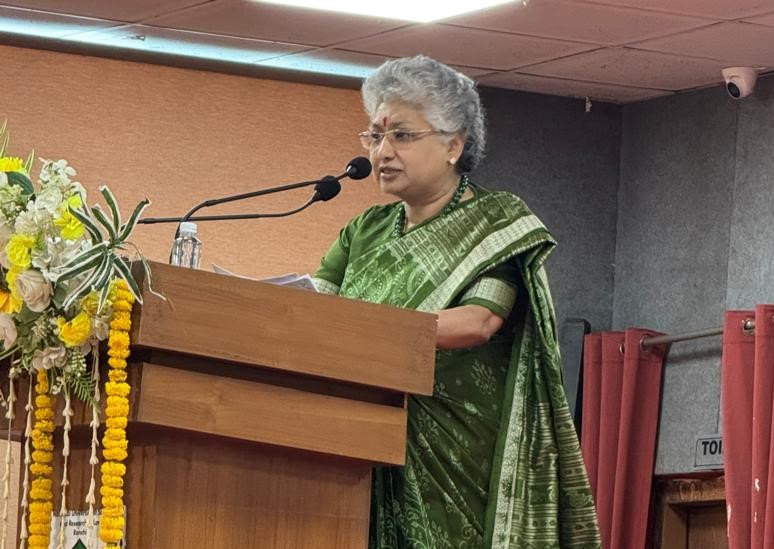
Addressing the 13th convocation of National Law University Delhi, Justice Nagarathna urged the graduating class to see themselves not as traders in legal knowledge but as officers of a constitutional trust.
Her remarks delivered in the measured but unmistakably pointed diction that has characterised Justice Nagarathna’s public addresses throughout her distinguished judicial career arrived weeks after the Bar Council of India’s most publicly damaging self-inflicted institutional wound in recent memory the August 13 directive by BCI Chairman Manan Kumar Mishra threatening to bar the entire NALSAR Hyderabad 2026 graduating batch from professional enrolment as advocates, in apparent retaliation for the students’ representation questioning the CJI’s convocation invitation.
Also present at the convocation were Delhi High Court Chief Justice Devendra Kumar Upadhyaya, who serves as the university’s Chancellor, judges of the Delhi High Court, and Vice-Chancellor Professor GS Bajpai.
The Observation That Defined the Address: Earning Respect, Not Demanding It
Justice Nagarathna’s most pointed observation and the one that will be most widely quoted in the weeks that follow was directed not at the graduating class but at the institutions that are supposed to represent and regulate them.
“The Bar Councils, whether Central or the States, must introspect their role and importance in upholding professional ethics, morality and professional competence.
When a Bar Council does not earn the respect of its members, it is not a good sign for the legal profession,” she said.
The statement is precise in its constitutional implications. A bar council’s authority over the legal profession flows from the Advocates Act, 1961 a statutory framework that confers regulatory power not for the benefit of those who exercise it but for the benefit of the profession and the public it serves.
That authority is legitimate only when it is exercised in a manner that commands the genuine respect of the members over whom it is claimed.
When the exercise of regulatory power produces not respect but active institutional dissent protests outside the BCI’s offices, formal demands for the chairman’s resignation from a sitting co-chairman, resolutions of condemnation from bar associations across the country, and writ petitions before the Supreme Court the authority has not merely been misused. It has been eroded at its source.
Justice Nagarathna’s observation that this erosion is not a good sign for the legal profession is a judicial understatement of the first order.
It is, in its quiet precision, a more devastating institutional critique than any number of more emphatic condemnations would have been because it comes not from a political rival, not from an aggrieved member, but from a sitting judge of the Supreme Court of India, speaking at the convocation of a national law university, in terms whose constitutional seriousness no institutional actor within earshot can afford to dismiss.
The Contextual Backdrop: NALSAR, Mishra, and the Enrolment Threat
That Justice Nagarathna’s remarks at NLU Delhi’s convocation arrive in the shadow of the BCI’s NALSAR controversy is not coincidental and the legal fraternity will read them with full awareness of that backdrop.
The BCI Chairman’s August 13 directive threatening to bar the enrolment of NALSAR’s entire 2026 graduating batch as advocates because students had questioned the appropriateness of the CJI’s convocation invitation was, by the near-universal assessment of the legal fraternity, an act of regulatory overreach whose constitutional implications were as grave as its institutional consequences were immediate.
It threatened the professional futures of dozens of young lawyers as a mechanism of institutional retaliation for the exercise of their constitutional right to express an opinion.
It was withdrawn within hours under the pressure of universal condemnation. But it was not forgotten.
Justice Nagarathna’s observation that a bar council which does not earn the respect of its members is not a good sign for the legal profession is, in the context of the NALSAR episode, a judicial statement about what the BCI’s conduct communicated to the graduating class it threatened, to the legal profession it claims to regulate, and to the constitutional values it is supposed to uphold.
The Institutional Challenge: One Voice Against Pendency and Delay
Beyond her pointed observations about bar councils, Justice Nagarathna placed the BCI crisis within a broader institutional argument about the role the Bar must play in addressing the most persistent structural failure of India’s justice system the crushing burden of pendency and delay that deprives millions of litigants of timely access to the legal remedies they are constitutionally entitled to seek.
She said the Bar in India must rise and speak in a singular voice on how it could sustain the system of justice dispensation in India, pointing to pendency, delays, rising costs and uncertainty in the system.
The call for a singular voice is an implicit critique of the institutional fragmentation that the BCI’s current leadership crisis exemplifies.
A regulatory body that is simultaneously the subject of a resignation demand from its own co-chairman, a formal resolution from the Bombay Bar Association, condemnation from CJAR, a writ petition before the Supreme Court, and public dissent from advocates protesting outside its offices is not a body capable of speaking in any single voice let alone the singular, authoritative, constitutionally grounded voice that the challenge of judicial reform demands.
The connection between bar council institutional integrity and the broader project of judicial reform is one that Justice Nagarathna has drawn with deliberate constitutional intentionality.
An organised, respected, and institutionally coherent Bar is not merely a professional desideratum it is a constitutional necessity for the functioning of the adversarial justice system.
When the Bar’s representative bodies are consumed by internal crisis, the energy that should be directed toward systemic reform is spent on institutional self-defence.
The pendency, the delay, the rising costs, and the uncertainty that Justice Nagarathna identifies as the justice system’s most urgent challenges are not addressed by a Bar Council at war with itself.
On the Independence of the Bar: A Constitutional Mandate, not a Privilege
Justice Nagarathna’s address was not merely a critique of present institutional dysfunction. It was an affirmative statement of what bar independence is for and why its erosion is a constitutional concern that extends far beyond the legal profession’s internal politics.
“The independence of the bar is not an entitlement given to lawyers for their own benefit.
It exists because a constitutional democracy requires a body of professionals who can advise, argue, challenge and represent without having to ask the permission of the State, the market, or even their own clients before doing so,” she said.
The formulation is constitutionally precise and institutionally vital. Bar independence is not the legal profession’s privilege it is the legal system’s functional requirement.
A lawyer who cannot advise without the state’s permission, who cannot argue without the market’s approval, who cannot challenge without the client’s authorisation, is not a lawyer in the constitutional sense at all. He or she is a conduit one through whom institutional power flows in directions predetermined by forces other than the law and the client’s legitimate interests.
The NALSAR episode, read through the lens of Justice Nagarathna’s formulation, is a case study in what happens when the body charged with protecting bar independence itself becomes the instrument of its infringement when the regulatory authority threatens a graduating class with professional exclusion for doing precisely what bar independence requires: advising, arguing, and challenging without asking anyone’s permission.
A Profession, Not an Occupation: The Warning to the Graduating Class
Justice Nagarathna’s address was simultaneously a diagnosis of the institutional present and a charge to those entering the profession and she delivered the latter with a directness that the graduates of NLU Delhi deserved to hear on the day they received their degrees.
She cautioned that any lapse or errors of the Bar will have a deep impact on political and civic life, and urged lawyers to change their mindset and work for their clients as a public service, lest they lose their relevance in the future.
On the legal profession more broadly, she said: “A profession is not an occupation or a trade but an office of trust and cannot be reduced to a person who sells legal knowledge by the hour.”
The distinction between a profession and a trade is not merely semantic. An occupation is defined by the service it provides and the payment it receives for that service.
“When a Bar Council does not earn the respect of its members, it is not a good sign for the legal profession. As the legal system in India is bogged down by pendency, delays, rising costs and uncertainty, the Bar in India must rise and speak in a singular voice as to how it could sustain the system of justice dispensation in India”
A profession is defined by the ethical obligations it undertakes, the public trust it holds, and the constitutional functions it serves.
A lawyer who treats legal practice as a commercial transaction exchanging knowledge for money, performing a service for a fee, optimising income without reference to the public dimension of the professional role has misunderstood not merely the ethics of the profession but its constitutional identity.
Justice Nagarathna’s insistence that the legal profession is an office of trust not a commercial enterprise, not a knowledge-selling operation, not a market player in the economics of dispute resolution is a charge to the graduates of NLU Delhi that they carry, as they enter practice, the constitutional obligations of the office they have been educated to hold.
She closed her address by telling the graduating batch that they leave their institution as Officers of the Court and Stewards of the Constitution a valedictory formulation whose weight, in the current institutional moment, is particularly apt. Officers of the Court.
Stewards of the Constitution. Not employees of clients. Not instruments of institutional power. Not members of a trade.
Officers and Stewards of institutions whose integrity they are now, by virtue of their professional admission, constitutionally responsible to protect.
The Timeliness of the Message: A Judicial Voice at the Right Moment
Justice BV Nagarathna’s convocation address at NLU Delhi on August 29 arrives at a moment when the legal profession in India is engaged in the most intense and consequential internal reckoning it has faced in years a reckoning about who its regulatory institutions serve, what values they represent, and whether the men and women who occupy positions of authority within them are worthy of the trust the profession has placed in them.