
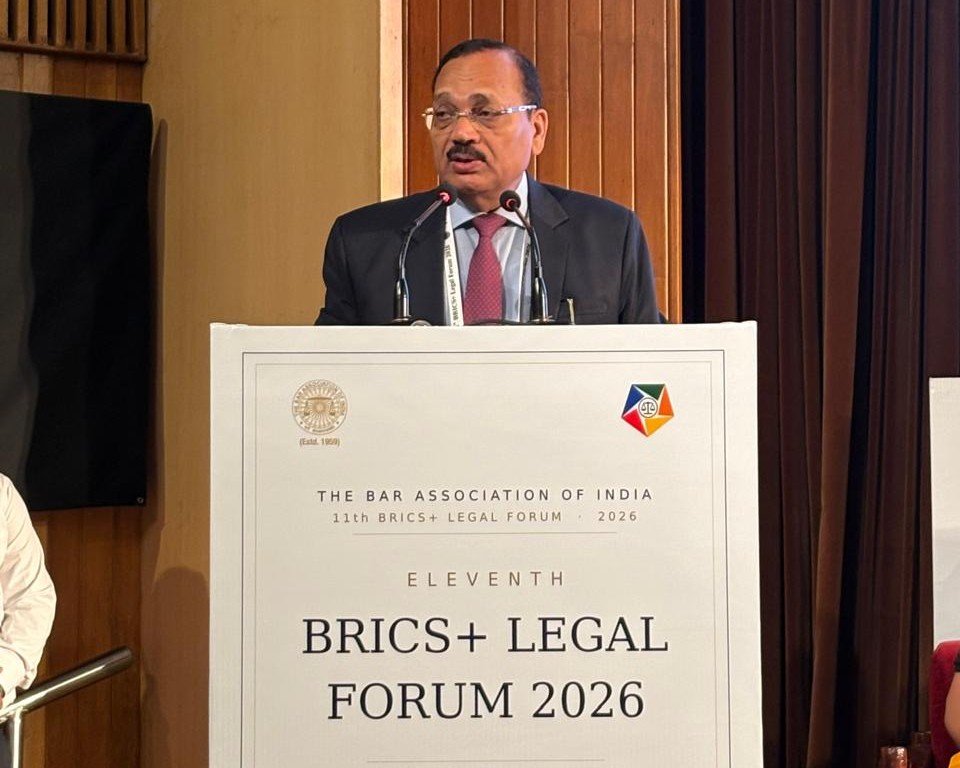
CJI Surya Kant to Lead High-Level Judicial Diplomacy as BRICS Chief Justices’ Forum Opens in New Delhi
Bilateral engagements with judicial heads from ten nations to focus on institutional cooperation, cross-border justice and emerging legal challenges
(By Syed Ali Taher Abedi)
New Delhi, September 3, 2026: Chief Justice of India Justice Surya Kant is scheduled to hold a series of bilateral discussions with senior judicial leaders from BRICS member states and partner countries during the BRICS Chief Justices’ Forum, which is slated to be held in New Delhi from September 4 to 6.
The three-day judicial conclave is being hosted by the Supreme Court of India and is expected to serve as a significant platform for deliberations on the evolving demands of justice administration in an increasingly interconnected world.
The forum is expected to convene Chief Justices, Presidents of Supreme Courts and other senior judicial representatives from BRICS member states and partner countries, providing a high-level platform for judicial dialogue and exchange on matters of institutional significance.
The deliberations are likely to examine the evolving challenges before justice delivery systems, with particular emphasis on the administration of justice, access to effective and timely remedies, international dispute resolution, the responsible integration of technology into judicial processes, and the judiciary’s constitutional and institutional role in furthering the principles of sustainable development and the rule of law.
CJI Surya Kant to engage judicial heads from ten countries
On the inaugural day of the conclave, September 4, Chief Justice of India Surya Kant is slated to convene bilateral consultations with the heads of judicial delegations from Russia, China, Egypt, Indonesia, the United Arab Emirates, Belarus, Kazakhstan, South Africa, Iran, and Uzbekistan.
The proposed meetings are intended to facilitate direct exchanges on issues of mutual judicial concern and to deepen institutional cooperation among the participating judiciaries.
The Chief Justice of India shall receive in official audience the following heads of foreign judiciaries and distinguished jurisprudence officials:
His Excellency Igor Krasnov, Chief Justice of the Supreme Court of the Russian Federation;
His Excellency Zhang Jun, Chief Justice of China and President of the Supreme People’s Court;
His Excellency Boulos Gahmy Iskander Boulos, Chief Justice of the Supreme Constitutional Court of the Arab Republic of Egypt; and
His Excellency Sunarto, Chief Justice of the Supreme Court of the Republic of Indonesia.
The visiting judicial leadership will also comprise Mohammed Hamad Al Badi Al Dhaheri, President of the UAE Federal Supreme Court; Andrei Shved, Chairman of the Supreme Court of Belarus; Aslambek Mergaliyev, Chairman of the Supreme Court of Kazakhstan; Mahube Betty Molemela, President of the Supreme Court of Appeal of South Africa; Ayatollah Gholam Hossein Mohseni-Eje’I, Chief Justice of Iran; and Malikakhon Kalandarova, Deputy Chairperson of the Supreme Court of Uzbekistan.
The bilateral engagements assume particular significance against the backdrop of growing judicial interdependence across jurisdictions.
They are expected to provide an avenue for the exchange of institutional experience, judicial best practices and perspectives on the legal and procedural questions arising from transnational commerce, technological advancement and global governance.
Delegation heads to present perspectives on common judicial concerns
On the second day of the forum, the heads of participating delegations are expected to address the gathering and place before the forum their respective perspectives on matters of common concern to judicial institutions.
Judicial representatives from Brazil, China, Egypt, Ethiopia, Indonesia, Iran, Russia, South Africa and the UAE are expected to participate, along with partner countries including Belarus, Bolivia, Kazakhstan, Malaysia, Thailand, Uganda and Uzbekistan.
The proceedings are likely to underscore the importance of sustained judicial dialogue in addressing legal challenges that extend beyond national borders.
By bringing together the leadership of apex and constitutional courts, the forum seeks to strengthen mutual understanding and promote structured cooperation among the participating legal systems.
Four principal themes before the BRICS judicial forum
The substantive agenda of the forum is structured around four principal themes, each reflecting a major area of contemporary judicial and legal concern.
| Theme | Principal focus |
| Mediation and international commercial disputes | The role of mediation as a strategic and efficient mechanism for resolving commercial disputes in a globalised economy. |
| Cross-border enforcement of arbitral awards | Enforcement-related difficulties and the possibility of greater procedural harmonisation among jurisdictions. |
| Artificial intelligence and the judiciary | Digital innovation, the responsible use of artificial intelligence and its implications for the future administration of justice. |
| Judicial leadership and sustainable development | The judiciary’s role in ecological governance and in promoting sustainable energy systems. |
The first thematic session will examine mediation and international commercial disputes, with emphasis on mediation as an important instrument for securing expeditious and effective resolution of commercial conflicts in the global marketplace.
The second will consider the cross-border enforcement of arbitral awards, including practical impediments to enforcement and the scope for harmonising procedures across legal jurisdictions.
The third theme artificial intelligence and the judiciary is expected to invite deliberation on the transformative impact of digital innovation on courts and judicial administration.
Judicial leaders are likely to examine both the opportunities presented by artificial intelligence and the institutional implications of integrating such technologies into systems of justice while preserving fairness, accountability and judicial independence.
The fourth subject, judicial leadership and sustainable development, will explore the judiciary’s contribution to ecological governance and the advancement of sustainable energy systems.
The discussion is expected to reflect the expanding recognition that courts and judicial institutions have an important role in interpreting and enforcing legal frameworks relating to environmental protection and sustainable development.
The Supreme Court of India has indicated that the forum is expected to deepen judicial dialogue, enable the exchange of experiences and reinforce cooperation among BRICS member states and partner countries in responding to emerging legal and institutional challenges.
The New Delhi gathering, therefore, carries the potential to consolidate a broader framework of judicial engagement founded upon dialogue, institutional respect and the shared pursuit of accessible and effective justice.

