‘Constitution Will Not Be Silenced’: Ex-Justice Muralidhar Says Gen Z’s Resistance Is a Reassuring Verdict for Indian Democracy
At the DS Borker Memorial Lecture, the former Orissa High Court Chief Justice cautions against weaponizing criminal law, weakening dissent and allowing courts themselves to become instruments of oppression
(Judicial Quest News Network)
New Delhi, August 26, 2026: Former Orissa High Court Chief Justice and Senior Advocate Justice S Muralidhar has said that the recent mobilisation of India’s Gen Z offers a significant measure of reassurance for the future of the country’s constitutional democracy.
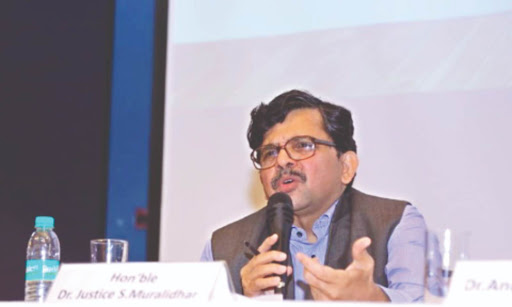
Speaking at the DS Borker Memorial Lecture, titled “My Vision of India: 2047 AD,” at the India International Centre in New Delhi, Justice Muralidhar said young Indians had demonstrated that they would not be easily distracted or silenced by political rhetoric, propaganda or attempts to stigmatise dissent.
His address combined a defence of democratic freedoms with a pointed critique of the State, the legal system and the judiciary.
At its core was the argument that the Constitution must remain a living safeguard for citizens who question authority, criticise governments and peacefully resist the denial of basic rights.
Gen Z and the constitutional culture of dissent
Justice Muralidhar said the recent protests by young people had shown a willingness to scrutinise official narratives rather than accept them unquestioningly.
He referred to attempts to describe protesters as “Dimagi Naxals”a phrase the report attributes to Prime Minister Narendra Modi and said the young generation had remained undeterred by such labels.
“It was reassuring to know that our young generation will not be swayed by rhetoric and propaganda,” Justice Muralidhar said, according to the report.
He described the protests as evidence of a generation that values compassion, truth and the freedom to ask difficult questions of those in power. In his view, the irreverence and humour associated with Gen Z should not be dismissed as political immaturity; rather, they may be read as signs of a confident democratic culture.
“It was reassuring to know that our young generation will not be swayed by rhetoric and propaganda, by powerful oratory reminiscent of the goebellsian polemic, and empty promises of acche din and viksit bharat. They remained undeterred by the demonising of the dimagi naxal. It told us that this generation values giving, compassion and adherence to truth. It does not hesitate to ask questions of those in power. Above all, it is soul-satisfying to know that Gen Z has a wonderful sense of humour. The irreverence of the Gen Z is a sure sign of democratic progress”
Justice Muralidhar further suggested that the protests had reaffirmed the public’s continuing faith in the Constitution.
He said the younger generation had conveyed that democracy would not simply be permitted to wither and that citizens would turn to constitutional values to protect the country’s future.
Free speech must remain protected under the rule of law
The former Chief Justice said the India of 2047 would be better served by a legal order that protects honest criticism of the government and those holding public office.
“It told us that this generation values giving, compassion and adherence to truth. It does not hesitate to ask questions of those in power. Above all, it is soul-satisfying to know that Gen Z has a wonderful sense of humour. The irreverence of the Gen Z is a sure sign of democratic progress.”
In that vision, satire, cartoons, humour and political commentary should not automatically be converted into criminal conduct.
“Law should not be used to target a group for what they wear and what they eat”
He also cautioned against the use of criminal law against peaceful protesters.
According to Justice Muralidhar, citizens who demonstrate against the denial of basic rights should not be portrayed as conspirators merely because they challenge governmental decisions or demand accountability.
“The India of 2047 would be better served if the law of today does not permit criminalising of honest criticism of a government or those running it, of their being lampooned in cartoons or joked about by stand-up comedians. The India of 2047 would be better served if the government of the day stops weaponizing law to punish those who peacefully protest about the denial of basic rights and if it stops labelling them as sinister acts of conspiracy to destabilise the government. The India of 2047 will be better served if the plethora of preventive detention legislations and the draconian bail-denying provisions of the UAPA, the PMLA and other similar enactments, are repealed. In 2047 such enactments should be accessible only in parliamentary and judicial archives. “
The remarks place freedom of expression, peaceful assembly and the right to dissent at the centre of his constitutional vision.
They also raise a broader legal question whether criminal law is being used as a shield for public order or as a sword against legitimate democratic disagreement.
| Constitutional concern | Justice Muralidhar’s reported position |
| Political criticism | Honest criticism of the government should not be criminalised. |
| Satire and humour | Cartoons, jokes and stand-up comedy should remain within the protected space of public discourse. |
| Peaceful protest | Protest against the denial of basic rights should not be treated as a conspiracy to destabilise the government. |
| Personal autonomy | Personal choices such as marriage and cohabitation should not be criminalised. |
| State accountability | Government action must remain open to scrutiny and challenge. |
Justice Muralidhar also referred to what he described as a series of uniform civil code laws enacted in some BJP-ruled States.
“A day when we find there is no Trump, no Putin, no Xi, no Erdogan, and India has a biological PM! India is at peace with her neighbours.”
In that context, he argued that the constitutional order of the future should not criminalise personal decisions involving marriage or cohabitation.
Warning against concentration of wealth and political power
Turning to the economic and political structure of the country, Justice Muralidhar identified the growing concentration of wealth and power as a serious concern for India’s democratic future.
“The growing inequality in wealth and power both externally and within the country is a cause for concern. And so is the bitter truth that our governments are controlled by corporate oligopolies here and abroad to serve their interests.”
He alleged that governments were increasingly influenced by corporate oligopolies and that public policy could be diverted from the common good towards the interests of powerful economic groups.
“By taking arbitrary decisions, or not deciding at all, or by unthinkingly criminalising normal activities in a democracy like peaceful protests and unnecessary arrests, governments drive people to courts. This explains why despite the delays, costs and uncertainties in the court system, the filings have grown over the years.”
He also made an apparent reference to Prime Minister Modi’s earlier remarks about being “non-biological” while imagining an India of 2047 in which the country would have a “biological Prime Minister.” The comment formed part of a wider critique of the concentration of political power in the hands of dominant leaders.
“The judiciary’s track-record in delivering on the constitutional promise of being a bulwark between the people and an anarchic state has, at best, been inconsistent and quite often, disappointing. The attempts at creating a false equivalence between fundamental rights and fundamental duties misses the point about the obvious imbalance between the mighty powerful state that monopolises the use of force and a citizen seeking the protection and enforcement of the basic survival rights to life and human dignity”
These observations, taken together, presented democracy not merely as a periodic electoral exercise, but as a continuing constitutional commitment to dispersed power, institutional checks and public accountability.
Judiciary must remain a bulwark, not a site of oppression
Justice Muralidhar reserved some of his strongest criticism for the justice system itself.
He said governments often drive citizens towards the courts through arbitrary decisions, administrative inaction, unnecessary arrests and the criminalisation of ordinary democratic conduct.
“Our courts cannot be compared to automobile assembly lines and disposal of cases is not the same thing as assembling cars. It is too simplistic to think that by merely appointing more judges the existing pendency of cases can be effectively tackled. Every case filed in the system is not a pending case because it has to go through different stages before it can be said to be ready for a final hearing and disposal. Further, each category of case has a different life cycle having regard to its complexity. A murder case cannot be compared to a motor accident or a traffic violation case.”
However, he cautioned that the judiciary’s own record in protecting citizens from excessive State power had been inconsistent.
The courts, he said, could not claim the moral authority of constitutional guardians if their procedures became oppressive or inaccessible to the very people they are meant to protect.
“If courts themselves and their processes turn into sites of oppression, it will undermine the faith of the people in the justice system and its ability to deliver fair and equal justice,” Justice Muralidhar said, as reported by Bar & Bench.
The warning carries particular significance in a constitutional democracy. Judicial independence is not limited to institutional freedom from the executive or legislature it also requires courts to function fairly, transparently and with sensitivity to the litigant who seeks protection of law.
Pendency cannot be solved by numbers alone
On judicial delays, Justice Muralidhar rejected the idea that courts can be treated like production lines in which the simple addition of judges automatically produces faster justice.
He argued that case disposal is fundamentally different from manufacturing output because every case involves human rights, competing claims, legal complexity and the consequences of State action.
The report notes that Justice Muralidhar referred to more than 5.1 crore pending cases in district courts, approximately 65 lakh cases in the High Courts and nearly 93,000 cases before the Supreme Court. [1]
He also drew attention to the pressures borne by judges, including the emotional burden of deciding disputes involving human suffering, criticism from lawyers and litigants, anonymous complaints, anxiety over disposal targets, media scrutiny and strictures from superior courts.
While highlighting these pressures, he maintained that judges alone could not be blamed for the problem of delay.
Judicial pendency, in his assessment, is a structural issue involving governments, litigants, lawyers, court administration and the wider legal system.
Call to dismantle colonial remnants in judicial administration
Justice Muralidhar also criticised what he described as the continuing influence of patriarchal and feudal practices within judicial administration.
He questioned the persistence of rigid protocols, archaic forms of address and inherited institutional conventions that, in his view, have survived long after Independence.
He called for these practices to be acknowledged, examined and dismantled.
The objective of reform, he suggested, should not be limited to improving statistics or increasing disposal rates.
The real test should be whether an ordinary litigant can approach the justice system more easily, understand its procedures and obtain fair relief without being overwhelmed by institutional complexity.
His criticism was directed at a legal system that, he said, continues to revolve around the convenience of lawyers, judges and the State rather than the needs of litigants.
A genuinely democratic justice system, in this view, must be litigant-centric, accessible and accountable to its users.
A constitutional vision for 2047
Justice Muralidhar’s lecture presented a broad constitutional agenda for India’s centenary year: protect dissent, restrain the misuse of criminal law, safeguard personal autonomy, prevent the concentration of political and economic power, and restore public confidence in the courts.
His message was both cautionary and hopeful. The caution was that democratic institutions lose legitimacy when criticism is criminalised, peaceful protesters are treated as threats, and legal processes become inaccessible or oppressive.
The hope was that citizens particularly the younger generation continue to recognise the Constitution as an instrument through which power can be questioned and accountability demanded.
In that sense, Justice Muralidhar’s remarks amounted to a reminder that the ultimate strength of Indian democracy lies not only in its institutions, but also in the willingness of citizens to insist that those institutions remain faithful to the rule of law.
Editorial note: This article is an original rewrite based on the report cited below.
Political and institutional criticisms have been attributed to Justice Muralidhar and should not be read as independently established findings.