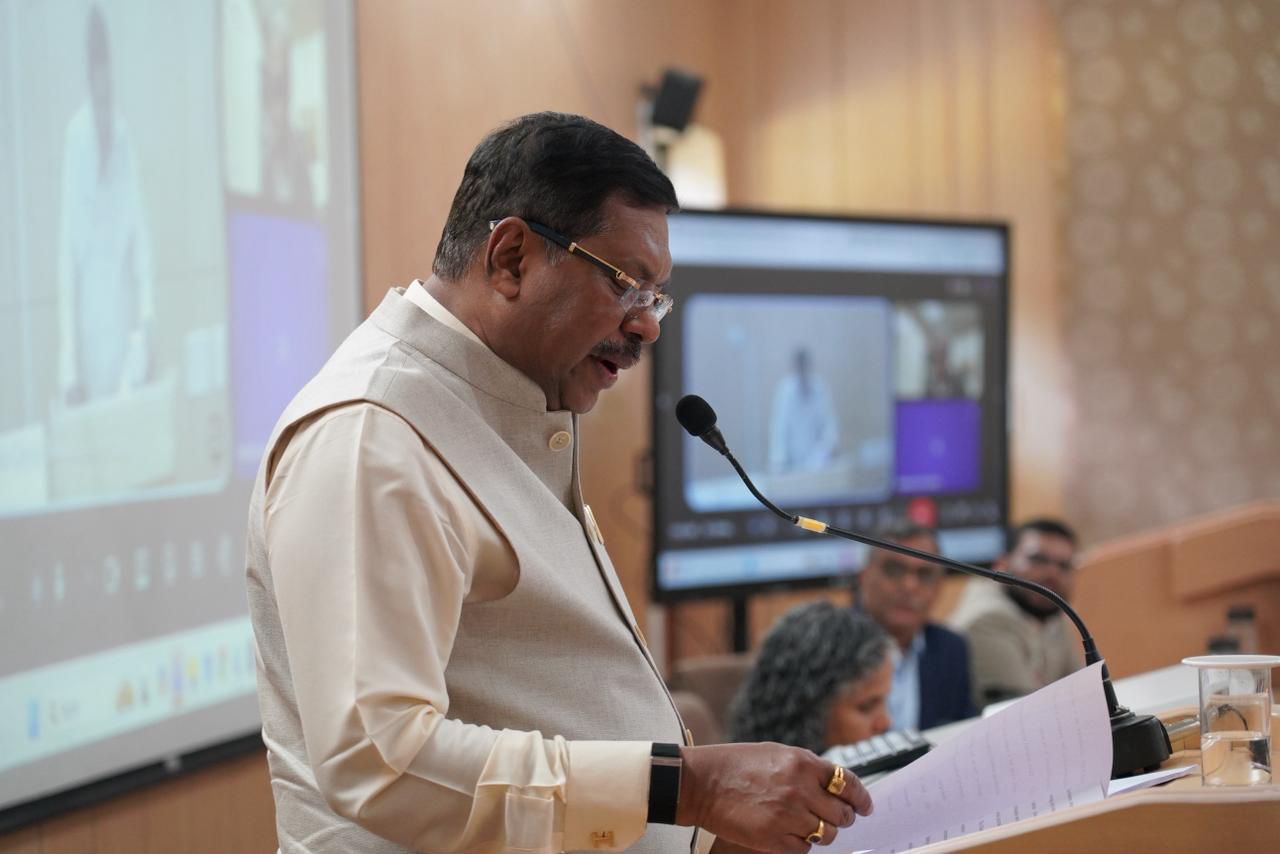
When Silence Becomes Evasion, the Bar Must Find Its Voice: Former CJI Gavai Issues a Constitutional Summons to Conscience in Colombo
(By Syed Ali Taher Abedi)
Sri Lanka,10, May,2026-In an address that resonated far beyond the shores of the Indian Ocean, former Chief Justice of India Justice B.R. Gavai stood before the Bar Association of Sri Lanka and delivered what can only be described as a manifesto for the age — a clarion call for the legal profession to remain the last, unyielding bulwark between constitutional democracy and its erosion.
The Occasion: A Bar Association, A Region, A Reckoning
Justice Gavai addressed the Bar Association of Sri Lanka on the topic of the role of an independent Bar in protecting the constitution and the rights of citizens a subject that, in the current geopolitical and judicial climate of South Asia, could not have been more urgently chosen.
“The true strength of a Bar Association is not measured merely by the number of lawyers it represents. Its strength lies in whether it possesses the courage to speak when silence is convenient, whether it can defend institutional integrity when institutions themselves are under strain, and whether it can continue to nurture younger generations of lawyers with a sense of professional ethics and public responsibility.”
The timing was deliberate, the audience receptive, and the message unflinching.
This was not a ceremonial address dressed in pleasantries.
It was a judicial reckoning an eminent jurist, having presided over one of the world’s largest and most complex constitutional courts, speaking directly to a fraternity of lawyers about what they owe to the societies that vest their trust in the rule of law.
The Core Thesis: Independence as Constitutional Necessity, Not Professional Privilege
At the heart of Justice Gavai’s address lay a proposition of foundational importance that the independence of the Bar is not merely a professional privilege to be safeguarded by lawyers for their own benefit, but a constitutional necessity one that ensures citizens receive fearless legal representation and that the state remains accountable through constitutional challenge.
“Much is often said about the necessity of an independent judiciary for the functioning of a democracy. That proposition is, of course, undeniable. Courts are the ultimate interpreters of the Constitution. But an independent judiciary does not operate in isolation. Its independence is both sustained and tested through the functioning of an independent Bar”
It is a distinction that matters enormously. Professional privilege can be regulated, curtailed, even bargained away through legislative amendment. Constitutional necessity, by contrast, is structural it goes to the very architecture of how a democratic republic sustains itself.
By framing Bar independence in the latter terms, Justice Gavai elevated the conversation from guild interest to civic obligation.
He was equally emphatic that the Bar and the Bench are not rival institutions but complementary ones together forming the twin pillars upon which accountability in a democracy ultimately rests.
Where one falters, the other is weakened. Where both stand firm, the constitutional order holds.
A Tribute to Sri Lanka’s Legal History
Justice Gavai offered measured but meaningful praise for the Bar Association of Sri Lanka, acknowledging that the institution has earned public trust over the years by consistently standing for justice, constitutionalism, and citizens’ rights and that it has demonstrated the courage to take principled stands during particularly difficult constitutional moments in Sri Lanka’s history.
For a nation that has endured executive overreach, constitutional crises, and the long shadow of a civil conflict that tested every institution of the state, those words carried the weight of lived history.
The Bar Association of Sri Lanka has not always operated in comfortable conditions. That its independence has survived those conditions is itself a testament to the principal Justice Gavai was expounding.
“Over the last five decades, the Bar Association of Sri Lanka has emerged not only as a professional body of lawyers, but as a moral and constitutional presence within the life of the nation.
Its roots stretch far deeper than 1974. They travel back to the early foundations of the legal profession in Sri Lanka, to a time when the profession itself was divided into separate branches of advocates and proctors.
Yet, through these institutional transitions and historical transformations, one principle remained constant the belief that the law must ultimately serve society, and that the legal profession carries responsibilities that go beyond courts, briefs, and statutes.”
The Lawyer as History-Maker: From Gandhi to Ambedkar
Ranging across history to substantiate his argument, Justice Gavai observed that throughout the ages, lawyers have shaped societies in ways that extend far beyond the courtroom.
Drawing on India’s own freedom movement, he pointed to the transformative contributions of lawyer-statesmen such as Mahatma Gandhi, B.R. Ambedkar, Jawaharlal Nehru, and Sardar Vallabhbhai Patel figures who wielded constitutional and legal reasoning as instruments of social and political change.
The point was not merely historical. It was a reminder to every practitioner in the audience that the law brief they hold today exists in a long continuum of advocacy that has, at its finest moments, changed the course of nations.
The lawyer who stands before a court arguing for a citizen’s rights is engaged in the same fundamental enterprise as those who drafted constitutions and argued before colonial tribunals for the dignity of a people.
Landmark Jurisprudence: The Basic Structure Doctrine and Due Process
Justice Gavai drew specific attention to the Supreme Court of India’s landmark ruling in Kesavananda Bharati v. State of Kerala, noting how the arguments advanced by the celebrated jurist Nani Palkhivala before that bench gave rise to the basic structure doctrine the constitutional principle that places certain foundational features of the Indian Constitution beyond the amending power of Parliament itself.
In citing this case, the former Chief Justice was making a point of enduring constitutional significance that it is often the Bar, through the quality and courage of its advocacy, that shapes the evolution of constitutional law in ways that no legislative majority can thereafter undo.
The courtroom, in that sense, is as much a site of constitutional creation as the constituent assembly itself.
He also invoked the Supreme Court’s 2024 ruling on the demolition of properties belonging to accused persons, in which the Court held unequivocally that the executive cannot simultaneously occupy the roles of prosecutor, judge, and executioner and that punitive action taken without due process is fundamentally incompatible with constitutional governance.
The relevance to contemporary South Asian realities was unmistakable. Across the region, the phenomenon of extrajudicial punishment of bulldozers deployed as instruments of state displeasure, of accused persons stripped of property before any court has rendered judgment has increasingly tested the boundaries of the rule of law.
In citing this ruling, Justice Gavai drew a firm constitutional line.
The Challenges Ahead Digital Governance, Migration, and the Environment
Concluding his address, Justice Gavai cast his gaze toward the horizon, warning that constitutional democracies across the world now require an independent, vigilant, and engaged Bar with particular urgency as legal systems face mounting challenges arising from digital governance, migration, environmental degradation, and transnational crime.
These are not abstract threats. They are the defining legal frontiers of the twenty-first century each one raising questions that existing jurisprudence is only beginning to answer, and each one demanding a Bar that is intellectually equipped, institutionally independent, and constitutionally grounded enough to argue those questions fearlessly before courts that must ultimately decide them.
In Closing The Duty That Survives Convenience
The former Chief Justice’s address to the Bar Association of Sri Lanka was, at its core, a meditation on professional duty in the deepest sense not the duty to a client, nor even to a court, but to the constitutional order itself.
His insistence that lawyers must defend institutional integrity precisely when silence would be the easier and more comfortable choice is not merely an exhortation.
It is, in every meaningful sense, a description of what the profession is for.
In a region where that duty is tested with increasing frequency, the words delivered in Colombo on Saturday evening deserved and will continue to deserve careful and sustained attention.