From Sustainability to Equity: Justice Nagarathna Redefines Environmental Justice Discourse
(By Syed Ali Taher Abedi)
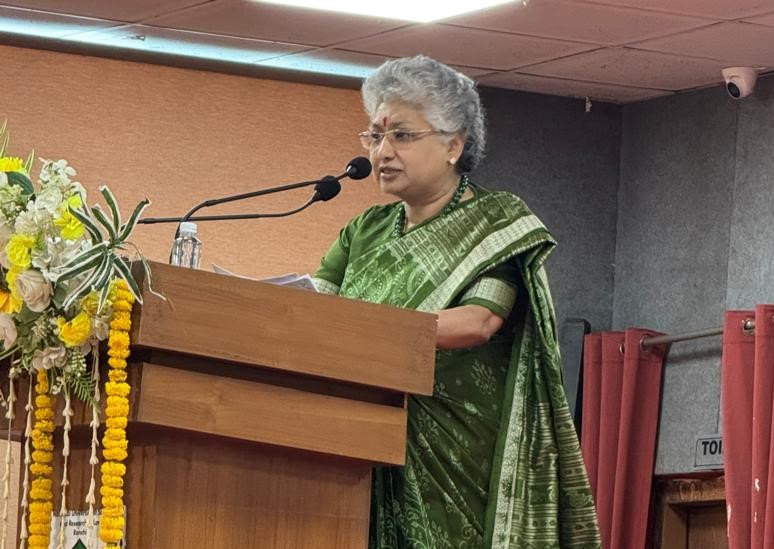
Ranchi, March 28, 2026 – Supreme Court Justice B.V. Nagarathna on Saturday urged integrating equity and fairness into environmental justice, highlighting how environmental harms disproportionately burden the poor and marginalised despite being evenly distributed.
“Environmental harms are rarely distributed evenly; instead, they tend to disproportionately affect the poor and the marginalized Therefore, integrating environmental justice into a wider framework of justice ensures that environmental protection is pursued alongside, rather than at the cost of, equity”
Delivering the 4th Justice S.B. Sinha Memorial Lecture on “Environmental Justice and Climate Change: How Courts Can Lead the Way Forward” at the National University of Study and Research in Law (NUSRL) here, Justice Nagarathna paid rich tributes to the late judge.
“In an article he wrote for the National Law School of India Review, titled “Constitutional Challenges in the 21st Century (2009)”, 7 Justice Sinha reflected on the need for judicial intervention for securing good governance in India. He argued that in a constitutional democracy such as ours, the judiciary cannot remain a passive institution. Rather, when governance failures threaten constitutional guarantees, courts must step in through principled interpretation to ensure accountability and uphold the rule of law. In this sense, Justice Sinha recognized the judiciary not merely as an adjudicatory body, but as an institution capable of guiding the constitutional order when other branches fall short”
She described Justice S.B. Sinha as one of the “most celebrated jurists” of his time, an “academic at heart” and a “scholar through and through,” lauding his legacy of powerful dissents.
Justice Nagarathna spotlighted his landmark opinion in Zee Telefilms v. Union of India, where he held that the BCCI falls within the ambit of “State” under Article 12 of the Constitution.
“Among his many dissents included Zee Telefilms v Union of India1 where Justice Sinha held that the BCCI performed a public function, and was therefore ‘State’ within the meaning of Article 12. I had advocated a similar argument about The Karnataka State Cricket Association (KSCA) (formerly the Mysore Cricket Association) in the year 2000 which was accepted by the Supreme Court in the year 2006. Speaking of his dissents, I have had the occasion to consider, at length, the dissent of Justice Sinha in Kesoram Industries, 2 in the nine-judge bench decision of Mineral Area Development Authority v. Steel Authority of India, 3 of which I was a part.”
She also referenced Kesoram Industries and his contributions to the Judicial Academy, reflecting on his enduring judicial philosophy.
The event drew dignitaries including Jharkhand High Court Chief Justice M.S. Sonak, who serves as NUSRL Chancellor and was the guest of honour, and Vice-Chancellor Prof. (Dr.) Ashok R. Patil, who gave the welcome address.
Justice Nagarathna traced the evolution of environmental rights in India, noting that the word “environment” was absent from the original Constitution but introduced via the 42nd Amendment in 1976 through Article 48A (Directive Principle) and Article 51A(g) (Fundamental Duty).
She emphasised that landmark Supreme Court decisions have expanded Article 21 to encompass the right to a healthy environment, guided by doctrines like sustainable development, polluter pays, and precautionary principle.
Stressing the courts’ pivotal role, she asserted that balancing development with environmental protection demands proactive judicial leadership to ensure justice for vulnerable communities.
She further drew upon the work of Elizabeth Fisher, characterizing environmental law as “hot law” a domain shaped by competing interests, and inherently dynamic and uncertain. She observed that each case entails a careful balancing exercise between these often-conflicting interests.
In conclusion, she underscored that courts are not passive observers of international affairs but active participants in shaping them. She emphasized three key lessons: first, that judicial decisions demand a deep contextual understanding of the circumstances in which they are made; second, that the principles of law are not fixed, but evolve through the careful balancing of competing interests; and third, that when the limits of such balancing are reached, certain fundamental areas must remain inviolable, safeguarded against compromise.
In his address at the function, Chief Justice of the Jharkhand High Court, Justice M.S. Sonak, hailed the late Justice S.B. Sinha as one of the “tallest intellectuals” in the annals of law.
Justice Sonak illuminated the lecture’s theme of climate justice, warning that conflagrations such as the Gulf War imperil our fragile planet. He exhorted all to treat the Earth with profound consciousness and collective responsibility, poignantly observing: “We do not inherit the Earth from our forebears; we borrow it from future generations.”
Drawing an erudite parallel, he noted that both Justice S.B. Sinha and Justice B.V. Nagarathna embody intellectual rigour, originality of thought, unswerving passion, and indomitable courage ever guided by fealty to law and the Constitution.
Justice Sonak further extolled their readiness to deliver dissenting opinions, remarking that such judicial valour demands “extraordinary courage,” thereby enriching the constitutional tapestry.
The vote of thanks was delivered by Mr. Indrajit Sinha, son of late Justice S.B.Sinha