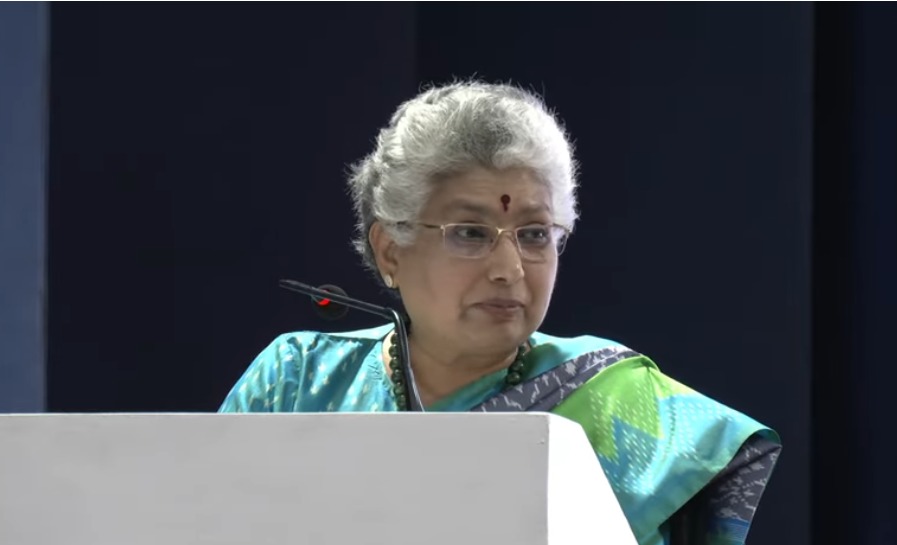
In Defence of Judicial Conscience: Justice B.V. Nagarathna’s Strong Word Against Institutional Pressure
(By Syed Ali Taher Abedi)
In the august halls of the Kerala High Court, Justice B.V. Nagarathna of the Supreme Court of India delivered a lecture that resonated far beyond the walls of the courtroom. Speaking at the 2nd T.S. Krishnamurthy Iyer Memorial Lecture, she reminded the nation of a timeless truth: judges must never hesitate to take the right decision, even if it costs them their elevation or displeases those in power.
The Burden of Judicial Review
Justice Nagarathna emphasized that judicial review is not a ceremonial exercise but a meaningful constitutional duty. Courts are often called upon to:
- Invalidate legislation that violates fundamental rights.
- Restrain executive actions that overstep authority.
- Even set aside constitutional amendments passed by political majorities.
These are not easy tasks.
They carry political consequences, and judges are acutely aware that unpopular rulings may affect their prospects of elevation, extension, or place them in the “bad books” of those wielding power. Yet, she insisted, such awareness must never cloud the oath of office.
“Even if judges know that unpopular decisions may cost them elevation, extension, or bring them in the bad books of the powers that be. That should not come in the way of their decisions. Ultimately, it is the conviction, courage and independence of each judge which really matters. We, as Judges, should always follow our oath of office which is our judicial Dharma and live up to it irrespective of its consequences on our career. The best example we have of this is in Justice H.R. Khanna who was keen to uphold the Constitution during the most difficult period of our history, even at the cost of being overlooked to the highest judicial office in the country.”
The judicial dharma demands fidelity to the Constitution, irrespective of personal or professional consequences.
Symbolic vs. Substantive Justice
She warned that if decisions are shaped by apprehensions about career outcomes, judicial review risks becoming symbolic rather than substantive.
The Constitution does not ask judges to be popular; it asks them to be faithful. The oath of office is not a mere formality—it is a solemn commitment to uphold justice, even when it comes at great personal cost.
The Example of H.R. Khanna
Justice Nagarathna invoked the legendary dissent of Justice H.R. Khanna in the infamous ADM Jabalpur v. Shivkant Shukla case during the Emergency. While the majority held that fundamental rights could be suspended, Justice Khanna stood firm, declaring that the Constitution did not permit the State to extinguish the right to life and liberty—even in an emergency.
His dissent cost him the Chief Justiceship, but it immortalized him as the embodiment of constitutional courage.
“Second and more subtly, independence also operates within the judicial institution. Judicial independence is not exhausted by insulation from the political branches. It also requires that each judge be free to form and express his or her own considered 40 views of the law, even when that view diverges from colleagues. Separate and dissenting opinions are manifestations of intellectual autonomy. This is independence of the judiciary in its most enlightened form.”
She reminded the audience that fundamental rights are not at the mercy of the executive. Justice Khanna’s sacrifice demonstrated that constitutional fidelity ultimately outlasts transient political expediency.
Judicial Independence: Beyond Safeguards
“First is independence from external influence. A judge must be free from political pressure, institutional intimidation, or popular demand.”
Justice Nagarathna concluded that judicial independence derives not merely from constitutional safeguards or institutional design, but from the manner in which judges discharge their office. Independence is lived through courage, not granted by statutes.
“A judicial opinion is not a negotiation document; it is an articulation of constitutional conviction. If the law, as we understood it, requires clarity – even bluntness – then dilution for the sake of consensus is a form of compromise we should be unwilling to make.”
Her lecture, titled “Transformative Constitutionalism and the Basic Structure Doctrine”, was a clarion call to the judiciary: to remember that the Constitution is not a document of convenience, but a covenant of courage.
Invoking the foundational principles of constitutional adjudication, B. V. Nagarathna underscored that separate and dissenting opinions are not symptomatic of institutional fragility, but rather the clearest expression of judicial independence in its most enlightened and principled form.
A dissent, she observed, is not an act of discord but an affirmation of conscience.
It represents the intellectual honesty of a judge who refuses to subordinate constitutional conviction to the comfort of unanimity.
A judicial opinion, she emphasised, is never a negotiated settlement nor a document crafted for accommodation it is a reasoned declaration of constitutional fidelity.
Where clarity requires firmness, dilution of reasoning for the mere sake of consensus would amount to a compromise inconsistent with the solemn duty cast upon a constitutional court.
Elaborating further, she reflected on the delicate balance within a democracy committed to liberty and equality.
In such a polity, majoritarian institutions may not invariably serve as reliable guardians of individual freedoms or minority interests.
While an elected majority unquestionably possesses the democratic mandate to govern, that mandate, she cautioned, is neither absolute nor untrammelled.
It is the constitutional function of the judiciary to delineate and enforce the boundaries of that power.
Courts, she noted, derive their legitimacy not from public approval or transient popularity, but from unwavering fidelity to the Constitution and the rule of law.
In her concluding remarks, Justice Nagarathna observed that the endurance of constitutional governance rests not merely upon carefully drafted doctrines or meticulously designed institutions, but upon the moral fibre, courage, and intellectual integrity of those entrusted with interpreting and enforcing the Constitution.
Judges, she declared, must remain prepared to invalidate laws that transgress constitutional limitations, to restrain executive excesses that defy legality, and to preserve the fundamental identity of the Constitution itself—even when such decisions invite criticism, isolation, or personal cost. For it is in such moments of trial, she implied, that the true strength of constitutional democracy is tested and affirmed.