Rights Must Reach the Doorstep: Justice Ramasubramanian Calls for Accountability in Public Service Delivery
(Judicial Quest News Network)
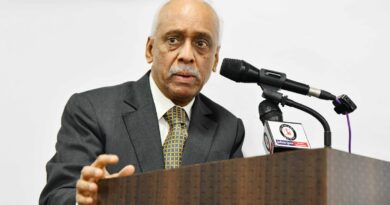
Delhi,10, December,2025- At a national conference held to mark Human Rights Day, NHRC Chairperson Justice V. Ramasubramanian underscored that civil servants carry a fundamental responsibility to ensure that the benefits of welfare schemes reach the common man with dignity, reflecting India’s character as a welfare State.
Speaking alongside him, Dr. P.K. Mishra, Principal Secretary to the Prime Minister, contrasted the pre-2014 legal-centric approach to rights with the post-2014 saturation model aimed at closing last-mile gaps in public service delivery.
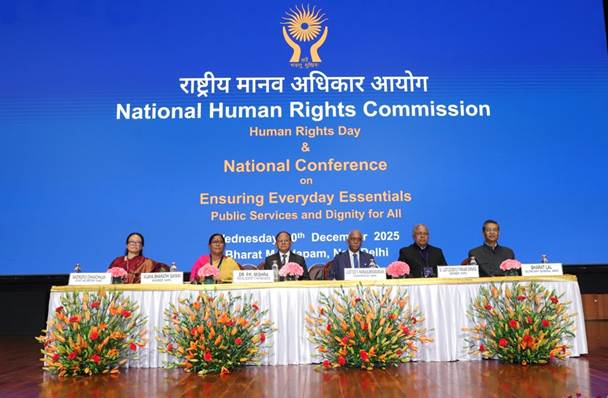
The conference, organised by the National Human Rights Commission on the theme “Ensuring Everyday Essentials: Public Services and Dignity for All” at Bharat Mandapam in New Delhi, highlighted the Commission’s focus on linking everyday public services to the dignity and rights of citizens.
He said that while policies are framed by elected representatives for the welfare of the people, they are implemented through officers who are in the civil services of the Union or the State and called public servants.
Therefore, enabling and assisting an elected Government to frame policies for the welfare of the people and ensuring that the benefits of those policies reach the common man is the task assigned to public servants. Quoting the Ramayana, he highlighted three ideals for launching an undertaking which has maximum benefit with minimum cost and without delay.
Delivering the keynote address, Dr. P. K. Mishra, Principal Secretary to the Prime Minister reflected on Human Rights Day as a reaffirmation of India’s democratic values. Citing Article 25 of the Universal Declaration of Human Rights, he highlighted India’s remarkable progress in the past decade in improving standards of living through housing, nutrition, clothing, medical care and livelihood security. He recalled Hansa Mehta’s contribution in ensuring gender-sensitive language in the UDHR and noted India’s evolution from civil and political rights to socio-economic, ecological and cultural rights shaped by digital transformation and environmental consciousness.
Dr. Mishra contrasted the pre-2014 legal-centric rights approach with the post-2014 saturation model, centred on closing last-mile gaps so that every entitlement reaches every citizen. He detailed major achievements, including 4 crore pucca houses under PMAY, 12 crore tap-water connections under JJM, Swachh Bharat sanitation coverage, Saubhagya electrification, Ujjwala clean cooking gas, free food grains for 80 crore people, Ayushman Bharat benefiting 42 crore citizens and expanded social security and reforms for gig and platform workers. He highlighted rapid declines in multidimensional poverty, the success of Aspirational Districts, the COVID-19 response and the ongoing Viksit Bharat Sankalp Yatra.
Calling upon NHRC to examine emerging challenges, climate and environmental rights, AI and technology governance, gig-economy protections and digital surveillance, he said that good governance is itself a human right, rooted in empathy and dignity.
Before this, NHRC, India Secretary General, Bharat Lal in his address said that the Commission continues to work to ensure equitable access to essential services through a wide spectrum of interventions. This year’s Human Rights Day theme highlights human dignity is shaped by people’s experience about access to basic amenities and essential public services every day. These are not administrative conveniences but fundamental entitlements. He gave a brief insight into the two thematic sessions of the Conference including ‘Basic Amenities for All: A Human Rights Approach and ‘Ensuring Public Services and Dignity for All.’
NHRC, India Chairperson, Justice V. Ramasubramanian chaired the first session on ‘Basic Amenities for All: A Human Rights Approach. Speaking as a panellist, NHRC Member, Vijaya Bharathi Sayani said that there must be clear standards of service delivery, monitoring and grievance redressal. She emphasised zero tolerance for corruption and negligence to ensure that services reach the person who need them the most. She said that the NHRC has been addressing a wide range of human rights concerns in different aspects of life including education, health, shelter homes, elderly care among others.