
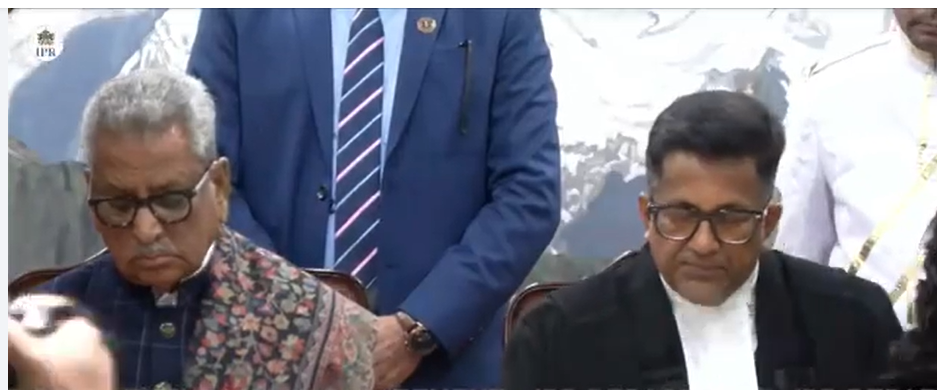
Protocol in Question: The Curious Case of Justice A. Muhamed Mustaque’s Elevation
(Judicial Quest News Network)
New Delhi / Thiruvananthapuram: A series of extraordinary procedural deviations marked the appointment of Justice Muhammed Mustaque as Chief Justice of the Sikkim High Court, raising serious questions about institutional coordination, adherence to constitutional protocol, and the manner in which judicial transitions are being handled.
The Supreme Court Collegium, headed by Chief Justice of India Justice Surya Kant, recommended Justice A. Muhamed Mustaque —then serving on the Kerala High Court—for elevation as Chief Justice of the Sikkim High Court on 18 December 2025. Under established constitutional practice, such a recommendation acquires legal effect only upon issuance of a Presidential notification. In this case, however, events appear to have raced far ahead of the formal approval.
Despite the absence of any notification from Rashtrapati Bhavan, Justice Mustaque reached Gangtok on the morning of 3 January 2026, apparently in anticipation of an imminent oath-taking.
Even more strikingly, the Kerala High Court had already conducted farewell events well in advance.
On 1 January 2026, a farewell dinner was hosted, followed by formal farewell functions organised by multiple institutional bodies, including the Computer Committee, the Kerala State Legal Services Authority (KeLSA), the Kerala State Mediation and Conciliation Centre (KSMCC), the High Court Arbitration Centre, and the Kerala High Court Legal Services Committee (KHCLSC).
What followed bordered on the unprecedented. On 2 January 2026, nearly 30 advocates and seven sitting judges of the Kerala High Court, along with the Registrar General and other senior registry officials, travelled to Sikkim—despite the fact that the constitutional process for appointment had not yet been completed.
With the incumbent Chief Justice, senior judges, and top registry officials already present in Sikkim, the continued delay in issuing the notification reportedly triggered mounting concern.
Multiple urgent communications ensued, culminating in the intervention of the Ministry of Law and Justice. The Presidential notification was finally issued on 3 January 2026 at around 7:00 pm, narrowly averting what several sources described as a potentially humiliating institutional situation.
Legal observers note that had the notification been further delayed—or withheld—the consequences could have extended beyond personal embarrassment, calling into question the legality of any oath-taking ceremony conducted without formal presidential approval.
The episode has triggered quiet unease within judicial and legal circles, with questions being raised about whether undue assumptions were made regarding executive concurrence, and whether ceremonial and logistical preparations were allowed to override constitutional formality.
While no official explanation has been offered by the High Court or the Law Ministry, the incident underscores a deeper concern: whether established constitutional processes are being treated as procedural formalities rather than binding prerequisites in high judicial appointments.


