New Delhi Becomes Nerve Centre of Global Anti-Corruption Strategy as GlobE Meet Begins
(By Syed Ali Taher Abedi)
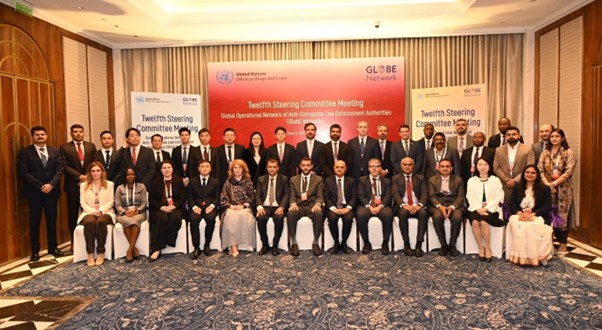
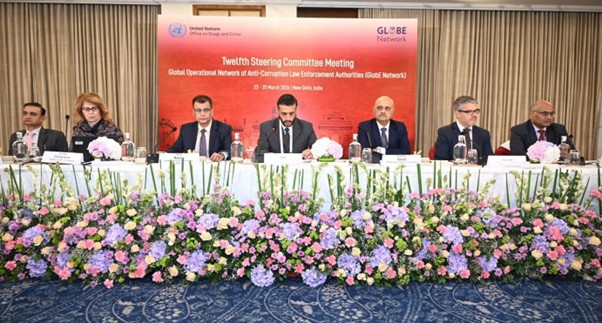
23,March,2023-Delhi-The 12th Steering Committee Meeting of the Global Operational Network of Anti-Corruption Law Enforcement Authorities (GlobE Network) commenced in New Delhi on Monday, with India hosting the high-level deliberations aimed at strengthening international cooperation in combating corruption.
The inaugural session witnessed the presence of senior officials including the Director of the Central Bureau of Investigation and the Director of the Directorate of Enforcement, alongside Special Directors, representatives of the GlobE Secretariat under the United Nations Office on Drugs and Crime, and delegates from member countries.
The three-day meeting, scheduled from March 23 to 25, 2026, brings together 15 Steering Committee nations to deliberate on the Network’s strategic priorities, operational roadmap, and frameworks for enhanced cross-border collaboration.
Established under the Riyadh Initiative during Saudi Arabia’s G20 Presidency and operating within the ambit of the United Nations Convention Against Corruption, the GlobE Network today comprises 135 countries and 250 authorities, along with 18 observers including Europol and the World Bank, serving as a key platform for swift, practitioner-level cooperation in tackling transnational corruption and asset recovery.
The GlobE Steering Committee currently includes 15 nations: Azerbaijan, Brazil, China (with Hong Kong and Macau SARs), Ethiopia, Grenada, India, Italy, Nigeria, Romania, Russia, Saudi Arabia, Spain, South Africa, South Korea, and the UAE.
India’s Role in GlobE India joined the Network in 2022, designating the CBI and Directorate of Enforcement as member agencies.
In September 2024, India was elected to the Steering Committee in Beijing, underscoring its rising influence in global anti‑corruption efforts.
India’s engagement predates formal membership, beginning with participation in the G20 Anti‑Corruption Working Group under Saudi Arabia’s presidency, when GlobE was first conceptualized.
During its own G20 Presidency in 2023, India prioritized anti‑corruption and asset recovery, keeping operational cooperation central to ACWG discussions.
India has since championed GlobE across multilateral forums, FATF processes, and UNCAC reviews.
Its enforcement case studies feature in the GlobE Compendium of Practices, highlighting their global relevance and replicability.
The opening session of the 12th Steering Committee Meeting of the GlobE Network witnessed a series of high-level addresses underscoring the growing urgency of coordinated global action against corruption.
The session commenced with a welcome address by the Director of the Directorate of Enforcement, followed by a keynote address from the Director of the Central Bureau of Investigation.
The gathering was further addressed by Dr. Nasser Abaalkhail, Chair of the GlobE Network, and Ms. Rositsa Zaharieva, Coordinator of the Network, both of whom highlighted the expanding role of the platform in fostering real-time international cooperation.
In his welcome remarks, the Director of the Enforcement Directorate elaborated on the complementary mandates of India’s two principal member agencies within the GlobE framework.
He noted that while the CBI serves as the country’s nodal agency for anti-corruption investigation and prosecution, the ED operates under the Prevention of Money Laundering Act with a specialised mandate to trace, attach, confiscate, and ultimately restitute proceeds of crime.
Emphasising the evolving global enforcement paradigm under the United Nations Convention Against Corruption, he asserted that asset recovery must be viewed not as a peripheral objective but as the most definitive indicator of enforcement effectiveness.
Highlighting India’s recent achievements, he revealed that the Enforcement Directorate has facilitated the restitution of assets amounting to approximately USD 5.6 billion, including significant recoveries in corruption-linked cases much of which has been realised in the past few years.
He also drew attention to the tangible operational benefits of the GlobE Network, citing a specific instance of cooperation with Spain, where intelligence shared through the platform directly contributed to the successful restraint of illicit assets via formal legal channels.
Additionally, he pointed to the utility of tools such as the Directory of Open-Source Registries in expediting preliminary investigative processes.
Delivering the keynote address, the Director of the Central Bureau of Investigation underscored the increasingly transnational and technologically sophisticated nature of corruption, stressing that international collaboration is no longer optional but indispensable.
He commended the GlobE Network’s Secure Communication Platform as a robust mechanism enabling encrypted, real-time exchange of actionable intelligence among member agencies.
Calling for deeper engagement, he urged participating authorities to actively collaborate with the CBI and leverage the full spectrum of cooperation mechanisms available within the Network.
He also highlighted the CBI’s role as India’s National Central Bureau for INTERPOL, noting that this position significantly enhances India’s capacity for global law enforcement co-ordination.
The speaker highlighted how timely, coordinated action ensures justice for offenders and recovery of illicit assets, praising the GlobE Network for enabling real-time collaboration among members.
He reaffirmed India’s full commitment to strengthening the network as a key pillar of global anti-corruption efforts.
The GlobE Network Chair and Co-ordinator thanked India for hosting the 12th Steering Committee meeting marking the network’s 5th anniversary, with India pivotal in its founding.
They outlined upcoming deliberations on sustainability, tool enhancements, progress reviews, and strategic choices.
India is represented by the Directorate of Enforcement (ED) and Central Bureau of Investigation (CBI), covering priorities like guiding principles, the Model Cooperation Agreement, operational updates, and informal cooperation mechanisms.
India’s Rising Role
Hosting this meeting underscores India’s growing global anti-corruption stature.
Over the past decade, ED and CBI have built strong reputations in probing financial crimes, with India’s asset recovery record aligning with UNCAC Chapter V goals.
Beyond providing a venue, India contributes expertise to combat corruption’s harm to public resources, institutions, and vulnerable citizens, amplifying the network’s impact.