
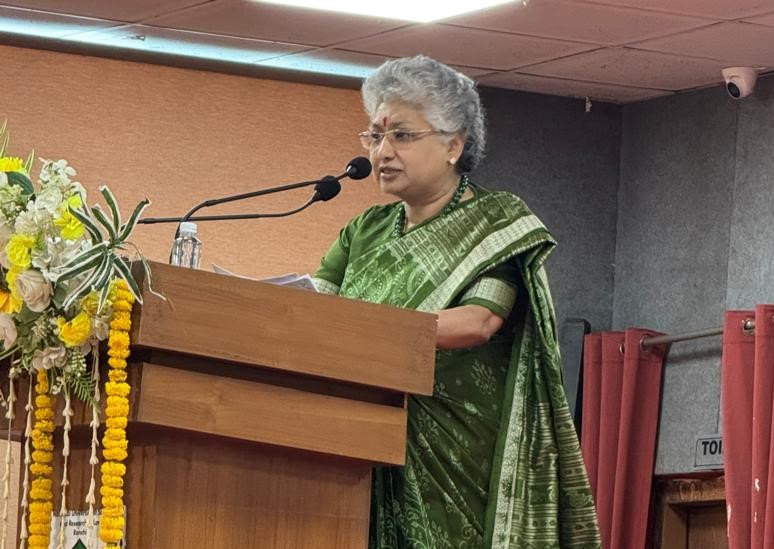
Justice B. V. Nagarathna: Centre Must Treat States as Partners, Not Subordinates
(By Syed Ali Taher Abedi)
Patna, April 4, 2026: In a pointed address amid rising Centre-state tensions, Supreme Court Justice BV Nagarthna urged the Union government on Saturday to view states not as subordinates but as coordinate partners in the federal structure.
Speaking at a lecture hosted by Chanakya University here, she asserted that the separation of powers enshrined in the Constitution represents an arrangement of co-equals, where no arm of government dominates another.
Her remarks assume added significance ahead of Assembly elections in Assam, West Bengal, Tamil Nadu, Kerala, and the Union Territory of Puducherry, where political rivalries and allegations of central interference have already surfaced.
Justice Nagarthna warned that the neutrality of the electoral process cannot be assured if institutions conducting elections remain dependent on those contesting them. “Power must always be answerable,” she emphasized, underscoring the need for institutional independence to uphold democratic integrity.
Dwelling on frequent discord between Centre and state governments, the judge advocated amicable resolutions guided by “constitutional dharma” and the federal spirit of the Constitution.
“States are the coordinate units of the Constitution and not subordinates to the Centre,” she reiterated, reinforcing the horizontal balance of power.
Justice Nagarthna further highlighted the robustness of India’s constitutional framework, noting that its strength extends beyond the rights it guarantees to the resilience of its institutions.
She spotlighted key bodies like the Election Commission of India (ECI), Comptroller and Auditor General of India (CAG), and Finance Commission, insisting they must operate independently to preserve constitutionalism. “The integrity of the democratic process must be safeguarded at all costs,” she added.
Elaborating on the separation of powers both vertical (among legislature, executive, and judiciary) and horizontal (federal vs. state) she observed that while legislative and executive actions are subject to judicial scrutiny, judicial accountability itself is firmly anchored in the constitutional text.
Her lecture served as a timely reminder of the need for mutual respect among constitutional organs, especially as electoral battles loom large.
The address drew applause from legal scholars and students, reflecting ongoing debates on federalism in India’s polity.
