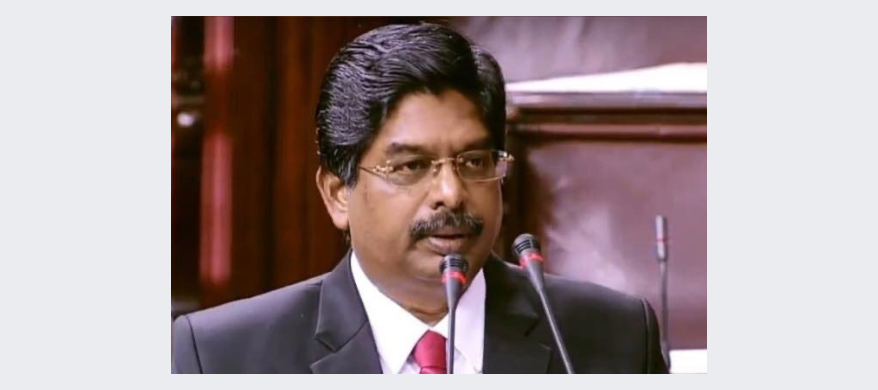
India-US Trade: DMK MP P.Wilson Accuses Govt of “Selling Out”
(Judicial Quest News Network)
Delhi, 10, February,2026- DMK Rajya Sabha MP P. Wilson on Wednesday launched a scathing attack on the Union Government, accusing it of an “abject surrender” to the United States in the negotiation of what he described as a “one-sided” bilateral trade agreement, and demanded that the Government place the full details of the pact before Parliament.
Participating in the general discussion on the Union Budget 2026–2027 in the Upper House, Wilson alleged that the agreement was the product of economic coercion, claiming that the “weaponisation of tariffs” by the United States had exerted undue pressure on India’s negotiating position.
Such an arrangement, he warned, would result in irreparable harm to India’s domestic manufacturing sector and farming community, with long-term consequences for economic sovereignty.
“The entire nation is deeply concerned about this trade deal with the United States,” Wilson said, observing that Capitol Hill appears to be celebrating, while Raisina Hill remains conspicuously silent. “We are yet to hear, in clear terms, what India has conceded.
We are extremely unhappy with this abject surrender. India is a proud nation with an ancient civilisation, not one that should submit to unequal economic terms,” he asserted.
The DMK MP took particular exception to reports suggesting that the deal could facilitate USD 500 billion worth of American exports, arguing that such an imbalance would disproportionately benefit the U.S. economy at India’s expense.
Turning to judicial infrastructure and tax administration, Wilson underscored the urgent need to strengthen the country’s dispute resolution mechanisms.
He urged the Union Government to create additional benches of the Income Tax Appellate Tribunal (ITAT) and the Goods and Services Tax Appellate Tribunal (GSTAT), and to appoint adequate members without delay.
“Businesses cannot afford to spend years entangled in litigation under a cloud of uncertainty,” he said. “If disputes are decided conclusively—one way or the other—enterprises can make provisions, comply, and move forward. But prolonged uncertainty is fatal to business confidence.”
Raising a pointed question to the Treasury benches, Wilson also revisited the issue of economic offenders who fled the country, reminding the House of past assurances made by the Government. “What happened to those tax evaders who were promised to be brought back to India, and from whom arrears were to be recovered?” he asked. “They continue to live comfortably abroad, while taxpayers’ money is used to write off loans of their companies.”
On infrastructure spending, which the Government has projected as the “crown jewel” of the Budget, Wilson struck a sceptical note.
While acknowledging the announcement of ₹12.2 lakh crore for capital expenditure, including ₹3.1 lakh crore for roads and ₹2.8 lakh crore for railways, he questioned the Government’s track record in execution.
“Year after year, allocated funds remain unspent,” he said, arguing that the Budget prioritises flashy mega-projects such as bullet trains and freight corridors while neglecting basic, sustainable urban planning. Flagship schemes like AMRUT and Smart Cities, he pointed out, have received no fresh allocations, merely extensions, resulting in cities expanding without adequate planning and with little regard for environmental risks.
Wilson further contended that the infrastructure push has assumed an anti-federal and politically skewed character.
Responding to claims by the railways minister that Tamil Nadu’s railway allocation had increased 7.5 times since 2014, Wilson noted that the overall national railway budget had expanded nearly 25 times during the same period.
“Repeating selective figures does not make it an act of generosity,” he said, adding that Tamil Nadu’s share, when viewed proportionately, reveals a systemic imbalance that undermines the principles of cooperative federalism.