CJI Surya Kant Envisions Digital Future for Bhutan’s Judiciary
(Judicial Quest News Network)
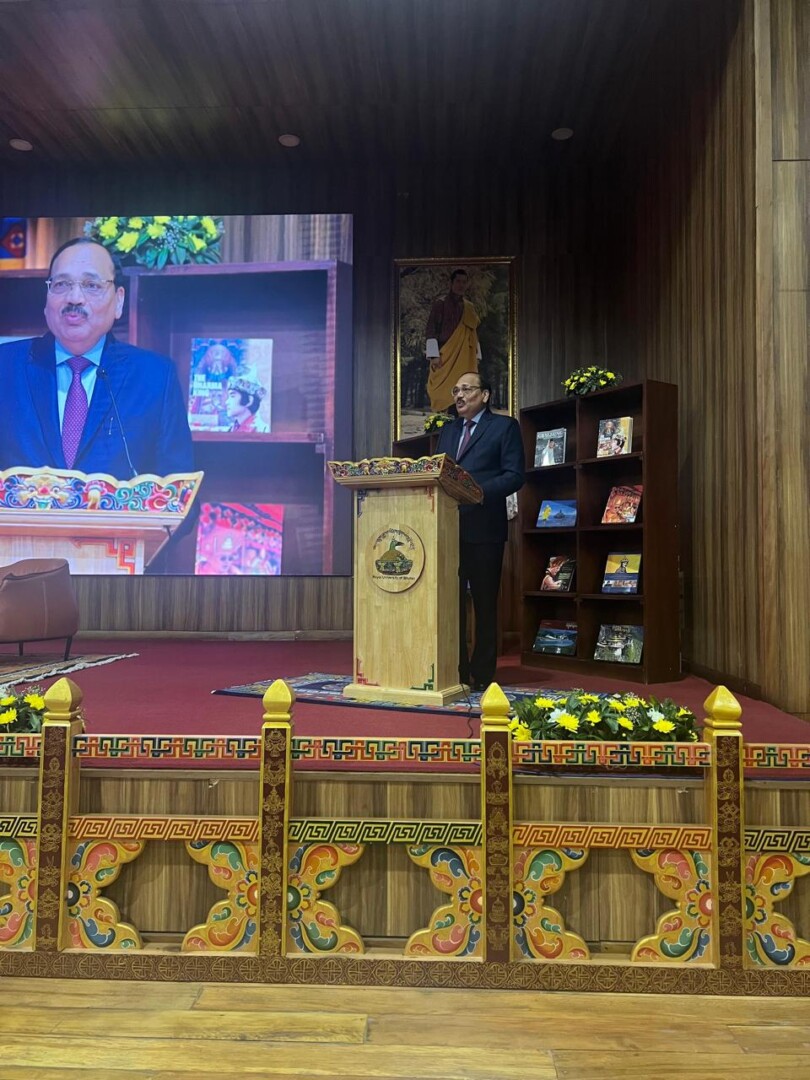
Thimphu, Bhutan: In a landmark keynote address at the JSW Talk Series Lecture on Access to Justice in the 21st Century: Technology, Legal Aid and People-Centred Courts, Chief Justice of India Surya Kant unveiled a vision of technology as the new sentinel of justice.
Speaking at the Royal University of Bhutan, the CJI proposed a suite of reforms that could transform the Himalayan nation’s judicial landscape—placing justice not behind the solemn doors of a courtroom, but within the palm of every citizen’s hand.
Justice Kiosks: Courts in the Community
At the heart of his proposal was the concept of “Justice Kiosks”—small digital centres equipped with video conferencing facilities and document scanners, strategically located in local administrative hubs.
These kiosks, he explained, would allow litigants from Bhutan’s remote mountainous regions to participate in hearings without the arduous burden of travel. “By bringing the courtroom to the community, we ensure that geography is no longer a tax on the seeker of justice,” he observed, underscoring the democratizing power of technology.
Simplified Digital Filing: Law Without Labyrinths
CJI Surya Kant also urged Bhutan to adopt a bilingual digital filing system in Dzongkha and English. He noted that many citizens are deterred from approaching courts due to procedural complexity. Step-by-step digital forms—akin to mobile banking applications—could empower litigants to initiate small claims or land disputes with clarity and confidence. “A people-centred court is where the complexity of the law is simplified by the elegance of technology,” he remarked, stressing that reforms must not merely digitize the status quo but democratize the very essence of judicial process.
Tele-Law and Digital Legal Aid
Expanding on the theme of inclusivity, the CJI proposed linking Bhutan’s regional legal aid centres with a tele-law platform.
This would connect paralegals and lawyers with indigent litigants through video consultations, ensuring early legal guidance and preventing disputes from escalating into prolonged litigation. Technology, he emphasized, is a “force multiplier for the judiciary.”
Lessons from India’s Digital Journey
Drawing from India’s own experience, Justice Surya Kant highlighted reforms such as electronic filing, digital cause lists, virtual hearings, and online dispute resolution mechanisms.
He recalled how virtual hearings during the COVID-19 pandemic proved that judicial proceedings could continue effectively even without physical courtrooms.
Yet, he cautioned against replacing physical barriers with digital ones, citing India’s SUVAS translation software as an example of ensuring inclusivity by rendering judgments in regional languages.
Law Schools and the Future of Legal Technology
The CJI also called for integrating legal technology into academic curricula, urging universities and judicial academies to introduce courses on legal informatics, AI ethics, computational law, and design thinking.
In a gesture of collaboration, he announced that the Supreme Court of India would welcome Bhutanese law students for internships and exchange programmes.
Justice as a Living Presence
Concluding his address, Justice Surya Kant reminded the audience that judicial reform is a collective endeavour requiring judges, legislators, lawyers, and students to work in unison.
Technology, he insisted, must remain a tool for fairness, transparency, and human dignity—never an end in itself. “Justice is not a cloistered virtue locked behind the heavy doors of a courtroom. It is a living presence that must walk out into the world and into the homes of the people,” he declared, leaving the audience with a vision of justice that is both majestic and accessible.