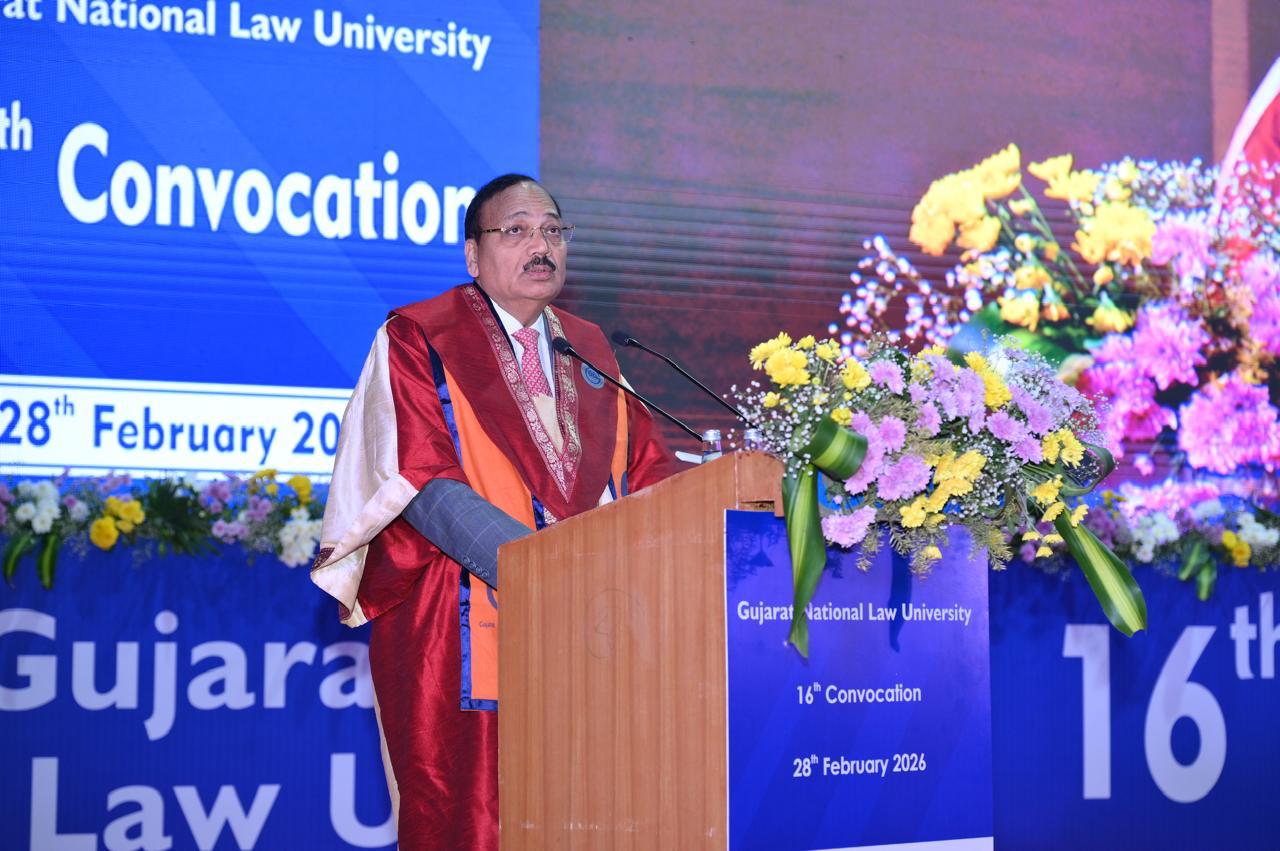
CJI Surya Kant Calls for Specialisation, Integrity & Apprenticeship-Oriented Legal Training at GNLU Convocation
(By Syed Ali Taher Abedi)
Gandhinagar, February 28: The Chief Justice of India, Surya Kant, on Friday delivered a profound and reflective keynote address at the convocation ceremony of Gujarat National Law University (GNLU), Gandhinagar, urging young advocates to embrace professional specialisation, ethical integrity, and discipline-driven practice as the cornerstones of a meaningful legal career.
Drawing a compelling parallel with modern sport, the Chief Justice likened the evolving legal profession to T20 cricket, observing that the contemporary professional world rarely rewards those who attempt to excel at everything simultaneously. Instead, he said, distinction in law is achieved by those who, “often quietly and over time, recognise where their thinking finds its natural discipline.”
According to him, lawyers who achieve lasting credibility are those who consciously identify their intellectual strengths and commit themselves to specialised domains of practice such as arbitration, commercial law, constitutional litigation, or regulatory frameworks.
Bridging the Gap Between Learning and Practice
Justice Surya Kant candidly reflected on the stark divide between academic learning and professional realities, describing the early years of legal practice as a period that exposes “a big gap between performing and practising.”
He explained that while textbooks provide doctrinal clarity and conceptual understanding, real-world legal practice demands discipline, responsibility, accountability, and the ability to function under practical constraints.
He eloquently described this transition as “the difference between learning the map and navigating the territory,” emphasising that true legal competence is forged not in classrooms alone, but through lived professional experience — courtrooms, chambers, negotiations, drafting rooms, and client consultations.
The Invisible Labour of Law
Highlighting the unseen dimensions of legal work, the Chief Justice noted that much of a lawyer’s labour remains uncelebrated and outside public view.
Research, drafting, strategic consultations, and case preparation often take place in silence, without recognition or applause.
He reminded the graduating students that in the legal profession, “effort precedes recognition by years,” and that perseverance, patience, and quiet dedication are essential virtues.
Probity, Trust and Professional Credibility
Justice Surya Kant laid strong emphasis on probity and professional credibility, stating that public trust in the legal system is directly linked to the integrity and consistency of those who practice law.
He observed that advocacy is not merely a technical profession but a public trust function, where character, ethics, and conduct are as important as competence and skill.
“The strength of the legal profession,” he said, “lies not only in legal knowledge but in moral authority. Without integrity, even brilliance loses its meaning.”
Towards an Apprenticeship-Oriented Legal Education
Looking to the future of legal education in India, the Chief Justice envisioned a shift towards an apprenticeship-oriented model, where students would learn not merely about law, but within the profession.
He advocated sustained engagement with real-world disciplines and responsibilities, enabling young lawyers to develop practical wisdom alongside academic excellence.
“The profession, however, rarely teaches this lesson at the beginning. In those early years, there is little permission to say, this is where I am strongest. You are simply expected to keep up. Yet, if you observe closely, those you admire did not become distinguished by attempting everything equally. They got there by recognising, often quietly and over time, where their thinking found its natural discipline.”
Such a model, he suggested, would produce professionals who are not only legally trained but professionally formed — capable of ethical judgment, disciplined practice, and institutional responsibility.
Ethical Foundations of the Profession
In a deeply philosophical conclusion, Justice Surya Kant invoked the ancient moral injunction from the Taittiriya Upanishads —
“Satyam Vada, Dharma Chara” (Speak the truth, walk the path of righteousness) —
and reminded the graduates that these timeless principles continue to define the ethical foundations of the legal profession.
He told the young lawyers that the profession does not demand extraordinary achievements every single day, but rather reliability in ordinary moments, consistency in conduct, and integrity in action — qualities that, over time, shape the kind of lawyer one ultimately becomes.
The address, rich in philosophy, professional realism, and ethical vision, offered the graduating class not merely guidance for careers, but a blueprint for building lives in law anchored in discipline, dignity, specialisation, and trust.