Ex-CJI B.R. Gavai Writes to President Murmu, Alleges Community Bias in Judicial Appointments.
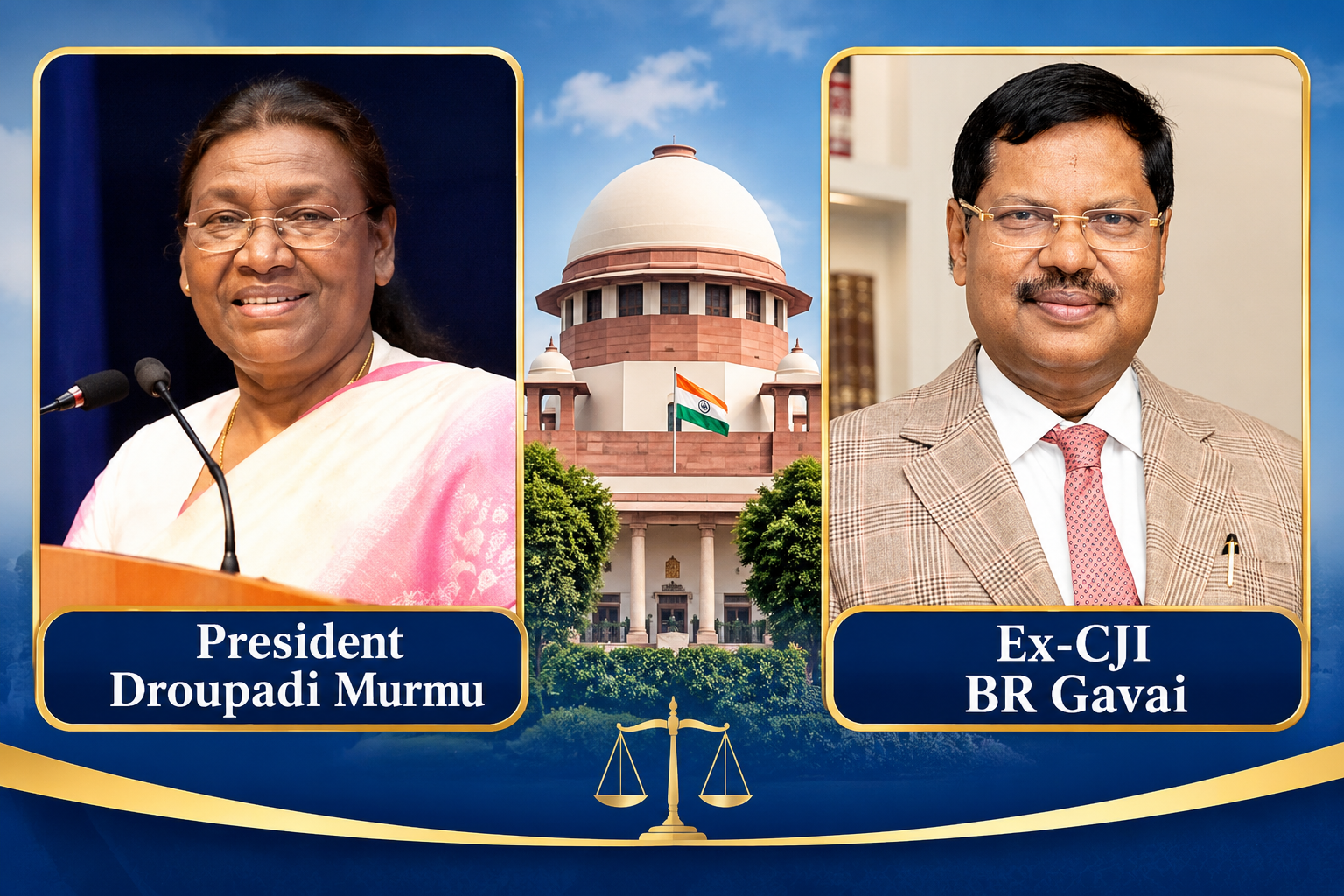
In a significant intervention in the debate over judicial appointments, former Chief Justice of India B.R. Gavai has written to President Droupadi Murmu expressing deep concern over what he describes as an emerging pattern of disregard for diversity, inclusivity and merit in appointments and transfers within the higher judiciary.
(By Syed Ali Taher Abedi)
Delhi, 27, November,2026-The former CJI, drawing upon his experience as a member and subsequently head of the Supreme Court Collegium, has urged the President to acknowledge the concerns and intervene, as deemed appropriate, to ensure that the constitutional principle of equitable representation is upheld in one of the most important pillars of Indian democracy.
In his communication to the President, Justice Gavai has described himself as a concerned citizen who also happened to serve as the Chief Justice of India.
Clarifying that his letter was neither written in anger nor lightly, he said his intervention was prompted by a sense of constitutional responsibility and the need to address what he considers a worrying trend requiring immediate remedial measures by all stakeholders.
“However, in the recent past disturbing events have unfolded, showing complete disregard to principles of merit and inclusivity. Candidates belonging to one particular section of the society are being favored for recommendation/elevation to the exclusion of everyone else including marginalized communities including scheduled casts, tribes, other backward classes, minorities, women and even persons from forward sections of the society who are not from a particular community” Gavai said.
Recalling his tenure in the Collegium, Justice Gavai stated that he consistently followed the principles of diversity and inclusion while considering recommendations for elevation to the High Courts and the Supreme Court.
He emphasised that adequate representation was sought for different sections of society, including Scheduled Castes, Scheduled Tribes, Other Backward Classes, minorities, women and candidates from the forward communities.
However, expressing serious reservations over recent developments, the former CJI alleged that the established principles of merit and inclusivity appeared to have been disregarded, with candidates belonging to one particular section of society allegedly receiving preference at the expense of other communities.
“Even in the case of recent recommendation of transfer from one high court to another high court there is a perception that merit has been ignored and other similar factors have weighed in.” Said Ex-CJI.
He was careful to clarify that his objection was not to the elevation of candidates from forward communities, but to what he described as an imbalance in representation and the exclusion of deserving candidates from other sections.
Justice Gavai observed that compelling circumstances had emerged to support a perception that judicial recommendations were increasingly being influenced by considerations of appeasement and preference for a single community.
To substantiate his concerns, Justice Gavai referred to parliamentary records concerning the social composition of appointments to the High Courts.
According to figures cited in his letter, the Union Law Minister had informed the Rajya Sabha in March 2025 that, out of 715 judges appointed to various High Courts since 2018, only 22 belonged to Scheduled Castes, 16 to Scheduled Tribes, 89 to Other Backward Classes and 37 to minority communities.
The former CJI pointed out that approximately three-fourths of the appointments were from the general category. He also referred to observations made by the Union Law Ministry before a parliamentary committee, acknowledging inequitable representation of backward and minority communities in the higher judiciary.
Referring to appointment figures between January 2021 and January 2026, Justice Gavai stated that the share of forward communities was reported to be close to 80 per cent, while the representation of OBCs remained below 14 per cent, despite their substantial share in the country’s population.
“I am aware of the factors that prevailed at the relevant time with the collegium for recommending such an appointment/ transfer. However, on account of propriety and judicial disciple I refrain from divulging these reasons. In another instance, a judge was transferred from his parent high court to another high court on punitive consideration and was subsequently rewarded by appointment as Chief Justice of a large and a prominent High Court”
He further raised concerns over the representation of a particular community in the Supreme Court, observing that although caste-wise data relating to appointments to the Apex Court is not officially recorded, the absence of such information itself contributes to the difficulty of assessing representational inequalities.
Invoking historical research by Professor George Gadbois, Justice Gavai recalled that a community constituting approximately one-nineteenth of India’s population had accounted for more than one-third of Supreme Court judgeships between 1950 and 1989.
He observed that even after 75 years of the Republic, the social composition of the Supreme Court had not undergone the degree of transformation that constitutional ideals of equality and representation would demand.
“In another instance, a judge was transferred from his parent high court to another high court on punitive consideration and was subsequently rewarded by appointment as Chief Justice of a large and a prominent High Court.”
In another significant aspect of his communication, Justice Gavai questioned certain recent transfers of Chief Justices of High Courts, alleging that considerations other than merit appeared to have influenced some decisions.
Without disclosing the identities of the judges concerned, the former CJI referred to an instance in which a Chief Justice, after being transferred from one High Court to a smaller High Court and subsequently to one of the smallest High Courts in the country, was allegedly rewarded with a transfer to a prominent High Court.
At the same time, he pointed out that a meritorious and hardworking Chief Justice of a High Court was transferred to a smaller High Court to facilitate the former’s elevation to the more prominent position.
Describing the development as demoralising, Justice Gavai cautioned that such decisions could have a chilling effect on hardworking members of the judiciary, particularly those belonging to marginalised sections of society.
Significantly, he disclosed that he had personally been associated with the Collegium decisions concerning the transfers of the judges mentioned in his letter.
He stated that he had participated in the recommendations relating to the first judge’s earlier transfers and had also headed the Collegium when the second judge was unanimously recommended for appointment as Chief Justice of a prestigious High Court on the basis of merit.
He said the subsequent developments raised several unanswered questions about the criteria governing judicial transfers and appointments.
“Therefore, I am constrained to voice my dissent and disappointment as evidently appointments and transfers are being done in complete disregard to ethos of diversity, inclusion and merits taking into consideration other irrelevant factors.”
The former CJI also referred to another instance in which a judge, allegedly transferred from his parent High Court on punitive considerations, was subsequently appointed Chief Justice of a large and prominent High Court.
Justice Gavai, however, maintained that judicial propriety and discipline prevented him from disclosing the reasons and considerations that had prevailed before the Collegium at the relevant time.
Article 124(2): President’s Constitutional Responsibility Highlighted
Invoking the constitutional framework governing judicial appointments, Justice Gavai specifically referred to Article 124(2) of the Constitution of India, which provides for the appointment of Supreme Court judges by the President.
He observed that although judicial interpretation over several decades had accorded decisive importance to Collegium recommendations, this arrangement did not render the Collegium unaccountable or absolve the President’s high constitutional office of its responsibility to preserve, protect and defend the Constitution.
In a pointed observation, the former CJI asserted that the executive remained an equal stakeholder in matters concerning the appointment and transfer of judges to constitutional courts.
He further noted that Parliament and the executive had, on several occasions, proactively urged the Supreme Court Collegium and various High Court Collegiums to consider suitable candidates from marginalised communities to restore the balance of representation in the higher judiciary.
According to Justice Gavai, ensuring diversity and inclusivity in judicial appointments was a shared constitutional responsibility, which every stakeholder must discharge in the larger interest of the justice delivery system.
Concluding his communication, Justice Gavai expressed his dissent and disappointment over what he characterised as appointments and transfers being undertaken in disregard of the principles of diversity, inclusion and merit, allegedly influenced by considerations that ought not to determine judicial selections.
He earnestly requested President Droupadi Murmu to acknowledge the concerns raised and intervene in an appropriate manner to ensure that all constitutional stakeholders remain conscious of their obligation to secure equitable representation in the higher judiciary.
The letter assumes considerable significance as it comes from a former Chief Justice of India who not only participated in the Collegium system but also headed the body responsible for recommending appointments and transfers to constitutional courts.
The intervention has brought renewed attention to a fundamental constitutional question: Can the higher judiciary truly reflect the pluralistic character of Indian democracy unless merit, social diversity and equal opportunity remain integral to the process of judicial appointments?
The concerns articulated by the former CJI place the spotlight on the need for greater transparency, institutional accountability and a more inclusive approach to judicial appointments, while also renewing the debate over the functioning of the Collegium system and the respective constitutional responsibilities of the judiciary, executive and President of India.
The former CJI has shared copies of the letter with Prime Minister Narendra Modi and Union Law Minister Arjun Ram Meghwal.