
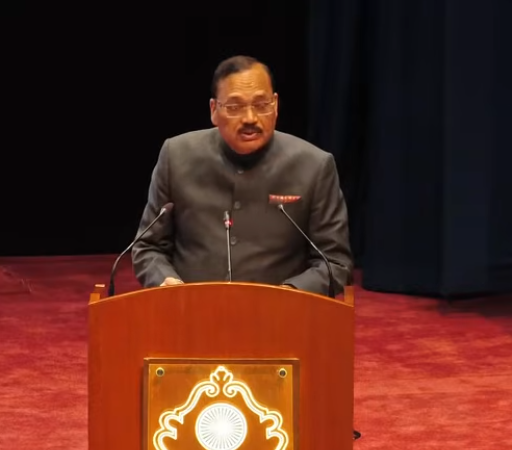
CJI Surya Kant Reaffirms Supreme Court’s Role as Guardian of Equal Access to Justice
Sub-heading: Listing reforms, priority for the marginalised, and technology are cited as steps to ensure that justice is available to every citizen, not merely to those who know the way to the Court’s doors
(Judicial Quest News Network)
Delhi,26 November, 2026- Chief Justice of India Surya Kant addressed the Supreme Court’s Constitution Day celebrations and placed the Court’s accessibility at the centre of his remarks.
The Chief Justice acknowledged, with candour, that the Supreme Court was once regarded as a court of the privileged, a forum in which the timing of a hearing could appear to turn upon who sought it, rather than upon how urgently it was needed.
He maintained that the institution must continue its work of ensuring that justice reaches every citizen.
Listing Reforms and Priority for the Vulnerable
Addressing the structural barriers that have historically hindered litigants, the Chief Justice pointed to listing reforms, including the automatic listing of fresh matters, which obviates the need for advocates to seek dates from the Bench.
Matters concerning personal liberty or urgent interim relief are required to be placed before a Bench within two working days.
The Court has further identified litigants who may face heightened obstacles to access, namely persons with disabilities, acid attack survivors, senior citizens above the age of eighty, persons below the poverty line, and those approaching the Court through legal aid, and their matters now receive priority listing.
“The responsibility for improving this situation is shared. Courts must continue to strengthen their processes and make justice more accessible. The Bar must contribute through focused and honest advocacy, responsible case management and professional discipline. We must also encourage younger members of the Bar, particularly those who do not have the benefit of established networks, so that talent and merit have a genuine opportunity to flourish.”
The Chief Justice underscored that such priorities rest upon criteria announced in advance and applied uniformly, so that the listing of cases follows a transparent and consistent pattern in which no litigant is shown undue favour. The principle, in his words, is that for many the very act of approaching the Court is an ordeal, and the least the institution can do is ensure that their turn arrives in good time.
The Constitution as a Charter of Justice, Not Privilege
The address drew upon the constitutional debates, recalling the observation of Constituent Assembly member Hansa Mehta that women sought social, economic and political justice rather than privileges.
The Chief Justice treated that distinction between privilege and justice as lying at the very heart of the Constitution, which he described as a covenant of justice extended to every citizen rather than a charter of advantage for a fortunate few.
“In the years since, this Court has tried to keep faith with that covenant, and I have often felt that its jurisprudence resembles nothing so much as the finest of pashmina shawls. Such a shawl is so delicate that it may be drawn through a finger ring, and yet warm enough to carry a traveller through the bitterest of winters. The judgments of this Court have served in much the same way, for while no single decision could have sheltered a Republic thousands of them, laid patiently together, have done precisely that. Yet even the most precious of shawls, for all its fineness, can protect only those who could afford to wrap it around their shoulders. And so, today of all days, we must ask ourselves whether justice, as dispensed here, has reached everyone it was meant for, or it has, at times, remained the privilege of those who already knew the way to our doors. “ he said.
In a notable metaphor, the Chief Justice likened the jurisprudence of the Court to a Pashmina shawl. Thousands of judgments, patiently laid together, have sheltered the Republic, yet even the finest shawl can warm only those who are able to wrap it around themselves.
It was on this note that he urged the Court to reflect upon whether its justice has reached all those for whom it was intended.
The Public Interest Jurisdiction and Its Enduring Lesson
The Chief Justice recalled that the institution had begun to change decades earlier, when the expansion of public interest litigation led the Court to treat letters and even postcards as petitions.
He recounted how a letter written on behalf of bonded labourers in the stone quarries of Faridabad had helped secure their freedom.
While acknowledging that the public interest jurisdiction has at times been abused, he observed that it taught the institution that its strength lies as much in the doors it keeps open as in the questions it decides.
Technology as an Instrument of Access
The Chief Justice also credited technology with widening the Court’s reach. Video-conferencing now enables advocates from distant places such as Kohima and Kochi to argue their cases without undertaking the journey to Delhi.
“There was a time when this Court was seen, and not entirely without reason, as a court of the privileged, more readily available to a familiar few than to the many. In those days, an out-of-turn hearing could sometimes seem to depend on who rose to ask for it, rather than on how urgently it was needed. For those of ample means, the highest court in the land was at times less a court of last resort than one of first resort, approached at the earliest stages of a dispute. By contrast, for the vast majority of our people, many of them in the greatest need of justice, this Court was revered from afar, but seldom reached. And yet, even in those years, the Court had begun to change, for more than four decades ago it started treating letters, and even postcards, as petitions espousing the public causes.” CJI Said.
Proceedings before Constitution Benches are livestreamed and transcribed through artificial intelligence, and the Court’s AI-assisted translation software, SUAS, renders judgments into languages spoken by citizens.
Observing that a judgment a citizen cannot read can never truly belong to that citizen, he also referred to the One Case, One Data initiative, which traces a case’s record from the Taluka court to the Supreme Court, and to an AI-powered assistant designed to guide litigants through the Court’s procedures.
Legal Aid Must Speak the Language of the Litigant
The Chief Justice emphasised that access to justice begins well before a matter reaches a courtroom, at the moment a person in distress first seeks assistance.
Through the National Legal Services Authority, legal aid is carried to the farthest corners of the country, where paralegal volunteers are often the first and sometimes the only face of the law that a person encounters. He directed that such volunteers must communicate with justice seekers in their own language or dialect, understand their experiences, explain available remedies, and guide them through each step of the process.
Conclusion: The Court Belongs to Every Generation
Concluding his address, the Chief Justice acknowledged that much remains to be done before the humblest litigant may approach the Supreme Court with the same ease as its most celebrated advocates. He affirmed that the Court belongs not merely to those who hold office at present, but to every citizen and every generation yet to come.
“We are on a continuous mission to ensure that no citizen ever finds the doors of justice closed.” He said.
He expressed the wish that the Constitution remain a “fine but most affordable Pashmina shawl”, light enough to rest upon every shoulder and warm enough to shelter the people through the winters ahead.
President Draupadi Murmu and Attorney General R. Venkataramani also addressed the occasion.


