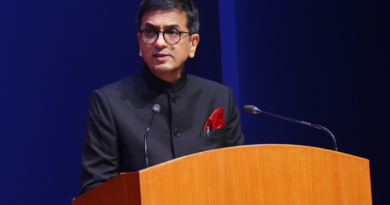
Legal Education Needs a Paradigm Shift, Emphasizes Justice M.M. Sandresh
(By Syed Ali Taher Abedi)
23 November 2026, New Delhi: Justice M.M. Sundresh, Judge of the Supreme Court of India, has underscored the urgent need to bridge the widening divide between academic legal education and the practical demands of the legal profession.
Expressing these views at the 1st Annual International Conference on Legal Education, organised by the Commonwealth Legal Educational Association (CLEA), Justice Sundresh called for a comprehensive reorientation of law school curricula to address emerging challenges posed by Artificial Intelligence (AI), research ethics, professional competence and access to justice.
He emphasised the need to make legal education more responsive to the evolving realities of legal practice, technological advancements and the constitutional imperative of ensuring accessible justice.
The deliberations highlighted that conventional legal education, predominantly centred on doctrinal learning and substantive legal principles, must evolve to equip law graduates with practical advocacy skills, ethical responsibilities, research competence and the ability to apply legal principles to real-world disputes.
Recognising the exponential growth in law graduates, technological transformation and increasing complexity of legal practice, the Conference examined institutional reforms encompassing responsible AI usage, uniform legal citation standards across Commonwealth jurisdictions, integration of clinical legal education into core subjects, strengthening of law school legal aid clinics and institutionalisation of Continuing Legal Education (CLE).
A significant part of the deliberations focused on the ethical implications of Artificial Intelligence in legal research and academic institutions, with participants distinguishing between constructive technological assistance and excessive or irresponsible dependence on AI-generated material said Justice Sundresh.
The discussions cautioned that fabricated judicial precedents, inaccurate statutory references and fictitious citations could undermine the credibility of legal scholarship and judicial reasoning. Referring to judicial proceedings such as Mata v. Avianca Inc., Park v. Kim and Zhang v. Chen, the Conference emphasised that lawyers, researchers and students must independently verify every legal authority against original judgments and statutory provisions.
It advocated transparent disclosure of material AI assistance, preservation of independent authorship, protection of confidential information and meaningful human oversight.
The Conference also called for simpler and more accessible legal language, observing that unnecessarily complicated expressions and archaic terminology often obstruct ordinary citizens from understanding legal rights and remedies.
Another major issue was the absence of a uniform citation framework across Commonwealth jurisdictions.
While acknowledging India’s transition towards neutral citation of Supreme Court judgments, the deliberations explored a common minimum citation framework that could accommodate jurisdiction-specific legal traditions while ensuring authenticity, accessibility and cross-border verification of judicial authorities.
The Conference further emphasised that clinical legal education must move beyond isolated compulsory courses and become an integral component of mainstream doctrinal teaching, including Constitutional Law, Criminal Law, Contract Law, Civil Procedure, Evidence and Family Law.
Referring to the Bar Council of India’s Rules of Legal Education, 2008, which provide for clinical courses, internships and legal aid clinics, the discussions identified the need to translate theoretical learning into practical professional competence through supervised client interviews, drafting of pleadings, bail applications, legal research, mediation exercises and courtroom simulations.
The deliberations proposed a three-tier model for law school legal aid clinics, comprising community legal literacy and outreach, identification and referral of legal grievances, and supervised clinical assistance. Emphasising Article 39A of the Constitution of India, which mandates equal justice and free legal aid, the Conference called for law schools to function as active centres of community legal services in collaboration with State and District Legal Services Authorities, advocates and civil society institutions.
It also recommended dedicated Centres for Access to Justice and Clinical Legal Education, supported by confidentiality safeguards, informed consent, faculty supervision and effective accountability mechanisms.
The final thrust of the Conference was directed towards institutionalising Continuing Legal Education as an essential component of professional development, recognising that the acquisition of a law degree cannot, by itself, meet the evolving demands of legal practice throughout an advocate’s career.
Frequent legislative amendments, changing judicial precedents, emerging regulatory frameworks and technological developments, particularly in AI, digital evidence and cybersecurity, make sustained professional learning indispensable.
The proposed measures included certified short-term courses, credit-based professional development programmes, practical workshops on drafting and advocacy, online learning platforms and structured collaborations between law schools and practising professionals.
An Indian model contemplating mandatory annual CLE requirements for enrolled advocates, supported by a credit-based system and a national digital registry, was also discussed.
Collectively, the five sessions advanced a wider institutional vision of legal education founded on academic integrity, technological accountability, practical training, accessible legal communication and constitutional commitment to equal justice.
The overarching message was that law schools must prepare not merely graduates possessing knowledge of legal principles, but ethically grounded and professionally competent members of the legal fraternity capable of strengthening the administration of justice.