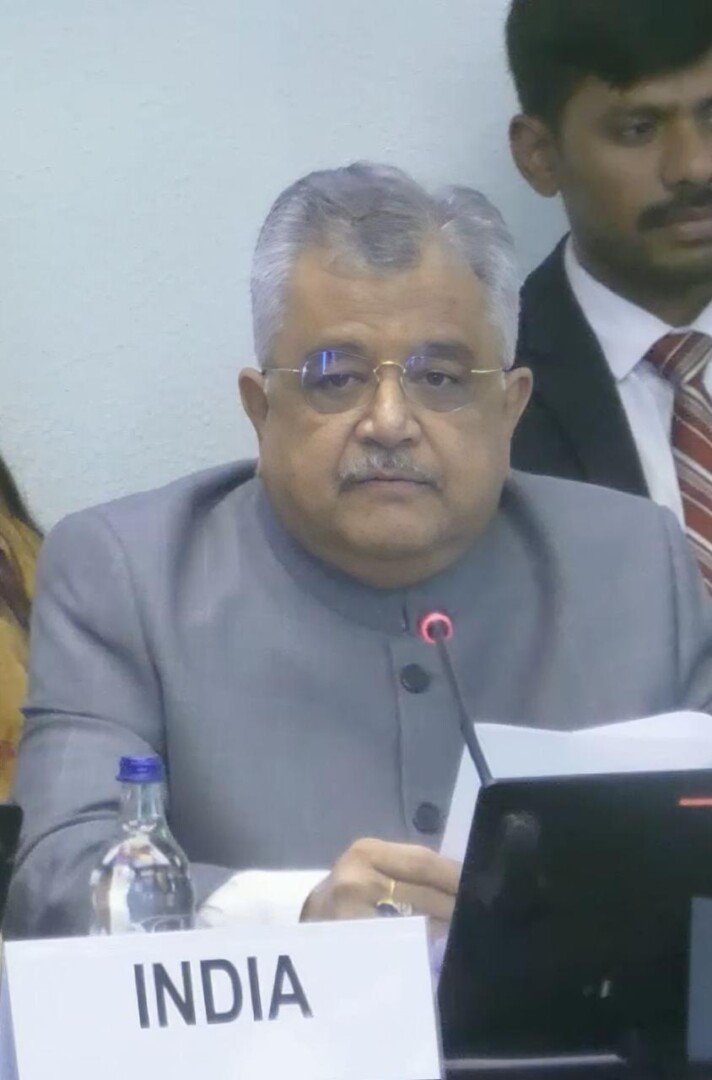
Globalizing Legal Education: SG Tushar Mehta on Equipping Indian Lawyers for International Justice
The legal profession is undergoing a profound transformation, with cross-border disputes, international arbitration and treaty obligations demanding a new generation of globally competent Indian lawyers.
(Judicial Quest News Network)
Hyderabad,21, November, 2026- A distinguished legal perspective on the globalisation of legal education has highlighted the growing need to equip Indian law students and legal professionals with the knowledge, skills and intellectual preparedness required to navigate an increasingly interconnected legal world.
Solicitor General Tushar Mehta said while delivering the Commonwealth Legal Education Association’s (CLEA) First Annual International Conference on Legal Education, 2026, in Hyderabad on Sunday.
Drawing upon nearly four decades of experience at the Bar, the speaker offered an insightful account of the realities of legal practice, emphasising that the true test of a lawyer’s competence often emerges not in university lecture halls but during the solitary hours spent preparing for a demanding courtroom appearance.
Recalling the familiar experience of advocates working late into the night, examining case files, refining submissions and anticipating questions from the Bench, the speaker observed that the most significant examination of legal education takes place when a lawyer is required to distinguish between what has genuinely been understood and what has merely been memorised. Mehta said.
According to this perspective, the ability to anticipate judicial scrutiny, analyse complex legal questions and respond with precision represents the real measure of professional legal competence.
Against this backdrop, the speaker argued that the discussion on globalising legal education must begin with a fundamental recognition: the nature of legal practice has changed considerably, while traditional legal education systems must evolve to keep pace with these developments.
Cross-Border Disputes Reshaping Legal Practice
Explaining the expanding dimensions of contemporary legal practice, the speaker noted that a generation ago, the typical legal brief largely revolved around Indian statutes, domestic judicial precedents and proceedings before Indian courts.
However, the legal landscape has undergone a significant transformation.
Today, a commercial dispute involving a power project may simultaneously involve bilateral investment treaties, international arbitration proceedings seated in Singapore or London, contractual obligations governed by foreign laws and enforcement of arbitral awards in multiple jurisdictions.
Similarly, complex taxation disputes may depend upon the interpretation of treaty provisions negotiated decades earlier, requiring lawyers to possess a thorough understanding of international conventions, comparative jurisprudence and the principles governing cross-border transactions.
The speaker underscored that international dimensions have entered ordinary legal practice, making it imperative for legal education to move beyond conventional domestic frameworks.
In a particularly striking observation, the speaker remarked that the legal brief had gone global long before the academic syllabus did, highlighting the widening gap between the demands of contemporary legal practice and the traditional structure of legal education.
India’s Ambition to Emerge as a Global Legal Hub
Highlighting India’s growing aspirations in the international legal arena, the speaker observed that the country must move beyond merely representing its interests before international institutions and work towards becoming a preferred destination for international legal services, arbitration and dispute resolution.
Reference was made to India’s arbitration framework, founded upon the Arbitration and Conciliation Act, 1996, which incorporates the principles of the UNCITRAL Model Law on International Commercial Arbitration.
The legislation provides the statutory foundation for domestic and international commercial arbitration in India, while subsequent institutional developments have sought to strengthen the country’s arbitration ecosystem.
Particular emphasis was placed on the India International Arbitration Centre (IIAC), New Delhi, which was established under the India International Arbitration Centre Act, 2019, and accorded the status of an institution of national importance.
The speaker maintained that when international parties choose India as the seat of arbitration, they place considerable confidence in the competence and credibility of Indian advocates, arbitrators and judicial institutions.
Such confidence, the speaker suggested, cannot be secured merely through legislative reforms or institutional declarations. It must be earned through professional excellence, judicial consistency, legal scholarship and the ability to deliver effective dispute-resolution mechanisms.
International Competence Must Accompany National Legal Identity
The address further highlighted the growing importance of preparing Indian lawyers to represent the country’s interests before international tribunals and other global legal forums.
The speaker observed that India’s rich constitutional heritage and long-standing legal traditions, by themselves, cannot guarantee success in international legal proceedings.
Indian lawyers appearing before international forums must demonstrate the same level of preparation, legal understanding, analytical ability and advocacy skills as their counterparts from other jurisdictions.
International legal practice demands familiarity with foreign legal systems, investment treaty jurisprudence, international commercial conventions, comparative constitutional principles and the evolving jurisprudence of global institutions.
The speaker emphasised that globalisation of legal education should not be understood as an abandonment of India’s legal identity. Rather, it should enable Indian lawyers to engage confidently with international legal standards while remaining firmly grounded in the country’s constitutional values and domestic jurisprudence.
The central objective, therefore, is to prepare students and young advocates to argue effectively wherever India’s legal interests are represented and wherever international disputes require competent legal intervention.
Concluding this segment of the address, the speaker indicated that the subject of globalising legal education would be examined through three important reflections, setting the stage for a broader discussion on the future direction of legal education and India’s emerging position in the international legal order.
Elaborating on the broader vision of globalising legal education, the speaker identified three significant considerations that, in his view, must shape the future of legal education in India.
These included the importance of comparative constitutional learning, greater international exposure for the legal profession and the indispensable role of professional credibility in the administration of justice.
1. Comparative Legal Learning Must Be a Two-Way Process
The first reflection centred on the need to promote comparative legal education as a reciprocal intellectual exercise, rather than treating foreign jurisprudence merely as a source of academic reference.
The speaker observed that India’s Constitution drew inspiration from several constitutional traditions across the world, a process that reflected the vision and intellectual openness of its framers. However, the constitutional principles subsequently developed and interpreted by Indian courts have acquired a distinct identity, shaped by India’s own historical, political and legal circumstances.
In this context, particular reference was made to the landmark judgment in Kesavananda Bharati v. State of Kerala (1973), which established the Basic Structure Doctrine, placing substantive limitations on Parliament’s constituent power to amend the Constitution under Article 368.
The speaker highlighted how this distinctly Indian constitutional doctrine subsequently entered constitutional debates in other jurisdictions.
The Supreme Court of Bangladesh drew upon the doctrine in 1989, while Kenya witnessed extensive judicial consideration of the principle during the Building Bridges Initiative litigation.
Although Kenya’s Supreme Court ultimately declined to adopt the doctrine, its consideration before different levels of the Kenyan judiciary demonstrated the growing international influence of Indian constitutional jurisprudence.
The speaker emphasised that the significance of comparative constitutional law lies not merely in whether another jurisdiction accepts or rejects an Indian legal principle, but in the fact that Indian judicial reasoning has become part of international constitutional discourse.
He maintained that Indian law students must therefore approach foreign jurisprudence with intellectual openness, analytical precision and a clear understanding of their own constitutional framework.
Comparative legal education, he suggested, must enable students to appreciate foreign legal systems without losing sight of India’s distinct constitutional identity.
2. Opening the Legal Profession to International Opportunities
The second reflection addressed the changing regulatory framework governing the participation of foreign lawyers and international law firms in India, alongside the emerging opportunities for Indian legal professionals abroad.
The speaker referred to the Supreme Court’s landmark ruling in Bar Council of India v. A.K. Balaji (2018), wherein the Court clarified that foreign law firms and foreign lawyers cannot practise Indian law in India.
However, the judgment recognised a limited scope for foreign lawyers to provide occasional legal advice on foreign law, subject to applicable regulations.
A significant subsequent development came in 2023, when the Bar Council of India notified the Bar Council of India Rules for Registration and Regulation of Foreign Lawyers and Foreign Law Firms in India, 2022.
These rules opened a regulated avenue for foreign lawyers and law firms to practise foreign law, international law and international arbitration matters in India, subject to the principle of reciprocity and prescribed conditions. The regulatory framework was subsequently amended in 2025.
Describing reciprocity as a two-way opportunity, the speaker observed that the opening of India’s legal services sector must also encourage Indian lawyers to develop the professional competence required to compete effectively in international legal markets.
He stressed that international professional readiness cannot be achieved through classroom instruction alone.
Practical exposure, courtroom experience and direct engagement with complex legal proceedings remain essential components of professional development.
Illustrating the practical demands of international legal practice, the speaker referred to the preparation of written memorials for international arbitration tribunals, cross-examination of expert witnesses through interpreters and negotiations involving participants from diverse legal, linguistic and cultural backgrounds.
These responsibilities, he observed, require specialised professional skills that can only be developed through sustained practical training, observation and supervised experience.
Calling for closer institutional collaboration between legal academia and the practising Bar, the speaker urged law schools to involve experienced advocates in academic instruction and create opportunities for students to work in established legal chambers, tribunals and government litigation departments.
Such exposure, he maintained, would bridge the persistent divide between theoretical legal education and the practical demands of professional advocacy.
3. Professional Credibility: The Foundation of Effective Advocacy
The third and, as the speaker described it, most personally significant reflection concerned the importance of professional credibility in the legal profession.
Emphasising that an advocate’s greatest asset is his or her word, the speaker observed that legal knowledge, persuasive submissions and courtroom preparation must ultimately be supported by integrity and professional reliability.
Drawing upon his experience before judicial and international forums, he maintained that the success of an argument frequently depends not merely upon its technical strength but also upon the confidence and trust that counsel has established with the adjudicating authority.
An advocate’s reputation for fairness, accuracy, candour and adherence to professional ethics, he suggested, carries considerable weight in judicial proceedings.
Courts must be able to rely upon the submissions made by counsel, particularly when dealing with complicated questions of law, disputed facts and matters involving substantial public or commercial consequences.
The speaker’s observations underscored that globalising legal education must not become confined to producing lawyers who are merely proficient in international statutes, conventions and legal terminology.
It must also nurture professional values, ethical responsibility and an unwavering commitment to the administration of justice.
Ultimately, professional credibility remains universal. Whether an advocate appears before an Indian constitutional court, an international arbitration tribunal or a foreign judicial institution, integrity and trustworthiness remain indispensable attributes of effective legal representation.
The three reflections collectively presented a broader vision of legal education in which comparative jurisprudence, practical professional exposure and ethical credibility form the foundation of India’s engagement with the global legal order.