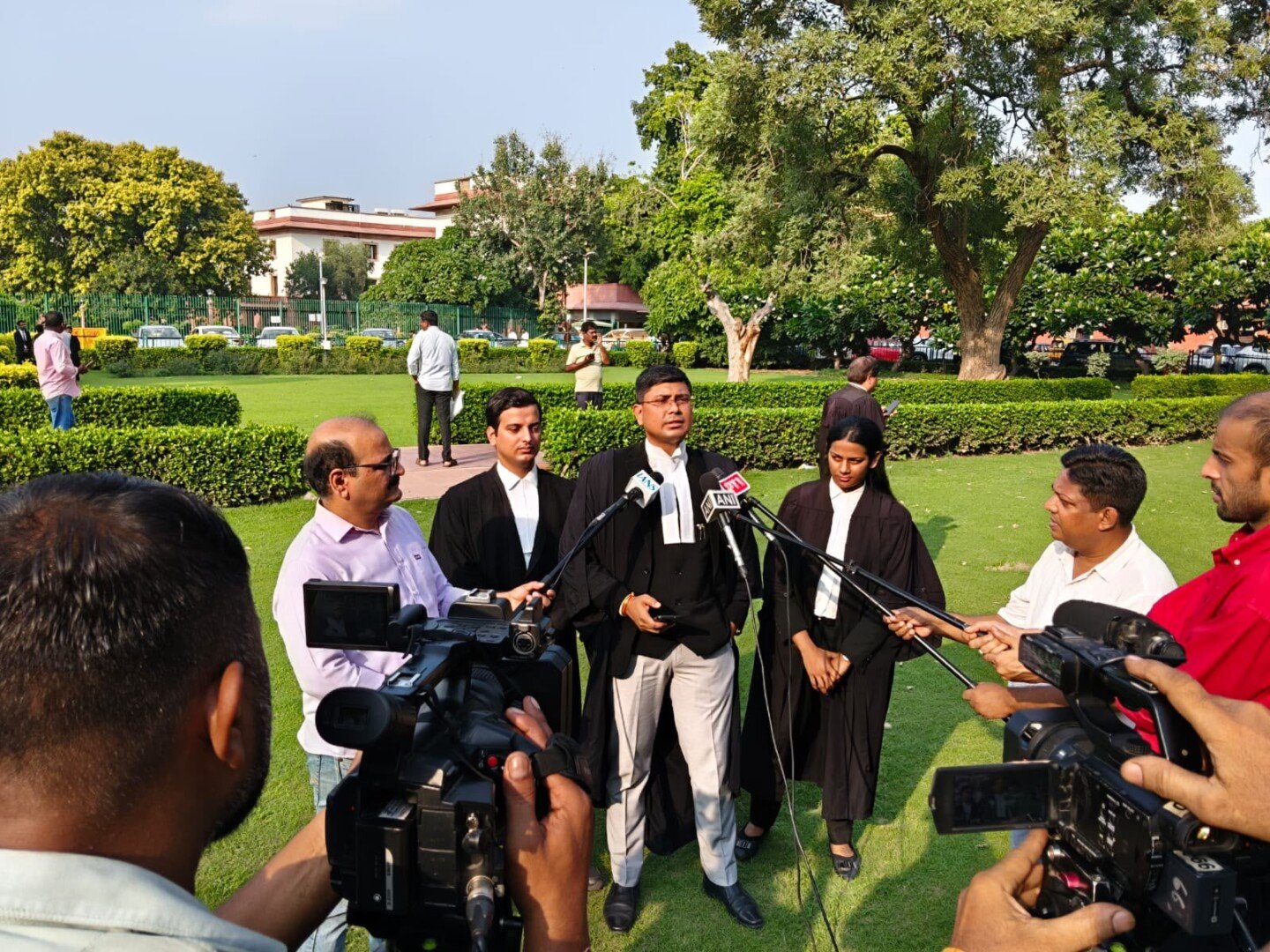
UPI Fee Row Reaches Supreme Court: Plea Challenges MDR Above ₹2,000
(By Syed Ali Taher Abedi)
Petitioner alleges that the proposed charges on high-value commercial UPI transactions could indirectly burden consumers, while the Centre maintains that person-to-person payments and eligible small-merchant transactions will remain free.
Delhi 17-9-2026-A writ petition has been filed before the Supreme Court challenging the Union Government’s recent decision to permit charges on certain commercial Unified Payments Interface (UPI) transactions exceeding ₹2,000.
The petition, filed by Advocate Anjan Datta, seeks the quashing of Gazette notifications issued by the Union Ministry of Finance on September 14 and 15, 2026. The proceedings have been instituted against the Union of India, the Reserve Bank of India (RBI), the National Payments Corporation of India (NPCI), and the UPI & Services Steering Committee.
The matter is registered as Anjan Datta v. Union of India, Writ Petition (Civil) Diary No. 57387/2026.
Challenge to proposed Merchant Discount Rate
At the centre of the dispute is the proposed application of a Merchant Discount Rate (MDR) to specified high-value, person-to-merchant or P2M UPI transactions.
MDR is a processing fee associated with digital payments made to merchants.
It is ordinarily distributed among various participants in the payment’s ecosystem, including banks, payment service providers and other intermediaries.
The fee is not described as a government tax or a direct levy collected by the Centre or NPCI.
Under the framework reported to have been introduced by the Union Government, an MDR of 0.4 per cent may apply to specified commercial UPI transactions above ₹2,000, subject to a maximum charge of ₹300 for transactions valued at ₹75,000 or more.
Different rates have reportedly been prescribed for certain sectors. Essential and low-margin segments including railways, telecommunications, insurance, fuel and agricultural inputs may attract a flat MDR of ₹5 on transactions above ₹2,000. Capital-market transactions may be subject to a lower rate of 0.02 per cent, capped at ₹300.
Petitioner raises concern over indirect impact on consumers
The petitioner has argued that although the proposed charge may technically be imposed within the merchant-payment ecosystem, the additional financial burden could ultimately reach consumers.
The plea contends that businesses may attempt to recover the cost by increasing prices, adding transaction-related charges or otherwise passing the expense on to customers.
According to the challenge, such an outcome could undermine the convenience and affordability that have contributed to the widespread adoption of UPI.
The petition is therefore expected to raise questions concerning the legality, fairness and broader public consequences of introducing charges into a payment system that has traditionally been perceived by users as free and accessible.
What the Finance Ministry notifications provide
The September 14 notification, issued under Section 10A of the Payment and Settlement Systems Act, 2007, reportedly identifies certain electronic payment modes on which banks and system providers cannot impose direct or indirect charges on persons making or receiving payments.
The protection covers UPI transactions up to ₹2,000 and payments made through RuPay debit cards.
The notification does not, by itself, impose a charge on every UPI transaction. Rather, it establishes the threshold below which specified transactions are protected from such charges.
The Centre has also clarified that person-to-person (P2P) UPI transactions will continue to remain free, irrespective of the amount transferred. Similarly, merchant payments up to ₹2,000 and transactions falling within the zero-MDR framework for eligible small merchants are expected to remain free.
Small merchants and major sectors covered by safeguards
Under the reported framework, small merchants receiving up to ₹1 lakh per month through UPI QR codes under the relevant P2M category will continue to receive the benefit of zero MDR.
The government has further stated that banks must ensure that merchants do not transfer the MDR to consumers.
UPI application providers have also reportedly been prohibited from imposing platform fees or concealed charges on users.
On the basis of the government’s assessment, approximately 96 per cent of merchant transactions are expected to remain unaffected either because they fall below the ₹2,000 threshold or because they are covered by existing zero-MDR arrangements for small merchants.
Legal questions before the Supreme Court
The proceedings place before the Supreme Court several questions of public and regulatory importance, including:
- Whether the impugned notifications were issued within the statutory authority conferred by the Payment and Settlement Systems Act, 2007;
- Whether the proposed MDR framework is legally sustainable in relation to high-value commercial UPI payments;
- Whether the mechanism creates an indirect financial burden on ordinary consumers;
- Whether the classification between P2P and P2M transactions, as well as between different merchant categories, is constitutionally and legally reasonable; and
- Whether adequate safeguards exist to prevent merchants or intermediaries from passing the charges on to users.
At this stage, the filing of the petition does not mean that the Supreme Court has struck down, stayed or finally adjudicated upon the notifications.
The legal validity of the framework will depend on the Court’s consideration of the pleadings, statutory provisions and government responses.
The case could have significant implications for India’s digital-payment architecture, particularly the future regulation of UPI transactions, the role of MDR in the payment’s ecosystem and the extent to which transaction-related costs may be imposed or recovered from consumers.