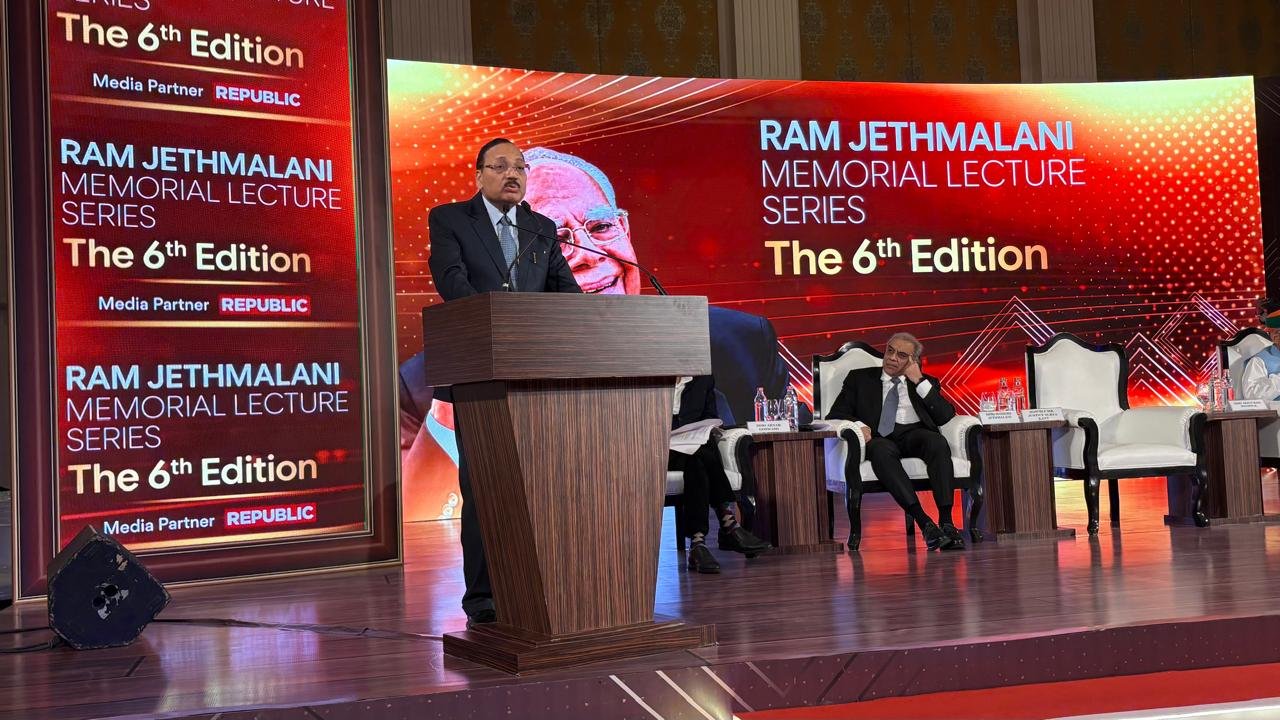
“No Institution Is Above Scrutiny”: CJI Surya Kant Says Constructive Criticism Vital to Judicial Accountability
Speaking at the sixth Ram Jethmalani Memorial Lecture, the Chief Justice of India underlined the indispensable link between transparency, institutional reform and public confidence in the justice delivery system
(Judicial Quest News Network)
NEW DELHI: 14-9-2026 Chief Justice of India Surya Kant has underscored that the judiciary, though entrusted with the solemn duty of upholding the Constitution and protecting individual rights, cannot place itself beyond public scrutiny.
Addressing the sixth Ram Jethmalani Memorial Lecture, CJI Kant said that fair, informed and constructive criticism of judicial functioning was not inconsistent with judicial independence.
On the contrary, he described such criticism as an essential feature of a living constitutional democracy and an important mechanism for institutional accountability.
Speaking on the theme “Justice Seen to Be Done: Transparency and Public Trust as Pillars of the Legal System,” the CJI observed that the judiciary must remain open to examination, questioning and, where warranted, criticism if it wishes to retain the confidence of the people.
“The judiciary as an institution is not and cannot be above scrutiny. Fair, informed and constructive critique of judicial functioning is a legitimate and necessary feature of a vibrant constitutional democracy, contributing to institutional accountability and self-correction,” CJI Kant said.
Public confidence cannot be claimed by avoiding questions
The Chief Justice made it clear that public trust in the courts cannot be secured by insulating judicial institutions from examination. Transparency, he said, requires a continuing institutional willingness to answer legitimate questions and acknowledge areas requiring improvement.
“A court cannot seek the confidence of the public by placing itself beyond scrutiny.
It must remain willing to be examined, questioned and, where necessary, criticised,” he observed.
The remarks assume significance in the broader context of discussions surrounding judicial transparency, institutional accountability and the public perception of the justice delivery system.
The CJI’s address emphasised that criticism, when fair and grounded in facts, can assist courts in identifying shortcomings and strengthening their functioning.
At the same time, he cautioned that certain institutional and administrative matters may not always be suitable for discussion or response on a public platform.
The need for openness, he suggested, must operate alongside institutional responsibility and restraint.
“Reform must be the rule”
CJI Kant further stressed that no constitutional institution could remain static or treat its existing practices as beyond improvement. Reform, he said, must be regarded as a continuing obligation rather than an occasional response to public pressure.
“We, without any hesitation, acknowledge that reform must be the rule. No institution can survive and feel proud to be static,” the CJI remarked.
His observation placed institutional reform within the larger constitutional responsibility of the judiciary.
According to the CJI, courts must continually examine their procedures, functioning and accessibility so that the justice system remains responsive to the needs of litigants and society.
Public trust: the judiciary’s only real currency
The Chief Justice described public confidence as the foundation of judicial authority. Unlike the executive and the legislature, the judiciary does not possess either the “power of the purse” or the “power of the sword,” he noted. Its authority therefore rests substantially on the faith that citizens repose in its constitutional role.
“Public trust is not decoration. It is, in fact, the only currency that authority is ever paid in, the only coin the judiciary has ever truly had,” CJI Kant said.
He cautioned, however, that public trust cannot be treated as a permanent institutional asset. It must be earned and renewed through the everyday functioning of courts and through the experiences of litigants who approach the justice system.
“That trust is not something an institution can earn once and then simply rely on forever. It has to be renewed continuously,” he added.
The CJI stressed that public perception is shaped not merely by landmark judgments but by the accumulated effect of ordinary courtroom experiences case after case, litigant after litigant.
Reasoned judgments central to transparency
CJI Kant also linked judicial transparency to the reasons courts provide for their decisions.
A verdict, he said, cannot be regarded as fully transparent if the reasoning that supports it is withheld from public scrutiny.
He drew a distinction between public trust and public approval, observing that the judiciary does not earn legitimacy merely by delivering outcomes that are popular or agreeable to the majority.
“A court that announces its verdict but keeps its reasoning to itself has not really been transparent,” he observed.
The Chief Justice further stated that judicial credibility does not depend on whether every person agrees with a particular outcome.
Rather, it depends on whether the decision is supported by clear reasoning, constitutional principle and a fair application of law.
A court, he said, should not seek to be liked or to deliver outcomes that conform to popular expectations.
Its legitimacy flows from the quality of its reasoning and its fidelity to the Constitution.
Senior advocates also address the gathering
Senior Advocates Harish Salve and Mahesh Jethmalani also spoke at the memorial lecture, which was organised in remembrance of the late jurist and Parliamentarian Ram Jethmalani.
The address by CJI Surya Kant placed transparency, reasoned adjudication and constructive criticism at the heart of the continuing conversation on judicial accountability.
It also reaffirmed that institutional independence and public scrutiny are not opposing constitutional values; rather, both are necessary to preserve the credibility of the justice system.
Key takeaways
The judiciary cannot claim immunity from fair and informed public scrutiny.
Constructive criticism is necessary for accountability and institutional self-correction.
Judicial reform must be a continuous process.
Public trust is the principal source of the judiciary’s authority.
Courts must provide adequate reasons for their decisions to satisfy the requirement of transparency.
Public confidence is different from public approval and cannot be secured merely through popular verdicts.