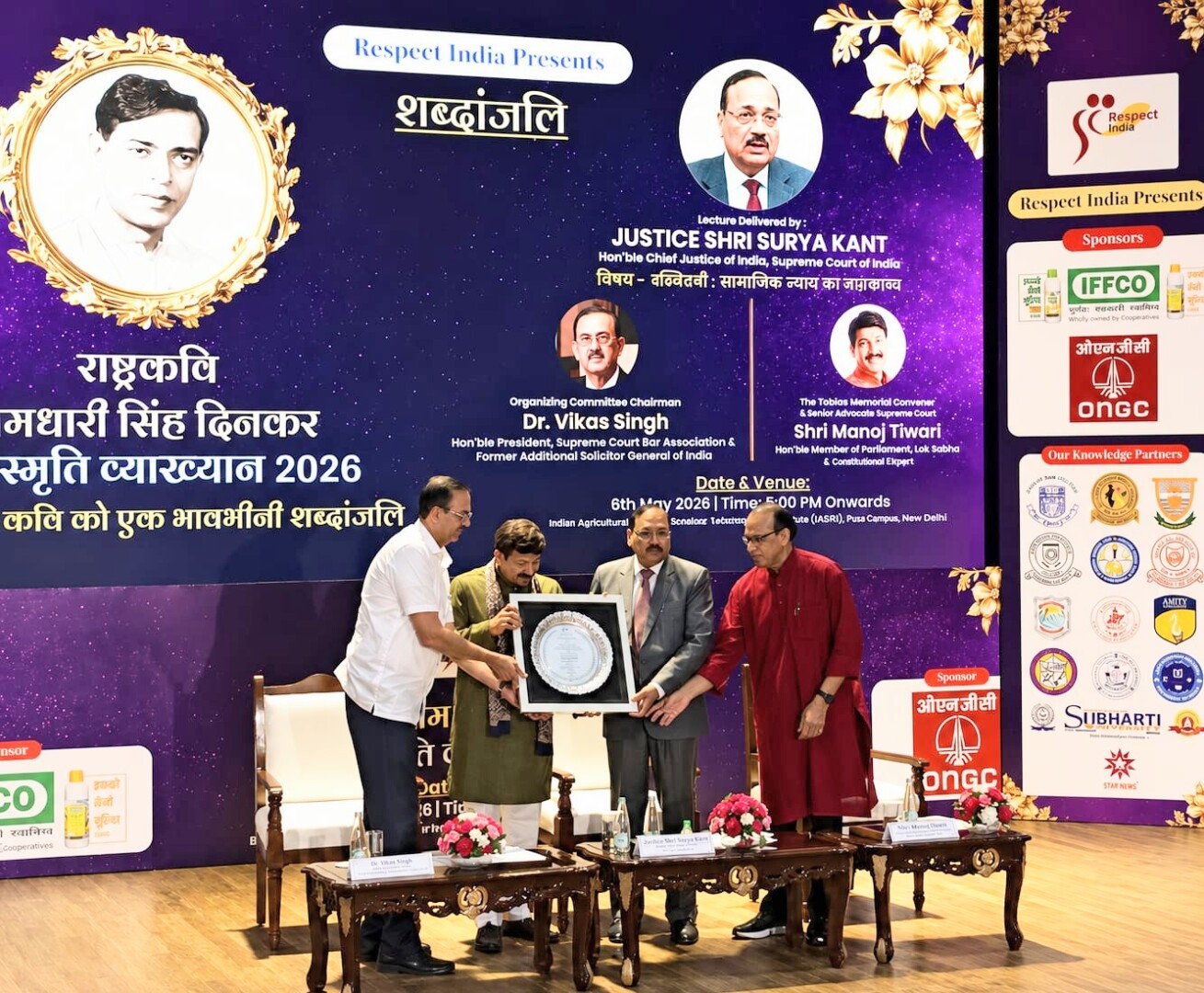
A Humane Society Begins with Social Justice, Says CJI Justice Surya Kant Amid AI Bias Concerns
(By Syed Ali Taher Abedi)
New Delhi, May 6, 2026 — The capital witnessed a powerful blend of cultural celebration and urgent social commentary as BJP MP Manoj Tiwari was conferred the Dinkar Sanskriti Samman during the 8th Dinkar Memorial Lecture. The event, organised by Respect India, was marked by a thought-provoking address from Chief Justice of India, Justice Surya Kant, who cautioned that Artificial Intelligence, despite its rapid rise, is already exhibiting troubling biases against the poor.
Justice Kant underscored that social justice must remain the cornerstone of a humane and equitable society, reminding the audience that technology cannot be allowed to deepen divides.
Speaking on “Rashmirathi: The Epic of Social Justice”, he invoked the enduring vision of Rashtrakavi Ramdhari Singh Dinkar, whose poetic ideals of equality and human dignity predated and later inspired the principles enshrined in the Constitution of India.
The lecture thus became more than a tribute it was a clarion call to ensure that modern innovation aligns with timeless values of fairness and compassion, echoing Dinkar’s legacy in today’s digital age.
With a judicial gravitas befitting the occasion, Chief Justice of India, Justice Surya Kant, drew upon the timeless lessons of Rashtrakavi Ramdhari Singh Dinkar’s Rashmirathi to remind the nation that justice, self-respect, and human dignity must remain the pillars of society. “In a democracy, equality, dignity, and social harmony are essential.
Merely passing laws is not enough unless every individual is treated with dignity and respect,” he declared, his words echoing like a verdict on the conscience of the republic.
Justice Kant lamented that even seven decades after Dinkar’s epic was penned, stark inequalities continue to persist.
He underscored that the ideals and practice of social justice are not ornamental aspirations but the very foundation of a just social order a constitutional mandate that must be lived, not merely legislated.
His remarks carried the weight of judicial authority, transforming the lecture into a solemn reminder that the pursuit of justice is both a cultural inheritance and a constitutional duty.
The conferment ceremony further illuminated Manoj Tiwari’s steadfast contributions to cultural renaissance and public stewardship. Upon receiving the Samman, the honoree reflected “The poetry of Dinkar ji endures as a perennial fount of inspiration, encapsulating the indomitable vigor of our cultural inheritance and beckoning us toward a more resolute national consciousness.”
Enriching the discourse was the perspicacious intervention of Shri Rameshwar Rai, eminent litterateur, literary critic, and former Professor at Hindu College. He posited “Dinkar’s magnum opus retains its perspicuity in the contemporary milieu, furnishing profound illuminations on the architecture of social justice, the sanctity of human values, and the inexorable trajectory of societal metamorphosis.”
The august assembly was graced by luminaries from the judiciary, academia, and spheres of public life, underscoring the event’s significance as a confluence of legal sagacity, intellectual rigor, and cultural veneration.