From Courtroom to Combat Zone: CJI Surya Kant Advocates Legal Aid for Defence Kin
(By Syed Ali Taher Abedi)
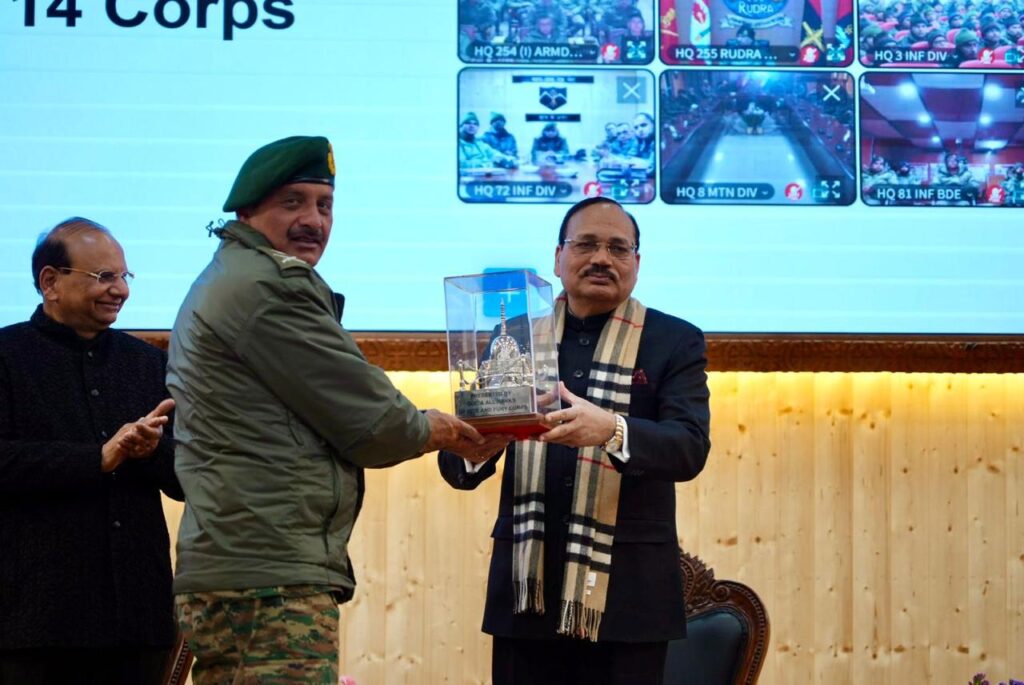
Leh, Ladakh, March 30, 2026 – Amid the stark, oxygen-scarce peaks of Ladakh, where India’s soldiers stand eternal vigil against inhospitable borders, Chief Justice of India Justice Surya Kant etched history today.
In a precedent-shattering first, he addressed troops at the Leh military camp, proclaiming that justice must bridge the chasm of remoteness “The law must travel to the soldier, because the soldier cannot always travel to the law.”
This poignant rendezvous at the Leh base camp the inaugural address by a sitting CJI to armed forces personnel from such a forward outpost resonated deeply with jawans and officers braving sub-zero extremes. Justice Kant, donning the mantle of judicial stewardship, laid bare the invisible battles fought off the battlefield legal and personal quandaries that fester in isolation, far from the marble corridors of courts and the comforting proximity of hospitals.
“I am here as the Head of the Indian Judiciary, which is one of the Republic’s Constitutional Institutions. While the Constitution speaks in the language of rights, dignity, equality, and justice, entire credit for the same goes to you for securing the conditions in which those promises are able to survive for the people of India.” Said CJI
“Soldiers often face legal and personal challenges while serving in distant and inhospitable terrains, which makes physical access to courts and hospitals difficult,” the CJI told the rapt gathering.
He drew a stark contrast: “A common citizen knows where courts and lawyers are located, but a soldier posted in a high-altitude region cannot simply leave to pursue litigation or manage disputes back home.”
Constitutional Mandate, Not Mere Goodwill
Elevating the discourse beyond sentiment, Justice Kant anchored his vision in the republic’s foundational promise Article 39A of the Constitution. “Legal aid is not charity but a commitment to ensure that access to justice does not depend on wealth, geography, or social position,” he asserted. This, he stressed, is a solemn constitutional obligation, compelling the judiciary to extend its reach where geography conspires against equity.
“It is a matter of constitutional duty. Article 39A of our Constitution is not merely ornamental language. It is a solemn commitment that access to justice must not depend on wealth, education, geography, or social position. Legal aid members of the Paramilitary Forces and CAPFs. I must say that conceiving and enacting that Scheme was perhaps one of the greatest highlights of my stint as the Executive Chairman of National Legal Services Authority.”
Veer Parivar Sahayata Yojna: A Beacon of Institutional Action
The CJI spotlighted tangible strides under his leadership, unveiling the Veer Parivar Sahayata Yojna a flagship scheme launched last year during his tenure as Executive Chairman of the National Legal Services Authority (NALSA). Tailored for serving defence personnel, ex-servicemen, their dependent families, and paramilitary forces, it delivers free legal aid, assistance, and support services right to the doorsteps of the valiant.
By December 31, 2025, the program had touched 14,929 lives, a evidence to its rapid scale-up. At its core lies a nationwide network of 438 legal services clinics, strategically embedded across all Rajya Sainik Boards and hundreds of district-levels Sainik Boards.
Powering this grid is a dedicated workforce of 1,100 legal aid personnel out of a total 1,123 members with 378 hailing from defence backgrounds, bolstered by 299 para-legal volunteers who bring battle-hardened empathy to the table.
From Property Feuds to Family Claims: Real Relief on the Ground
The scheme’s footprint spans the gritty realities of military life property disputes that simmer unresolved, pension and welfare entitlements caught in bureaucratic mazes, matrimonial tangles straining home fronts, school admission battles for children, and heartfelt claims by senior citizen parents of defence personnel. “These are not abstract issues they are the threads binding our soldiers to their duties,” Justice Kant emphasized.
United in Purpose: Judiciary and Armed Forces as Allies
In a stirring finale, the CJI forged an unbreakable bond between two pillars of the nation: “The work of the judiciary and the armed forces, though different in nature, is united in purpose safeguarding the sovereignty of our democracy and the dignity of every citizen.”
This Leh landmark signals a judicial pivot toward India’s uniformed sentinels, potentially heralding expanded mobile courts and tech-driven legal kiosks in conflict zones. As the sun dipped behind the Karakoram, soldiers saluted not just their CJI, but a judiciary marching toward them.