CJI’s Message to the Next Generation: Democratize Justice, Transform the Nation
(By Syed Ali Taher Abedi)
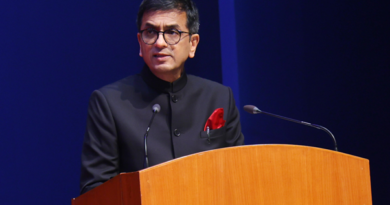
Jodhpur 22, February,2026-At the eighteenth Convocation Ceremony of National Law University, Jodhpur held on February 21, 2026, the Chief Justice of India delivered a stirring and jurisprudentially rich address, calling upon young graduates to commit themselves to making the legal system more accessible, intelligible, and responsive to the needs of ordinary citizens.
Anchored in the evocative theme, “From Fortress to Forum: Law in an Unfinished Republic,” the Chief Justice cautioned against the gradual transformation of law into an exclusive preserve—guarded by technical complexity and impenetrable jargon, accessible only to those fluent in its specialised language.
He warned that in every generation lies the latent danger that law, having once served as an instrument of liberation, may begin to distance itself from the very people it was meant to empower.
“In every generation, there is a risk that the law, having once liberated, may begin to distance itself again”
“Law,” he observed, “must not be allowed to become an arcane discipline, comprehensible only to a privileged few.
Its legitimacy rests on its intelligibility.” Emphasising the pivotal role of young members of the Bar, he underscored their constitutional responsibility to resist this drift towards exclusivity.
“When lawyers prioritise spectacle over substance, complexity over clarity, or convenience over conscience, they rebuild the very fortress mentality that democracy sought to transcend. A forum survives only when those who enter it, respect its discipline, and where success is measured not merely by victory, but by contribution to institutional strength.”
Their task, he urged, is not to narrow the forum of justice, but to widen it; not to render the law more obscure, but to make it clearer, more humane, and more accessible.
The Chief Justice further impressed upon the graduates that law is not a static or finished edifice but a living and evolving system, continually shaped by social transformation.
He cautioned them against the illusion that the body of law they had studied was complete or immutable. In this context, he invoked the celebrated words of Oliver Wendell Holmes Jr.: “The life of the law has not been logic; it has been experience.” Law evolves, he explained, because society itself evolves—its aspirations, conflicts, and moral understandings constantly reshaping legal interpretation.
Turning to constitutional philosophy, the Chief Justice described the Constitution as a living framework, conceived not as a rigid code but as an organic charter capable of growth.
“A fortress may endure by closing itself off, but a forum endures by opening itself up. Precision and patience are not virtues meant to harden the law into rigidity. They are the qualities that allow it to remain accessible, responsive, and humane. And if the law is to remain a forum in a living democracy at all, then those who practise it must combine discipline with openness.”
Over successive generations, its guarantees have been interpreted in light of contemporary realities, expanding the scope of personal liberty, privacy, and substantive equality.
This dynamic interpretation, he suggested, reflects the enduring vitality of constitutional democracy.
Drawing a powerful local metaphor, he referred to the majestic Mehrangarh Fort overlooking Jodhpur. In earlier epochs, he noted, law was often conceived as a fortress—designed to shield society from arbitrariness and disorder.
While such fortification served an essential purpose, constitutional democracy demands a more participatory vision.
Law must now function as a forum: a space where differences are debated, dissent is accommodated, and power is reasoned with rather than merely exercised.
“A fortress may endure by closing itself off,” he remarked, “but a forum endures by opening itself up.”
In conclusion, the Chief Justice’s address was both a caution and a call to action—urging the newest generation of legal professionals to safeguard the accessibility of justice and to ensure that law remains a living instrument of democratic engagement in what he described as India’s “unfinished republic.”