NHRC Examines Legal and Human Rights Fallout of Re-Verification Drive Targeting Employees with Disabilities
(By Syed Ali Taher Abedi)
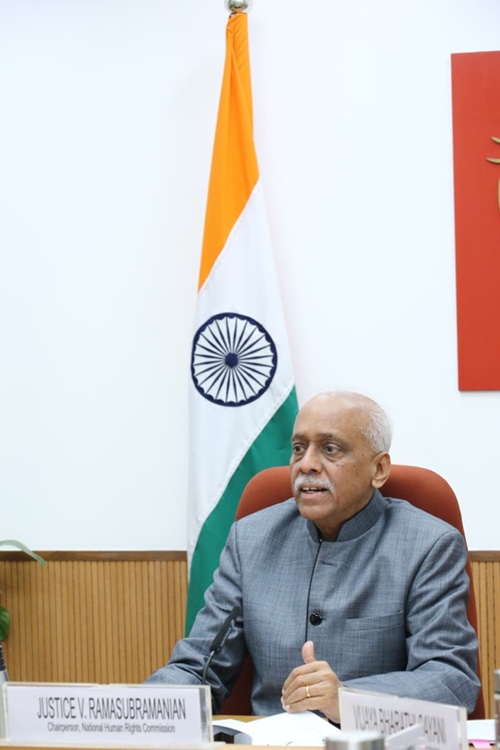
NEW DELHI,28,January,2026 — In a robust defence of the rights of the differently-abled, the National Human Rights Commission (NHRC) has intervened in the burgeoning controversy surrounding the “mass re-verification” of disability certificates for government employees. Presiding over a high-level Core Group meeting, NHRC Chairperson Justice V. Ramasubramanian underscored the legal precariousness of blanket audits, asserting that such administrative overreach may constitute a prima facie violation of human rights.
Justice Ramasubramanian maintained that the sanctity of existing certifications must be upheld, suggesting that the state’s power of scrutiny should be invoked only upon “specific suspicion” rather than through sweeping, universal reassessments.
Observations from the Bench of Deliberation
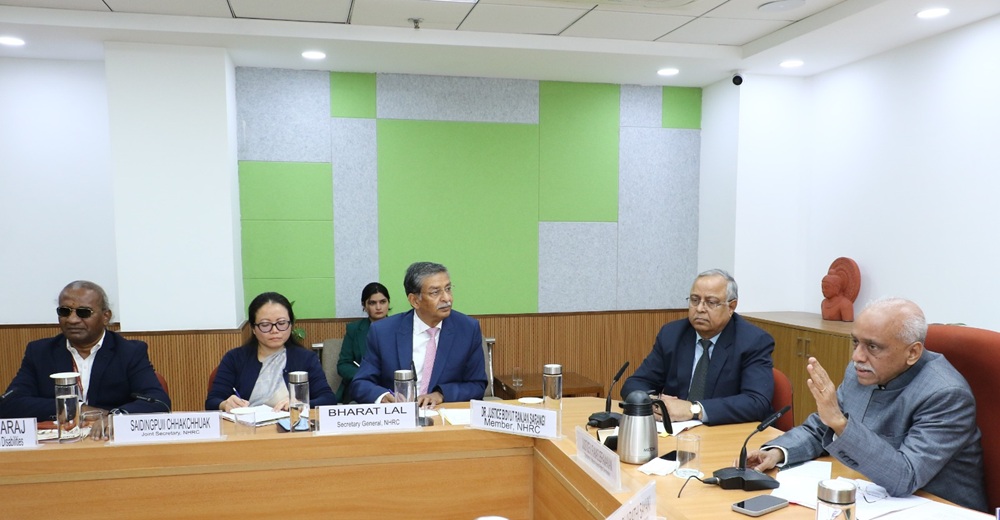
The hybrid session, convened at the Commission’s headquarters, brought together a formidable assembly of legal minds and stakeholders to address the systemic hurdles facing disabled public servants.
- Judicial Restraint in Administration: The Chairperson highlighted that indiscriminate re-verification processes risk stigmatizing bona fide employees and creating a climate of insecurity.
- Procedural Reform: The Commission called for a “streamlined” and transparent protocol for the initial issuance of certificates to preclude the need for retrospective litigation.
- Composition of the Meet: The deliberations featured key contributions from NHRC Members Justice (Dr) Bidyut Ranjan Sarangi and Smt. Vijaya Bharathi Sayani, alongside Secretary General Shri Bharat Lal and a panel of domain experts.
The pursuit of administrative integrity must not come at the cost of the dignity and legal protections afforded to persons with disabilities.
Justice Ramasubramanian, while addressing the scope and applicability of the Centre’s revised advisory dated 15th October 2025 along with the Standard Operating Procedure (SOP) governing disability verification in the context of public employment and educational admissions, clarified that such directions are intended to operate prospectively. Their application, he emphasized, is confined to future applicants seeking the benefit of reservation or other statutory entitlements, and not to be extended retrospectively so as to reopen or reassess the claims of those who have already been recognized as beneficiaries under the extant framework.
The learned Judge cautioned that any attempt to apply the SOP retrospectively across the board would inevitably invite serious legal consequences, including challenges on grounds of vested rights, legitimate expectations, and constitutional protections afforded to persons with disabilities.
He underscored that indiscriminate or mass verification of all existing beneficiaries would not only be administratively onerous but could also run afoul of principles of fairness and non-arbitrariness enshrined under Article 14 of the Constitution.
Accordingly, he opined that scrutiny ought to be circumscribed and limited to cases where there exists a specific, credible suspicion of impropriety or fraudulent claim, rather than subjecting genuine beneficiaries to unnecessary hardship.
Justice Ramasubramanian further observed that while the legislative and constitutional architecture provides robust safeguards for the rights of Persons with Disabilities (PwDs)—through enactments such as the Rights of Persons with Disabilities Act, 2016—the implementation deficit continues to remain a matter of concern.
He acknowledged the unfortunate reality that certain deserving individuals are deprived of the benefits of welfare schemes due to systemic lapses, bureaucratic inertia, or lack of awareness.
At the same time, he did not shy away from noting that instances of misuse or abuse of beneficiary legislation cannot be entirely ruled out, thereby necessitating a calibrated balance between protection of genuine claimants and prevention of fraudulent encroachments upon statutory entitlements.
In a high-level deliberation, the NHRC addressed the critical friction between preventing certificate fraud and safeguarding the dignity of Persons with Disabilities (PwDs). The consensus emphasized moving away from intrusive, “mass re-verification” toward a more precise, high-resolution entry-stage scrutiny.
Judicial & Executive Perspectives
- Systemic Access: Chairperson Justice V. Ramasubramanian flagged that the current system often favors the well-connected, urging participants to bridge gaps in the legal framework to protect the dignity of all PwDs.
- Medical & Social Security: Member Justice (Dr.) B.R. Sarangi advocated for accurate certification from birth to ensure legal benefits. While calling for strict medical board verification to curb “fake certificates,” he emphasized rehabilitation and a “compassionate, coordinated approach” via the Social Justice Department.
- Protection from Anxiety: Member Smt. Vijaya Bharathi Sayani asserted that disability should not require “repeated proof.” She condemned the re-verification of irreversible disabilities as a source of job insecurity and called for doorstep services, time-bound procedures, and dedicated grievance cells.
Administrative Oversight & Safeguards
| Official | Key Policy Focus |
| Shri Bharat Lal (Secy. Gen) | Stressed the October 2025 SOP for digital verification; noted that while reservation increased to 4%, misuse harms genuine candidates. |
| Shri Rajeev Sharma (JS, MoSJE) | Clarified that scrutiny is intended primarily at recruitment and admission stages; cited Section 91 of the RPwD Act for penalizing fraudulent claims. |
| Dr. S. Govindaraj (Commissioner) | Advised that verification must remain proportional and targeted to avoid inconveniencing bona fide individuals. |
Technical Agenda for Reform
The meeting’s three technical sessions focused on:
- Harmonizing administrative oversight with the RPwD Act, 2016.
- Ensuring dignity and non-discrimination during verification.
- Strengthening digital verification through the UDID (Unique Disability ID) framework.
Would you like me to synthesize these points into a formal recommendation letter for the Ministry?
Dr. S. Govindaraj, Commissioner of Persons with Disabilities said that verification mechanisms must remain targeted and proportional to ensure that genuine persons with disabilities are not unnecessarily inconvenienced.
He said that the existing guidelines emphasised validation rather than mass reassessment.
The participants included senior NHRC officers, Smt Anupama Nilekar Chandra, DG (I); Shri Joginder Singh,
Registrar (Law); Shri Samir Kumar, Joint Secretary;
Dr. Purva Mittal, Assistant Professor, University of Delhi and NHRC’s Special Monitor (Women and Disability Issues);
Prof. (Dr.) Amita Dhanda, Dr. Satendra Singh, Director-Professor of Physiology, University College of Medical Sciences & GTB Hospital;
Dr. Vaibhav Bhandari, Founder, Swavlamban Foundation;
Shri Muralidharan Vishwanath, General Secretary, National Platform for Rights of the Disabled;
Shri Rajive Raturi, Consultant, Shri Arman Ali, Executive Director, National Centre for Promotion of Employment for Disabled People (NCPEDP);
Shri Akhil S. Paul, Director, Sense International (India); Shri Nipun Malhotra, Co-Founder, Nipman Foundation, among others.
me of the other suggestions which emanated from the discussions were as follows:
• Prohibit blanket or mass medical reassessment of all government employees with disabilities;
• Adopt UDID-based digital verification as the default mechanism, with medical reassessment only as an exception, based on clearly defined and evidence-based suspicion;
• Incorporate safeguards in any verification exercise, including written reasons, opportunity to respond, time-bound decisions and a clear right to appeal along with protection from adverse service action during the process;
• Adopt dignity-centred protocols during verification, including providing a reasonable accommodation, improved accessibility, digital options and exemptions from redundant testing for permanent and irreversible disabilities;
• Strengthen accountability mechanisms to ensure deviations from SOP intent and statutory safeguards are documented, reviewed and corrected in a time-bound manner; and
• Eliminate the need to re-issue certificates to the employees living with irreversible disabilities.
The Commission will further deliberate upon the suggestions and inputs from different stakeholders to finalise its recommendations to the government for ensuring the protection of the rights of persons with disabilities.