Ex-CJI B.R. Gavai Warns: Free Speech Litigants Suffer as Process Turns Punitive; Says Supreme Court of India Facing Surge of Such Cases
(Judicial Quest News Network)
Mumbai 5, December, 2025-Former Chief Justice of India BR Gavai on Friday delivered a profound discourse on the critical impact of prolonged criminal proceedings in free speech-related offences, warning that such delays can inflict irreversible damage on fundamental freedoms even if the accused is later acquitted.
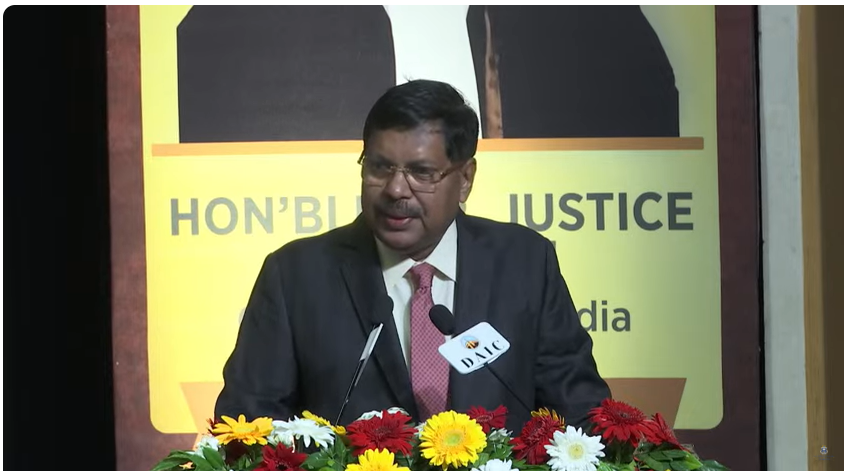
Speaking at the Justice KT Desai Memorial Lecture at the Bombay High Court, former CJI Gavai emphasized that by the time acquittal is secured, the delay may already have severely harmed the accused’s liberty, reputation, and capacity to express themselves freely.
“When cases involving speech offences remain pending for years, whether at the stage of investigation, trial, or appeal, the process itself becomes a punishment.” Justice Gavai Said.
In his lecture, Justice Gavai traced the constitutional evolution of the right to freedom of speech and expression over 75 years, charting its trajectory from the Constituent Assembly debates to the complexities of contemporary digital-age jurisprudence.
“Article 19(1)(a) states that, “All citizens shall have the right… to freedom of speech and expression.” However, Article 19(2), as adopted originally in 1950, provided the right can be restricted on the grounds of “libel, slander, defamation, contempt of Court or any matter which offends against decency or morality or which undermines the security of, or tends to overthrow, the State.””
He underscored the judiciary’s indispensable role in safeguarding journalistic freedom amid rapid technological advances and an increasingly digital public sphere.
“Article 19(1)(a) states that, “All citizens shall have the right… to freedom of speech and expression.” 9 However, Article 19(2), as adopted originally in 1950, provided the right can be restricted on the grounds of “libel, slander, defamation, contempt of Court or any matter which offends against decency or morality or which undermines the security of, or tends to overthrow, the State.”
Highlighting landmark Supreme Court judgments, the former CJI illustrated the courts’ expanding interpretation of Article 19(1)(a) of the Indian Constitution. Notably, he referenced the Anuradha Bhasin case, where the Supreme Court recognized internet access as essential for the meaningful exercise of free speech.
“Justice K.S. Puttaswamy (Retd.) v. Union of India (2017), Anuradha Bhasin v. Union of India (2020), Arnab Goswami v. Union of India (2020), Vinod Dua v. Union of India (2021), Mohd. Zubair v. State (NCT of Delhi) (2022),
The judgment declared indefinite internet shutdowns unconstitutional, marking a significant step in protecting digital freedom of expression.
Justice Gavai also examined the electoral bonds judgment, where the Court struck a delicate balance between competing interests.
The ruling underscored the voter’s right to make an informed electoral choice—an element central to free speech and democratic participation—as outweighing the donors’ interest in anonymity. This constitutional interpretation reflects a consistent judicial effort to preserve democratic transparency and accountability.
Through his detailed lecture, former CJI BR Gavai highlighted not only the evolving nature of freedom of speech in India’s constitutional landscape but also the judiciary’s vigilance in adapting legal protections to address emerging challenges in the digital age.
His remarks serve as a compelling reminder that the protection of fundamental rights requires not only robust legal frameworks but also timely and fair judicial processes, particularly in cases impacting core democratic freedoms.